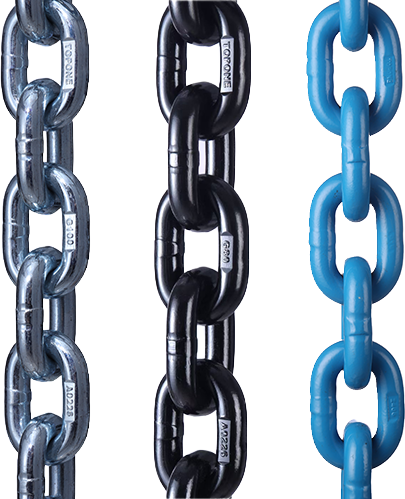
A twisted lifting chain may look like a minor rigging problem, but it can create serious safety risks during industrial lifting operations. When chain links become twisted, kinked, or improperly positioned, the lifting assembly may no longer carry the load as intended.
Lifting chains are designed to transfer tensile forces through correctly aligned links. Twisting can interfere with that alignment, create unfavorable contact between links, and affect the stability of the lifting arrangement.
Whether you are using a Grade 80 chain sling, Grade 100 lifting chain, or multi-leg lifting assembly, proper chain alignment is essential.
This article explains why you should never twist a lifting chain, how twisting affects lifting safety, and what to do when a chain becomes twisted before or during operation.
Why Is a Twisted Lifting Chain Dangerous?
A lifting chain is designed to carry loads through a series of interconnected steel links. When properly positioned, each link can articulate and transfer force through its intended contact areas.
When the chain becomes twisted or kinked, this movement may be restricted.
Instead of following the intended load path, individual links may press against neighboring links at unfavorable positions. The chain can become difficult to align, and its fittings may experience unintended loading.
Several problems can result:
Unfavorable stress concentrations between chain links
Restricted movement or improper link seating
Increased risk of bending or deformation
Unexpected movement as tension is applied
Improper loading of hooks and connecting fittings
Reduced control over the suspended load
A twisted chain should never be assumed safe simply because its marked Working Load Limit (WLL) exceeds the weight of the load.
The WLL applies to the manufacturer's approved lifting conditions and configuration, not to every possible arrangement of damaged or incorrectly positioned components.
How Does Twisting Affect Lifting Chain Strength?
The strength of a lifting chain depends on its material, link geometry, manufacturing quality, and intended loading conditions.
Grade 80 and Grade 100 lifting chains are commonly manufactured from quenched and tempered alloy steel to achieve the required mechanical strength and toughness.
However, high-strength materials do not eliminate the risks associated with improper rigging.
1. Uneven Contact Between Chain Links
Under normal loading, adjacent chain links transmit tensile forces through their designed bearing areas.
When a chain is twisted or kinked, links may contact each other in unintended ways.
This can create localized contact stresses and interfere with the normal articulation of the chain.
The problem becomes particularly concerning when a link is forced into an abnormal position or becomes trapped against another link.
2. Bending and Deformation
Lifting chains are primarily designed to carry tensile loads under their approved operating conditions.
Severe twisting can force links into unfavorable bending or contact conditions.
If the chain experiences sufficient stress, individual links may become permanently deformed.
Bent or twisted links must be treated as potential damage rather than a simple appearance issue.
3. Incorrect Hook and Fitting Alignment
Twisting may also affect how the chain connects to hooks, master links, shackles, or shortening components.
A hook that is not correctly aligned may experience unintended loading.
The strongest chain cannot compensate for an incorrectly loaded or damaged connection.
For this reason, the entire lifting assembly must be considered when evaluating a twisted chain sling.
4. Unpredictable Load Movement
A twisted chain can retain rotational tension or become caught in an unfavorable position.
As the load is raised or lowered, the arrangement may shift or rotate unexpectedly.
This can make load positioning more difficult, especially when lifting machinery, steel structures, or components with an uneven center of gravity.
Important: Twisting does not produce one universal percentage reduction in chain WLL. The actual risk depends on the chain condition and complete lifting arrangement. Do not invent a reduced WLL or assume the chain remains safe at a lower load.
Twisted Lifting Chain vs. Kinked Chain: What's the Difference?
The terms twisted and kinked are sometimes used interchangeably, but they can describe different conditions.
Condition | What It Means | Safety Concern |
Twisted Chain Leg | A chain leg has rotated along its length | Improper alignment and possible unintended loading |
Kinked Chain | Links are caught, folded, or abnormally positioned | Restricted movement and unfavorable local stresses |
Twisted or Bent Link | An individual link has undergone visible deformation | Possible permanent component damage |
Knotted Chain | The chain has been tied into a knot | Unapproved load path and potential damage |
A chain leg that has rotated without permanent link damage is different from a chain containing physically deformed links.
However, neither condition should be ignored.
If the chain cannot be correctly aligned without force, or any link appears damaged, the assembly must be removed from lifting service for appropriate inspection.
What Do Lifting Chain Safety Standards Say About Twisting?
Lifting chain safety is addressed by applicable regulations, standards, and manufacturer instructions.
OSHA Requirements for Chain Slings
OSHA 29 CFR 1910.184 addresses the use of slings in covered workplaces.
Its safe operating practices prohibit kinked sling legs and prohibit makeshift shortening methods such as knots or bolts.
OSHA's alloy steel chain sling guidance also instructs users to avoid twisting and kinking and not to shorten or lengthen a sling by knotting or twisting.
ASME B30.9 and Applicable Sling Requirements
ASME B30.9 provides requirements for slings within its scope, including relevant considerations for selection, use, inspection, and removal from service.
Operators should follow the applicable standard, the manufacturer's instructions, and site-specific lifting procedures.
The key principle is consistent:
A lifting chain should be correctly aligned, free from knots and kinks, and used only within its approved configuration.
How to Identify a Twisted Lifting Chain Before Use
A pre-use inspection helps identify chain twisting and associated damage before the load is lifted.
Check the Chain Leg Alignment
When unloaded, a correctly arranged lifting chain should hang freely without knots, kinks, or abnormal link positions.
Inspect the full length of each leg.
Look for chain sections that appear wound around themselves or links that do not articulate normally.
Inspect Individual Links
Examine the chain for:
Bent or twisted links
Cracks or damaged weld areas
Abnormal link shape
Excessive wear between links
Elongation or deformation
Corrosion or mechanical damage
Pay particular attention to links that remain out of alignment after the chain is unloaded.
Examine Hooks and Master Links
Check the upper and lower connection components.
Ensure that hooks are correctly positioned, the master link is properly seated, and the chain is not wrapped around or trapped against a fitting.
A twisted chain can sometimes be associated with incorrect connection or installation.
Check the Complete Sling Configuration
For double-leg, triple-leg, or four-leg chain slings, inspect each leg separately.
Confirm that:
Chain legs are not crossed or entangled.
Hooks connect to the intended lifting points.
The master link is correctly seated.
Shortening devices are properly engaged.
No leg contains a kink or twist that could affect loading.
For additional dimensional inspection methods, read TOPONE's How to Measure Lifting Chain Wear and Elongation.
What Should You Do If a Lifting Chain Becomes Twisted?
If you discover a twisted lifting chain, do not continue the lifting operation as though the problem will correct itself.
Follow a controlled process.
Step 1: Stop the Lifting Operation
Do not raise the load further while the chain is twisted or kinked.
If the load is already suspended, follow the site's approved procedure to lower it safely onto a stable support.
Keep personnel clear of the suspended load and potential movement.
Step 2: Remove the Load from the Chain
The chain must be unloaded before anyone attempts to reposition or inspect it.
Never attempt to untwist a chain by hand while it is supporting a suspended load.
Do not pull, strike, or force links into position under tension.
Step 3: Identify the Cause
Determine whether the problem is:
A chain leg rotated during installation
Incorrect hook or master link positioning
Crossed or entangled sling legs
Improper use of a shortening component
A kink involving trapped links
Permanent link deformation
This distinction helps determine whether the chain can be correctly repositioned or requires removal from service.
Step 4: Correct Simple Alignment Problems Only When Safe
If the chain is fully unloaded, undamaged, and merely positioned incorrectly, it may be possible to arrange the sling correctly according to the manufacturer's instructions.
This is not the same as repairing a damaged chain.
Do not hammer, heat, bend, weld, or force individual links back into shape.
If a link remains twisted or deformed, the chain must not be used until appropriately evaluated.
Step 5: Inspect Before Returning to Service
After correcting an unloaded positioning problem, inspect the complete chain assembly.
Confirm that the links move normally, the fittings are correctly connected, and no damage has occurred.
If the chain has experienced abnormal loading, shows possible damage, or its condition is uncertain, remove it from service and arrange an inspection by a qualified person.
Only return the equipment to service when it meets the applicable acceptance criteria.
Can You Lift with a Twisted Chain Sling?
A visibly twisted or kinked chain sling should not be used for lifting.
Even if the chain has sufficient nominal WLL, improper alignment may create loading conditions that are not covered by the approved sling rating.
In addition, twisting may conceal damage or interfere with the function of the chain and fittings.
The correct response is to correct the unloaded alignment problem where permitted, inspect the sling, and confirm that the complete assembly is suitable before lifting.
If individual links are bent, twisted, cracked, or permanently distorted, simply straightening the chain leg is not sufficient.
The sling must be removed from service for proper evaluation.
How to Prevent Lifting Chains from Twisting
Preventing chain twisting begins before the load leaves the ground.
1. Arrange the Chain Before Connecting the Load
Lay out the sling or allow it to hang freely in an unloaded condition.
Check that individual chain legs are not crossed, entangled, or rotated into an abnormal arrangement.
2. Connect Hooks Correctly
Use suitable lifting points and compatible rated hooks.
Make sure that each hook is properly seated and loaded in its intended direction.
Do not twist the chain to make a hook reach an attachment point.
3. Use Approved Shortening Components
If the effective chain length needs adjustment, use a manufacturer-approved shortening clutch, grab hook, or other compatible rated device.
Never shorten a lifting chain by tying knots or twisting the chain leg.
For applications requiring length adjustment, suitable configurations can be explored in TOPONE's Chain Lifting Slings range.
4. Check the Load's Center of Gravity
Uneven or offset loads can rotate as lifting tension is applied.
A suitable lifting arrangement must account for the load's center of gravity, the location of lifting points, and the forces acting on each sling leg.
Correct rigging geometry helps reduce unintended movement.
5. Take Up Slack Gradually
Apply tension slowly and verify that the chain remains correctly positioned before fully raising the load.
If links begin to kink, the chain becomes entangled, or the load moves unexpectedly, stop and reassess the arrangement.
6. Avoid Uncontrolled Load Rotation
When the load needs to be rotated or repositioned, use an appropriately planned lifting procedure and suitable rated equipment.
Do not rely on the chain winding or unwinding under load to control rotation.
Swivel fittings should only be used where they are approved for the intended loading and operation.
7. Store Chain Slings Properly
Hang or arrange chain slings in a way that avoids tangling, twisting, and mechanical damage.
Separate different sling assemblies where practical, and inspect them before their next use.
Does Chain Grade Prevent Twisting?
Grade 80 and Grade 100 lifting chains are engineered to provide specified mechanical strength and toughness.
However, higher chain strength does not prevent incorrect rigging or eliminate the risks of twisting.
A G100 chain may offer a higher rated capacity than a comparable G80 chain, but both must be correctly positioned and used within their approved configurations.
The same safety principles apply:
Keep the chain correctly aligned.
Avoid kinks and knots.
Use compatible rated fittings.
Follow the complete sling WLL.
Inspect for deformation and damage.
For specifications of commonly used lifting chain grades, explore TOPONE's Grade 80 Lifting Chain and G100 Lifting Chain.
Frequently Asked Questions About Twisted Lifting Chains
Why should you never twist a lifting chain?
Twisting can create improper link alignment, restricted movement, unfavorable local stresses, and problems with the associated hooks or fittings. These conditions can affect lifting safety and may damage the chain.
Can twisting reduce a lifting chain's WLL?
A twisted or kinked sling may no longer be in an approved operating configuration. There is no universal percentage by which its WLL can safely be reduced. Do not use it until the condition has been corrected and the sling has been appropriately inspected.
Can you untwist a lifting chain and use it again?
If the chain is completely unloaded and only its arrangement is incorrect, it may be repositioned according to the manufacturer's instructions, followed by inspection.
If links show permanent deformation or other damage, the chain must be removed from service for qualified assessment.
Is a twisted G100 chain safer than a twisted G80 chain?
No. Higher chain grade does not make an improperly rigged or damaged sling acceptable for use. Both G80 and G100 lifting chains must remain correctly aligned and within their approved working conditions.
What is the difference between a twisted chain and a kinked chain?
A twisted chain leg may have rotated along its length, while a kink typically involves links becoming caught or abnormally positioned. Either condition requires attention, especially if the chain is loaded or individual links are damaged.
Can I twist a chain to shorten a sling leg?
No. Twisting is not an approved method for shortening a lifting sling. Use only properly rated shortening components that are compatible with the specific sling assembly.
How can I prevent chain twisting during lifting?
Arrange the chain correctly before loading, check the position of hooks and master links, avoid crossed sling legs, take up slack gradually, and follow the approved lifting procedure.
Conclusion: Never Ignore a Twisted Lifting Chain
A twisted lifting chain is more than a minor inconvenience. It may indicate incorrect rigging, unfavorable link positioning, or damage that affects the safety of the lifting operation.
The most important principle is simple: lifting chains must be used in their approved configuration, with correctly aligned links and compatible fittings.
If a chain becomes twisted or kinked, stop the operation, unload the chain safely, identify the cause, and inspect the complete assembly before considering further use.
Never use twisting as a shortcut to adjust chain length, and never try to straighten damaged links by force.
For industrial lifting applications, TOPONE supplies Grade 80 Lifting Chain, G100 Lifting Chain, and Chain Lifting Slings in different configurations.
Safe lifting begins with correct rigging, proper inspection, and understanding how each chain component carries the load.