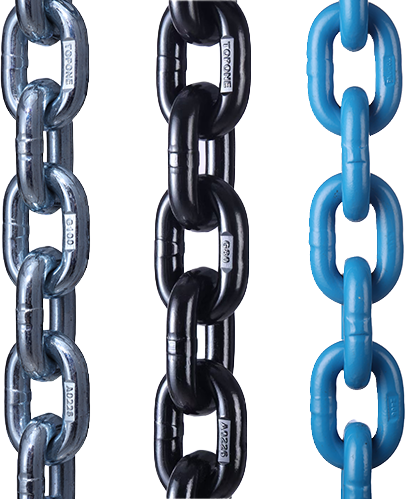
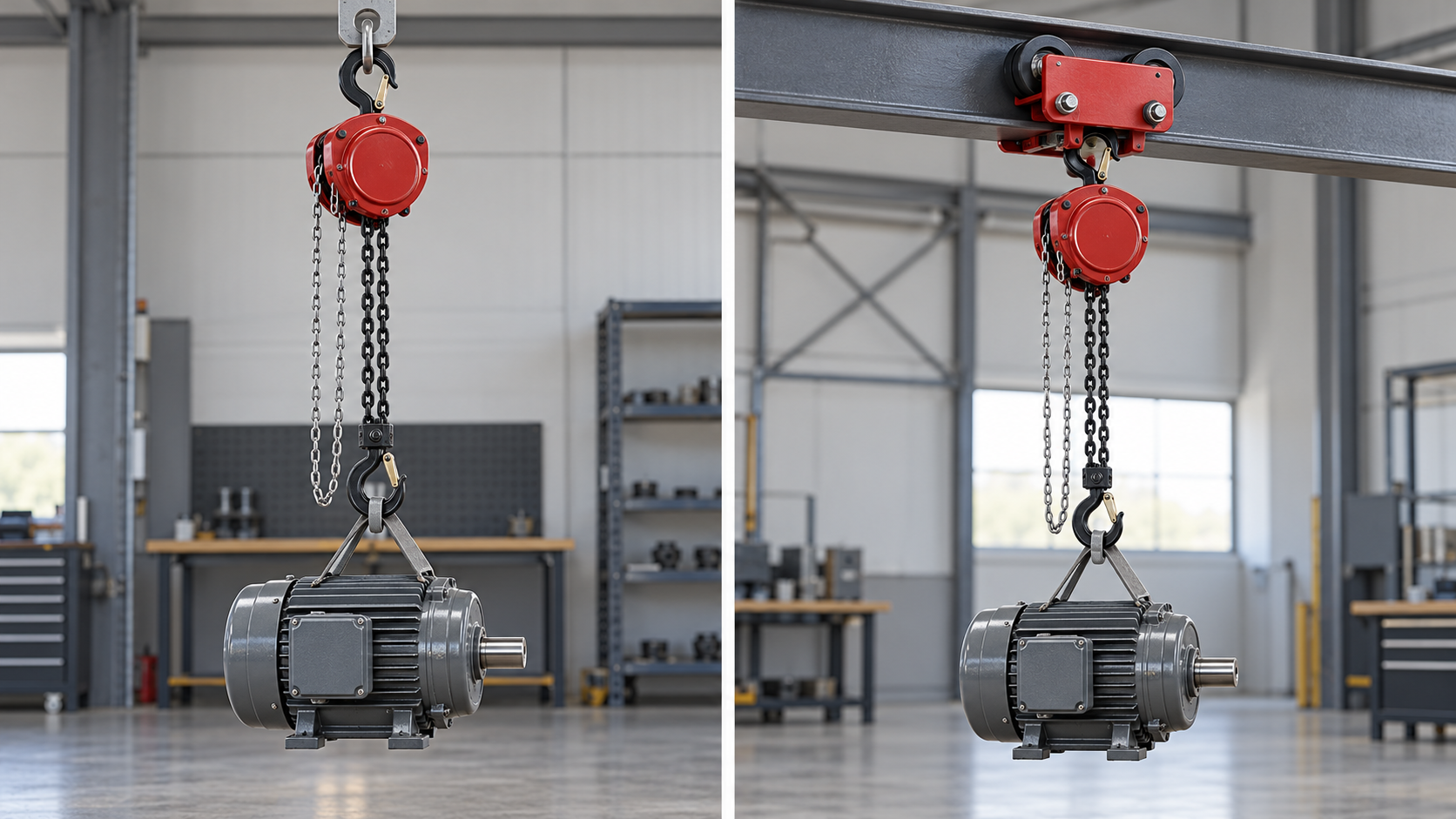
A maintenance team needs to lift a motor from its mounting point. If the motor only needs to rise and return to the same location, a fixed chain block may be enough. If it must also move along an overhead beam to a workbench, a trolley mounted chain block provides horizontal travel.
That is the central question in fixed vs trolley chain block selection: does the load need to move horizontally while suspended? The answer determines the suspension arrangement, but capacity, beam compatibility, available headroom and the intended lifting procedure still need to be checked.
What Do Fixed and Trolley Suspensions Mean?
A chain block, or manual hand chain hoist, raises and lowers a load when an operator pulls its hand chain. Its suspension determines where the hoist hangs and whether it can travel.
Fixed Chain Block
A fixed chain block hangs from a suitable stationary suspension point, often by its upper hook. It lifts and lowers beneath that point. This arrangement is useful for maintenance stations, equipment installation and other work where the load does not need to travel along a beam.
“Fixed” describes the position during the lift, not necessarily a permanent installation. A hook suspended chain block may be moved to another approved lifting point after it has been unloaded and removed.
Trolley Chain Block
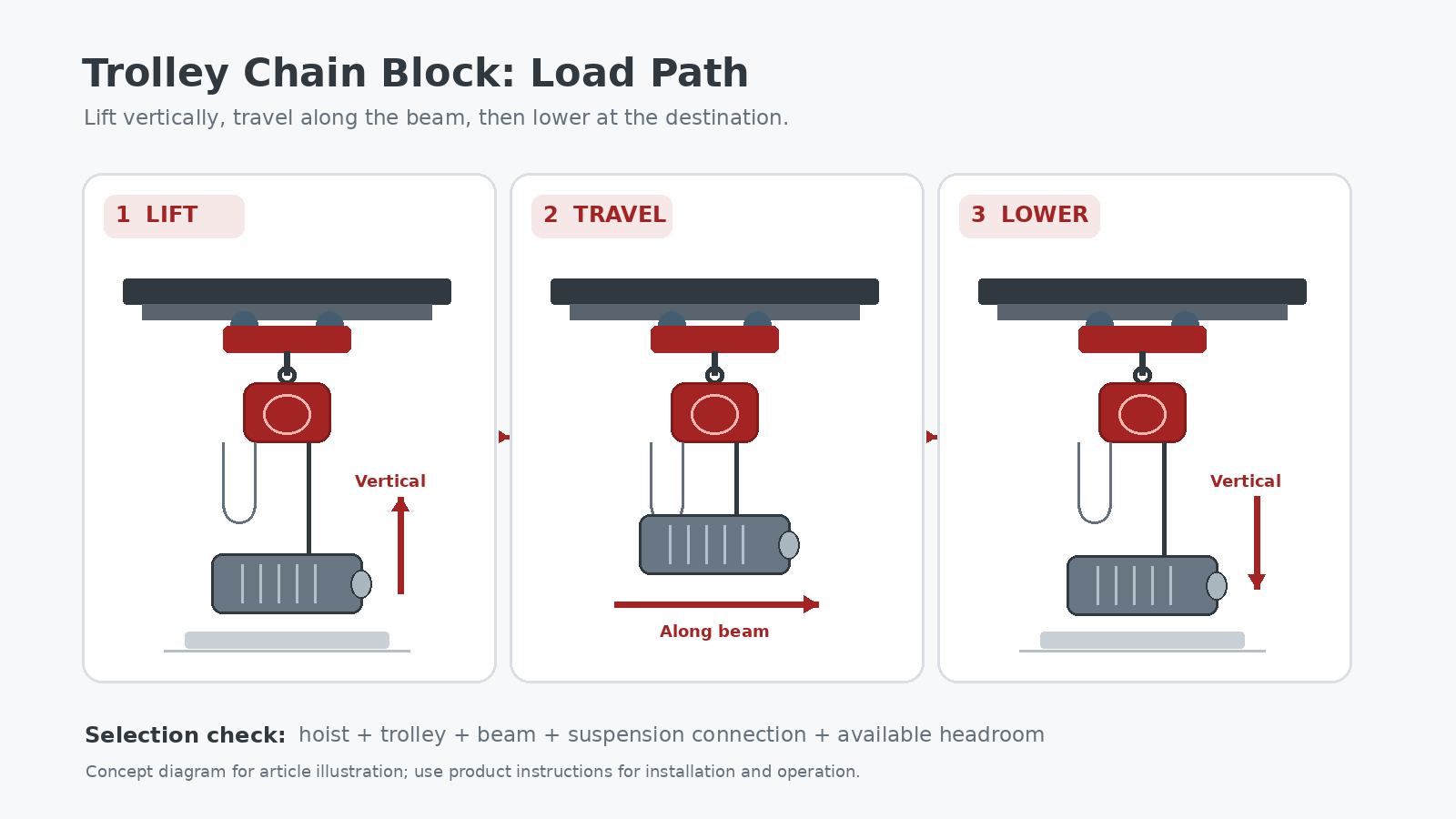
A trolley chain block is suspended from a trolley that runs along a compatible beam. The chain block provides vertical lifting; the trolley provides horizontal travel. This arrangement suits tasks that require the load to be raised, moved along a defined path and lowered at another position.
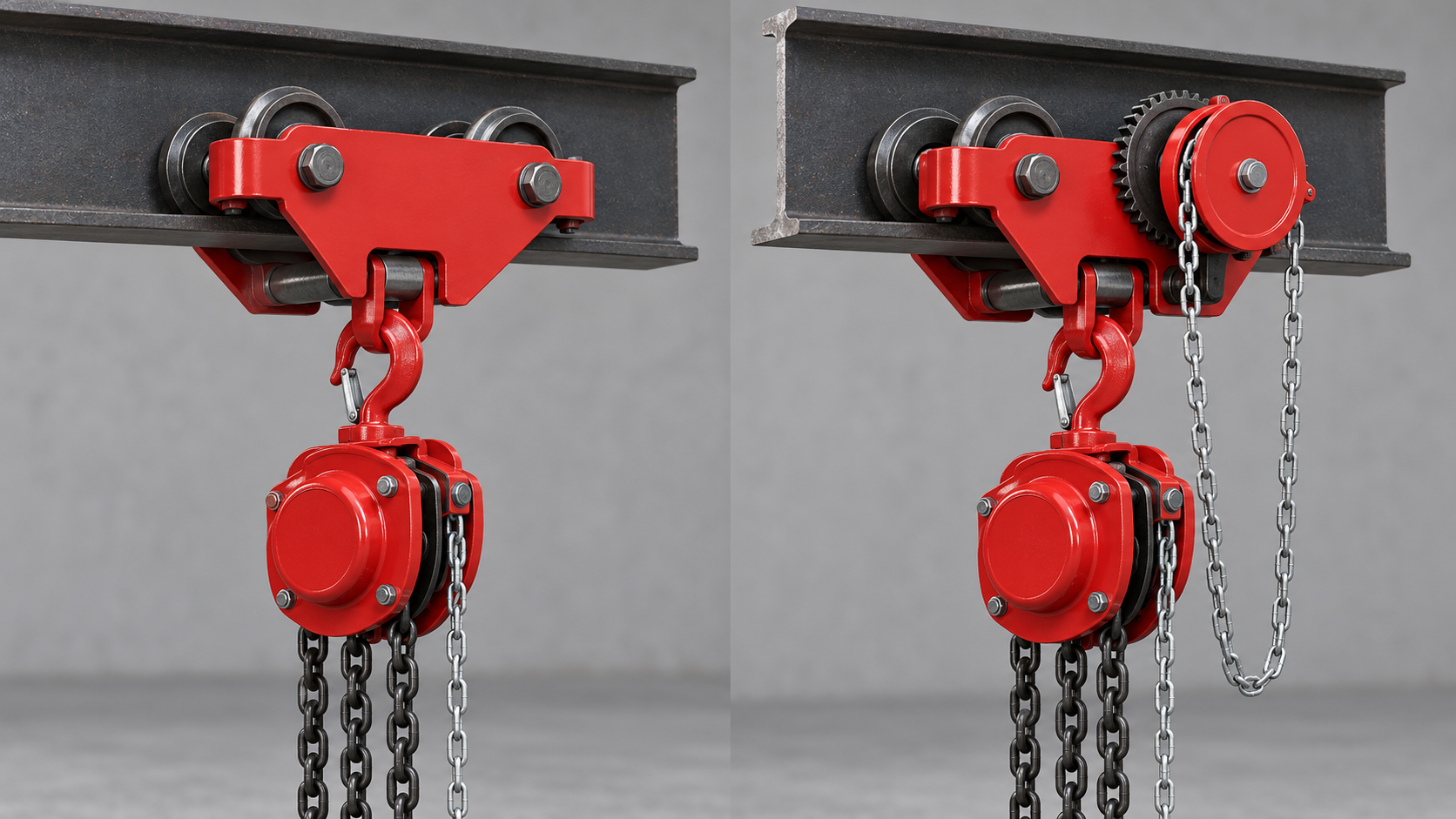
Trolleys are commonly available as plain or geared designs. A plain trolley is moved manually according to its operating instructions. A geared trolley has a separate hand chain for controlling trolley travel. The hoist’s lifting hand chain and the trolley’s travel hand chain perform different jobs.
Fixed vs Trolley Chain Block: What Changes in Practice?
The main benefit of fixed suspension is a simpler lifting arrangement when the work stays at one point. There is no trolley to match to a beam flange or to inspect for travel. The supporting structure and attachment point must still be suitable for the intended load.
A trolley adds a controlled route for horizontal movement. That can remove the need to lower a load and arrange a separate transfer between nearby work positions. It also adds components and installation checks: the trolley must fit the beam, travel correctly and remain within its intended path.
Neither suspension type makes the chain block itself lift more weight. A trolley rated above the hoist does not increase the hoist’s working load limit, and a higher rated hoist does not increase the trolley or supporting beam capacity. The complete arrangement must be suitable for the intended lift.
Plain Trolley or Geared Trolley?
A plain trolley can be practical when the load is easy to move along the beam under the manufacturer’s instructions and fine travel control is not the main concern.
A geared trolley uses a separate hand chain to move the trolley. It may be a better fit when more deliberate positioning is needed or when manually moving a plain trolley would be difficult. The choice also depends on load, travel distance, access and the trolley manufacturer’s instructions.
Key Parameters and Differences to Compare
Selection Factor | Fixed Chain Block | Trolley Chain Block |
Load movement | Vertical lifting at one position | Vertical lifting plus travel along a beam |
Suspension | Suitable stationary lifting point | Compatible trolley and supporting beam |
Horizontal positioning | Requires another planned method if the load must move | Provided along the trolley’s permitted beam path |
Installation checks | Support and hook attachment | Support, beam profile and flange width, trolley fit and travel stops |
Headroom | Depends on the hoist and suspension point | Depends on the combined hoist and trolley arrangement |
Equipment involved | Hoist and suitable support | Hoist, trolley and suitable beam system |
Typical use | A single maintenance or installation position | Repeated lifting between positions along a beam |
Treat this table as a selection guide, not a capacity chart. Compare the actual product drawings and instructions before deciding. A trolley can change the distance between the underside of the beam and the load hook, so available lifting height should be checked on the assembled configuration.
For a trolley installation, beam flange dimensions matter as much as the trolley’s rated capacity. Confirm that the trolley adjustment range suits the beam, that its suspension connects correctly to the selected hoist, and that the travel path and end stops are appropriate.
How to Choose and Use the Right Suspension
Start by mapping the load’s complete route. Mark where it will be picked up, whether it must travel while suspended, and where it will be set down.
1. Choose fixed suspension if the load only needs vertical lifting at one approved point.
2. Choose trolley suspension if the planned operation requires horizontal travel along a suitable beam.
3. Select plain or geared travel according to the required positioning control and the manufacturer’s operating method.
4. Check the entire system’s rating: hoist, trolley, beam, attachments and supporting structure.
5. Check dimensions: lifting height, available headroom, beam flange profile and width, and the clearance along the travel path.
Before use, inspect the hoist and its suspension according to their instructions. For a trolley installation, check its wheels, adjustment, fasteners, travel path and beam end stops. Keep the hoist positioned above the intended load path and do not use the load chain to drag a load sideways.
For example, a workshop may lift a pump from its base and place it back after servicing. A fixed chain block can suit that single lifting position. If the pump must travel along a beam to another service area, a compatible trolley arrangement becomes part of the lifting plan.
Related TOPONE Chain Hoist Products
The suspension decision should be made alongside the hoist selection. Review the required capacity, lifting height and the product’s suspension details before specifying a trolley connection.
The HSZ Hand Chain Hoist is one TOPONE manual chain block option for comparing lifting capacities and configurations.
The HSZ-T Hand Chain Hoist is another manual hoist option for industrial lifting applications.
Browse the full TOPONE Chain Hoist range to compare available models before confirming the hoist, suspension method and trolley compatibility.
A product page for a hand chain hoist does not, by itself, confirm that every trolley will fit it. Request the assembled hoist and trolley specifications for the intended beam and application.
FAQ
Is a fixed chain block safer than a trolley chain block?
Safety depends on selecting, installing, inspecting and using the complete lifting arrangement correctly. Fixed suspension has fewer travel components. A trolley arrangement is appropriate when horizontal movement is required and its hoist, trolley and beam are properly matched.
Can I add a trolley to an existing chain block?
Possibly, if the hoist has an approved connection compatible with the trolley and the complete arrangement is suitable for the load and beam. Confirm this with the relevant product instructions and supplier rather than assuming that matching capacities guarantee compatibility.
Does a trolley increase the chain block’s lifting capacity?
No. A trolley adds horizontal travel. The working load limit of the assembled arrangement cannot exceed the rating of its limiting component.
Which trolley is better for a manual chain block: plain or geared?
A plain trolley suits applications where manual movement is practical under its instructions. A geared trolley offers hand chain controlled travel, which may help with more deliberate positioning. Check the actual load, beam and work area before choosing.
What should I measure before ordering a trolley chain block?
Record the maximum load, required lifting height, available headroom, beam flange width and profile, planned travel distance, and pickup and set-down locations. These measurements help determine whether the hoist and trolley can be installed and used together.
Conclusion: Which Suspension Type Is Better?
For fixed vs trolley chain block selection, begin with the load path. Choose a fixed suspension when the job is a vertical lift at one point. Choose a trolley when the load must travel along a beam while suspended. Then decide whether plain or geared travel suits the required control.
Finally, verify the capacity and compatibility of the whole arrangement, including its support and available headroom. The better suspension type is the one that matches the movement the job requires and can be installed and operated as specified.