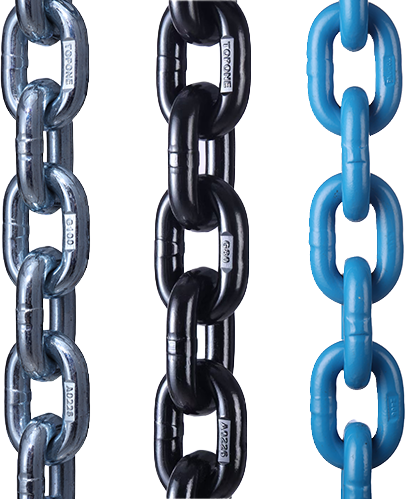
What Grade of Steel Are Chain Slings Made From?
When people search for “what grade of steel are chain slings made from”, they are usually not looking for marketing language. They want a clear, factual answer backed by industry practice and international standards.
The short answer is simple:
Certified chain slings are made from quenched and tempered alloy steel, most commonly Grade 80 (G80) or Grade 100 (G100).
But to understand why this is required—and why other steels are not acceptable—we need to look at how chain slings actually work in lifting applications.
What Is a Chain Sling and Why Steel Grade Matters
A chain sling is a load-bearing lifting assembly used for overhead lifting, typically with cranes, hoists, or gantry systems. Unlike transport or towing chains, a chain sling must safely withstand:
Repeated lifting cycles
Dynamic and shock loading
Bending at hooks and lifting points
Localized wear at contact surfaces
Sudden load changes during positioning
Because failure occurs overhead, the margin for error is extremely small.
This is why steel grade selection for a chain sling is regulated, not optional.
Industry Standards That Define Chain Sling Steel Requirements
International lifting standards explicitly specify what type of steel chain slings must be made from.
Key references include:
EN 818 (Europe)
ISO 3077 (International)
ASME B30.9 (United States)
While wording differs slightly, all of these standards share the same core requirement:
Chain slings must be manufactured from alloy steel, heat treated by quenching and tempering, and tested for overhead lifting.
Carbon steel or untreated steel is not permitted.
The Primary Steel Grades Used in Chain Slings
Grade 80 Alloy Steel (G80)
G80 chain sling is the long-established industry standard for overhead lifting.
Facts based on standards and practice:
Material: alloy steel
Heat treatment: quenched and tempered
Typical safety factor: 4:1 (minimum)
Approved for overhead lifting
Fully compliant with EN 818-2 / ISO 3077
Why G80 became standard:
High tensile strength compared to carbon steel
Good balance between strength and ductility
Predictable elongation before failure
Proven fatigue resistance in cyclic lifting
G80 steel allows chain slings to carry heavy loads while maintaining visible deformation before breakage—a critical safety feature.
Grade 100 Alloy Steel (G100)
G100 chain slings use a higher-performance alloy steel than G80.
Established technical facts:
Approximately 25% higher strength than G80
Also quenched and tempered alloy steel
Approved by EN 818-4 and equivalent standards
Allows reduced chain diameter for the same WLL
This higher strength does not mean higher brittleness. Proper alloy composition and controlled heat treatment preserve toughness and fatigue resistance.
In practice, G100 is selected when:
Weight reduction matters
Handling ergonomics are important
Higher performance is needed without increasing chain size
What Alloy Steel Means in Chain Sling Manufacturing
“Alloy steel” does not refer to a single formula.
It refers to steel deliberately combined with elements such as:
Manganese
Chromium
Molybdenum
Nickel (in some formulations)
These elements improve:
Hardenability during heat treatment
Tensile strength
Impact resistance
Resistance to fatigue cracking
After forging, chain sling links undergo quenching and tempering, which produces a controlled microstructure that balances strength and toughness—essential for lifting applications.
Why Carbon Steel Is Not Used for Chain Slings
It is important to clarify what chain slings are not made from.
Carbon or mild steel chains:
Lack sufficient tensile strength
Have poor fatigue resistance
Can fail suddenly without warning
Are not approved by lifting standards
Even if a carbon steel chain appears strong, it does not provide the controlled mechanical behavior required for overhead lifting.
This is why transport chains (e.g. Grade 70) are specifically excluded from use as chain slings.
How Steel Grade Influences Chain Sling Performance
The steel grade of a chain sling directly affects:
Working Load Limit (WLL)
Chain diameter for a given load
Weight per meter
Wear resistance at hooks
Inspection intervals
Service life under cyclic loading
Higher-grade alloy steel allows a safer and more efficient design, not simply a stronger one.
Steel Grade, Traceability, and Certification
A compliant chain sling must include:
Grade marking (G80 or G100)
Manufacturer identification
Working Load Limit
Traceability to test documentation
These markings are required by standards to ensure the steel grade and heat treatment process are verifiable.
Practical Field Observation
In real lifting operations, early wear or elongation often traces back to steel grade mismatch rather than operator error. In many cases, replacing lower-grade or uncertified chains with proper alloy steel chain slings resolves recurring inspection failures without changing lifting procedures.
This is a matter of engineering suitability, not branding.
Final Answer
So, what grade of steel are chain slings made from?
Factually and according to international standards:
Chain slings are made from quenched and tempered alloy steel
The most common grades are Grade 80 (G80) and Grade 100 (G100)
Carbon steel and untreated steel are not acceptable
Understanding this is essential for safety, compliance, and long-term lifting reliability.