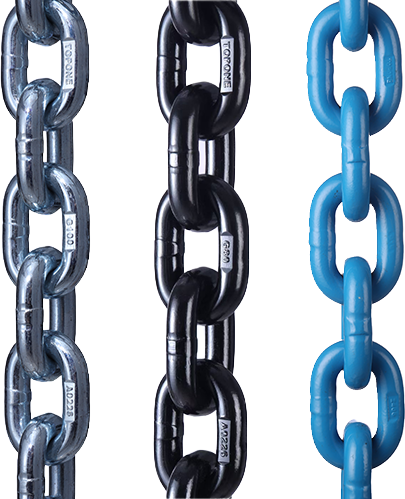
An engine lift chain is an essential lifting component used to remove, position, and install engines during automotive repair, machinery maintenance, and industrial assembly. When connected to a suitable engine crane, overhead hoist, or gantry system, a correctly selected lifting chain assembly helps control suspended engine loads and supports safe installation.
Choosing the right engine lifting chain requires more than checking chain strength. Engine weight, Working Load Limit (WLL), chain diameter, lifting points, sling configuration, and load balance must all be considered.
This guide explains the specifications, load ratings, applications, and selection factors for engine lift chains, with reference to TOPONE's Grade 80 and Grade 100 lifting chain products.

What Is an Engine Lift Chain?
An engine lift chain is a lifting chain assembly used to connect an engine or other machinery component to suitable lifting equipment.
It commonly consists of short-link alloy steel lifting chain and compatible rigging fittings, such as hooks, connecting links, and master links.
Depending on the lifting arrangement, an engine lift chain may be configured as:
Single-leg engine chain sling: Used for a suitable single lifting point or an engineered lifting arrangement.
Double-leg engine chain sling: Connects two approved lifting points and may help control engine orientation.
Adjustable engine lifting chain: Uses manufacturer-approved shortening components to adjust effective chain length and assist positioning.
Custom lifting assembly: Designed for specific engine geometries, lifting points, or maintenance requirements.
Grade 80 and Grade 100 alloy steel chains are commonly used in industrial lifting assemblies.
Explore TOPONE's Chain Lifting Slings to understand available sling configurations and compatible rigging components.
Key Components of an Engine Lift Chain
A complete engine lifting chain assembly generally includes several components.
Component | Function |
Alloy Steel Chain | Provides the load-bearing chain section |
Lifting Hooks | Connect to approved engine lifting points or compatible fittings |
Master Link | Connects the sling assembly to a suitable crane or hoist hook |
Shortening Components | Allow approved adjustment of chain length |
Identification Tag | Displays WLL, chain grade, identification, and other required information |
Grade 80 and Grade 100 Lifting Chains
Grade 80 lifting chains are commonly selected for general industrial lifting because of their strength, durability, and compatibility with rated sling components.
Grade 100 lifting chains offer higher nominal load capacity at the same chain diameter when compared under equivalent rating conditions.
However, the chain grade alone does not determine the capacity of an assembled engine sling. Hooks, connecting links, sling angles, and other components must also be considered.
Engine Lift Chain Specifications and WLL
When selecting an engine lift chain, the most important technical parameters include:
Chain grade: G80 or G100
Nominal chain diameter
Working Load Limit (WLL)
Number of sling legs
Effective working length
Hook and master link configuration
Lifting angle and load distribution
Applicable standards and identification
Reference Chain Sizes and Working Load Limits
The following table provides selected reference values from TOPONE lifting chain specifications.
Chain Diameter | Grade | Reference WLL | Configuration |
6 mm | G80 | 1.12 t | Single straight chain leg |
8 mm | G80 | 2.00 t | Single straight chain leg |
10 mm | G80 | 3.15 t | Single straight chain leg |
13 mm | G80 | 5.30 t | Single straight chain leg |
8 mm | G100 | 2.50 t | Single straight chain leg |
10 mm | G100 | 4.00 t | Single straight chain leg |
Important: These values represent reference capacities for the specified chain grades and sizes under straight loading conditions. They are not universal WLL ratings for completed engine lifting assemblies. The actual sling WLL depends on its approved configuration, fittings, lifting angles, and manufacturer's rating.
For complete chain dimensions, available sizes, and grade-specific parameters, refer to TOPONE's Grade 80 Lifting Chain and G100 Lifting Chain product pages.
Engine Lift Chain Configuration Reference
Different engine lifting applications require different chain assemblies.
Parameter | Common Options | Selection Consideration |
Chain Grade | G80 / G100 | Required load rating and compatible fittings |
Chain Diameter | Selected according to WLL | Engine weight and sling configuration |
Sling Legs | Single / Double / Custom | Approved engine lifting points |
Working Length | Standard or customized | Engine dimensions and available headroom |
End Fittings | Eye hooks / Clevis hooks / Self-locking hooks | Connection compatibility |
Adjustability | Fixed / Adjustable | Required engine positioning |
Surface Finish | According to product specification | Working environment and maintenance requirements |
The final configuration should be verified against the manufacturer's approved sling design and lifting requirements.
How to Determine the Correct Engine Lift Chain WLL
The Working Load Limit (WLL) is the maximum load permitted for the lifting equipment under its specified operating conditions.
For engine lifting, determine the total suspended weight, verify the sling configuration, and ensure the entire lifting arrangement has sufficient rated capacity.
1. Confirm the Engine Weight
Check the engine's actual lifting weight, including installed accessories and any additional components that remain attached during removal.
Do not rely only on the nominal engine model weight if the assembly has been modified.
2. Check the Number of Lifting Points
Some engines have designated lifting eyes or manufacturer-approved attachment points.
A two-point arrangement may be suitable for engines requiring controlled orientation, but both lifting points must be approved for the intended load and lifting direction.
3. Consider Sling Angles
For multi-leg chain slings, the forces acting on each leg depend on the sling angles and load distribution.
As the sling legs move farther away from vertical, the tension in each leg increases for the same suspended load.
An uneven engine center of gravity can also cause one sling leg to carry more load than another.
Therefore, always use the manufacturer's approved WLL for the actual sling angle and configuration rather than multiplying the WLL of a single chain leg by the number of legs.
4. Check the Complete Lifting System
The engine crane, hoist, master link, hooks, chain sling, engine lifting points, and supporting structure must all be suitable for their respective loads and loading directions.
The rated capacity of an engine crane may also depend on its boom extension or operating position.
The allowable load is limited by the applicable rating of the complete lifting arrangement, not simply the strongest individual component.
Common Applications of Engine Lift Chains
Automotive Engine Removal and Installation
Engine lift chains are commonly used in automotive workshops to remove engines for repair, replacement, or rebuilding.
They can connect approved engine lifting points to an engine crane, allowing the engine to be raised and positioned during maintenance.
Truck and Diesel Engine Maintenance
Larger diesel engines require careful lifting arrangements because of their increased weight and dimensions.
Suitable alloy chain slings can be incorporated into lifting systems used for commercial vehicle engine removal and heavy-duty powertrain servicing.
Marine Engine Installation
Marine maintenance operations may require engine lifting chains for removing or installing propulsion engines, auxiliary engines, and related machinery.
Available headroom, lifting point geometry, access restrictions, and environmental conditions must be evaluated.
Industrial Machinery Maintenance
Engine lifting chain assemblies can also support the handling of motors, gearboxes, generators, and other machinery components when their attachment points and lifting procedures permit.
Engine Assembly and Manufacturing
Industrial assembly facilities may use rated chain sling arrangements for transferring and positioning engines during production or maintenance operations.
The selected configuration should match the required handling frequency, load characteristics, and lifting equipment.
Engine Lift Chain Manufacturer: TOPONE CHAIN
TOPONE CHAIN manufactures high-strength alloy steel lifting chains for industrial applications, including Grade 80 and Grade 100 products used in compatible lifting chain assemblies.
The company's production facilities include automated chain manufacturing lines and related production equipment for high-strength lifting chains.
For engine lifting applications, suitable chains and sling configurations can be selected according to:
Required WLL and lifting capacity
Chain grade and diameter
Sling leg configuration
Effective working length
Hook and master link requirements
Engine lifting point arrangement
Inspection and documentation requirements
TOPONE also offers chain sling products with different hook configurations, including the Grade 80 Double Leg Chain Sling with Self-Locking Hooks.
This example illustrates an available industrial lifting sling configuration. Its suitability for a particular engine must be confirmed based on the engine lifting points, geometry, and complete sling rating.
How to Choose an Engine Lift Chain
Before selecting an engine lift chain, use the following checklist.
Selection Factor | What to Check |
Engine Weight | Actual suspended load |
Chain WLL | Rated capacity of the complete sling |
Chain Grade | G80 or G100 |
Chain Diameter | Compatible with required WLL |
Lifting Points | Number, location, and rated capacity |
Sling Length | Required effective working length |
Hook Type | Approved connection and loading direction |
Lifting Angle | Actual leg angle and load distribution |
Engine Crane | Rated capacity at the intended boom position |
Documentation | Sling identification and applicable records |
For a more detailed comparison of lifting arrangements and selection factors, read our Engine Lift Chain Buying Guide.
Engine Lift Chain Safety Considerations
A properly selected engine lift chain must be inspected and used according to the manufacturer's instructions and applicable lifting requirements.
Before lifting:
Check that the identification tag is present and readable.
Confirm that the sling WLL is suitable for the planned lift.
Inspect chain links for cracks, elongation, deformation, excessive wear, or corrosion.
Examine hooks, master links, and connecting components for damage.
Verify that hooks are connected to suitable lifting points and are loaded in their intended direction.
Check sling alignment and avoid twisting or unintended side loading.
Ensure the load is balanced and the crane has adequate capacity at the intended operating position.
Keep personnel clear of the suspended load.
Avoid sudden movements and shock loading during engine removal or installation.
If the chain sling shows damage or does not meet the manufacturer's inspection criteria, remove it from service until it has been assessed by a qualified person.
Frequently Asked Questions About Engine Lift Chains
What size engine lift chain do I need?
The required chain size depends on engine weight, sling configuration, lifting angle, and the ratings of the complete lifting assembly. Select a manufacturer-rated sling with adequate WLL rather than choosing chain diameter alone.
What is the difference between G80 and G100 engine lifting chains?
G80 and G100 are strength grades used for alloy steel lifting chains. G100 generally provides a higher WLL for the same nominal chain diameter under equivalent rating conditions, but compatible fittings and the approved assembled sling rating remain essential.
Can I use an engine lift chain with any engine crane?
Not automatically. The crane, lifting chain assembly, hooks, and engine lifting points must be compatible with the intended operation. The crane must have sufficient rated capacity at its actual boom position.
Can an engine lift chain be adjustable?
Yes. Adjustable chain sling arrangements may use manufacturer-approved shortening hooks or other suitable components. Any adjustment must follow the approved sling configuration and rating.
Is a double-leg engine lifting chain better than a single-leg chain?
Neither configuration is universally better. A double-leg sling may be suitable for an engine with two approved lifting points, while a single-leg sling may be appropriate for a different engineered arrangement. The correct choice depends on load geometry, weight distribution, and lifting requirements.
Does TOPONE provide different lifting chain sizes?
Yes. TOPONE supplies Grade 80 and Grade 100 lifting chains in different nominal diameters. Buyers should refer to the corresponding product pages for complete specifications and confirm the required chain sling assembly before ordering.
Conclusion
Choosing the right engine lift chain requires careful consideration of engine weight, WLL, chain grade, sling configuration, lifting angles, and compatible rigging components.
Grade 80 and Grade 100 alloy steel lifting chains provide options for appropriately designed engine lifting assemblies, but safe use depends on the rating and condition of the complete lifting system.
For detailed specifications, explore TOPONE's Chain Lifting Slings and Grade 80 or Grade 100 lifting chain products. Customers requiring a suitable engine lifting arrangement can contact TOPONE with the engine weight, lifting point layout, and working conditions for technical discussion.