X
Our staff will contact you within 12 hours, You can also contact us through the following ways:
Contact US WhatsApp: +8618766656705
- Email: [email protected]
- Tel: +8618766656705
- Web: https://www.toponechain.com/
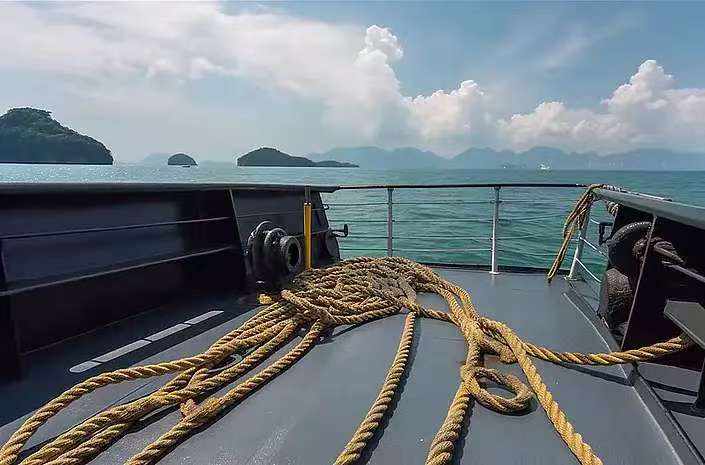
The maritime and offshore industries are in a constant state of evolution, demanding equipment that is not only stronger and more durable but also safer and more efficient to handle. In the critical field of vessel mooring, no innovation has been more impactful than the development of the PE fiber mooring rope, more commonly known by its material designation, High-Modulus Polyethylene (HMPE). This advanced synthetic marine rope has fundamentally changed the standards of performance, replacing traditional steel wire and conventional fiber ropes in the most demanding applications across the globe.
This guide provides an in-depth exploration of the HMPE mooring rope, detailing its material advantages, comparing the popular 8-strand and 12-strand constructions, and outlining the key applications where it excels.
At its core, an HMPE mooring rope is a high-tech synthetic line made from ultra-high-molecular-weight polyethylene fibers. These fibers are produced through a specialized gel-spinning process that results in extremely long molecular chains, aligning them in a parallel orientation. This unique molecular structure is the secret to its extraordinary properties:
Quote: The parallel alignment of the molecular chains allows the load to be distributed evenly, giving HMPE fibers a tensile strength that is, pound for pound, up to 15 times stronger than steel.
This incredible strength-to-weight ratio means that an HMPE mooring rope can have the same breaking strength as a steel wire rope of the same diameter but at a fraction of the weight. This is not just an incremental improvement; it is a revolutionary leap that enhances safety, reduces crew fatigue, and speeds up mooring operations.
While the fiber material is key, the rope's construction dictates its handling characteristics and performance under load. The two most common constructions for HMPE mooring lines are 8-strand and 12-strand.
Feature | 8-Strand (Plaited) Construction | 12-Strand (Braided) Construction |
Structure | Four pairs of strands are plaited together in a square or rectangular pattern. | Twelve strands are braided together in a tight, circular pattern. |
Handling | Highly flexible and non-rotating under load. It is easy to handle, coil, and store. | Offers a very smooth, round profile that runs easily over capstans and through fairleads. It is also torque-free. |
Splicing | Very easy to splice, even in the field, making it a favorite for crews. | Splicing is more complex than 8-strand but still manageable with proper training and tools. |
Strength | Offers excellent strength, but the 12-strand construction is slightly more efficient in translating fiber strength to rope strength. | Generally provides a slightly higher strength-to-weight ratio for the same amount of fiber. |
Best For | General vessel mooring, towing, and applications where ease of handling and field repairability are top priorities. | High-performance mooring, offshore installations, and lifting applications where a smooth, round profile is advantageous. |
Click here to see more product details.
The superiority of a high-strength mooring rope made from HMPE can be summarized by these key advantages:
Superior Strength-to-Weight Ratio: As mentioned, it is significantly lighter than steel wire rope of the same strength. This reduces the vessel's overall weight and makes manual handling safer and easier.
Floating Capability: With a specific gravity of 0.97, HMPE rope floats on water. This makes it a floating mooring line that is easy to retrieve and dramatically reduces the risk of it getting tangled in propellers or on the seabed.
Low Elongation: HMPE ropes have very low stretch (around 3-4% at break), similar to steel wire. This provides high stiffness and precision, which is critical for keeping a vessel securely in position, especially for offshore platforms and FPSOs.
Exceptional Fatigue Resistance: It exhibits outstanding resistance to both bending and tension fatigue, lasting many times longer than steel wire or other synthetic fibers. This translates to a longer, more reliable service life.
Abrasion and Chemical Resistance: Modern HMPE ropes are often treated with protective coatings that enhance their already excellent resistance to abrasion, UV light, and common marine chemicals.
The unique properties of PE fiber mooring rope make it the premier choice for a range of critical applications:
Offshore Mooring: The stability, strength, and durability of HMPE lines are essential for mooring deep-water platforms, FPSOs, and drilling rigs.
Commercial Vessel Mooring: Used on large vessels like LNG carriers, tankers, and container ships where secure mooring is critical and operational efficiency is valued.
Towing Operations: Its high strength and low stretch make it ideal for main tow lines, offering more control and safety than traditional ropes.
Military and Defense: Naval vessels utilize HMPE ropes for their performance, low weight, and stealth (no noise from wire rope).
To ensure reliability, all high-quality HMPE mooring ropes are manufactured in compliance with stringent international standards. When selecting a rope, look for compliance with:
ISO 10325:2018: The definitive standard for HMPE ropes.
OCIMF MEG4: The guidelines that set the industry benchmark for mooring system safety and design.
Classification Society Type Approval: Certification from bodies like DNV, ABS, LR, or CCS provides third-party verification of a rope's design, manufacturing process, and performance.