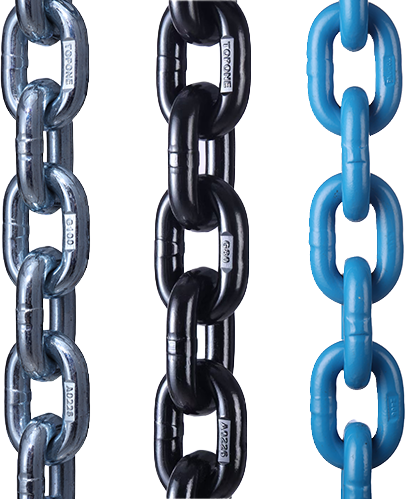
When a lifting chain is marked Grade 80, the number identifies its strength grade. It does not mean the chain can lift 80 tons. Grade 80, also called Grade 8 or G80, is a classification used for alloy steel lifting chain. To find out how much a particular chain can lift, you must check its working load limit (WLL), which depends on the chain size and the lifting arrangement.
Understanding the grade helps you compare chains. Understanding the WLL helps you select one for a specific lift.
What Does the “80” Refer To?
For Grade 80 lifting chain made to EN 818-2, the grade corresponds to a nominal mean stress of 800 N/mm² at the minimum breaking force. The figure describes a mechanical strength classification; it is not a load rating in kilograms or tons.
EN 818-2 covers Grade 8 short link chain intended for chain slings and general lifting purposes. A chain sold as Grade 80 should be assessed against the applicable product standard and its manufacturer’s documentation, rather than by its grade marking alone.
Grade 80, WLL, Proof Load, and Breaking Load
These terms describe different points in a chain’s performance:
Term | What it tells you | How to use it |
Grade 80 | The chain’s strength classification | Identify the specified type of lifting chain |
Working Load Limit (WLL) | The maximum load assigned for normal lifting use under stated conditions | Use this value to select the chain |
Manufacturing Proof Force | A test force applied during manufacture | Check the manufacturer’s testing information |
Minimum Breaking Force | The minimum force the chain must withstand before breaking in a test | Understand the chain’s strength margin; never use it as a working load |
For the EN 818-2 Grade 80 chain listed by TOPONE, the manufacturing proof force is 2.5 times the WLL, and the minimum breaking force is approximately 4 times the WLL. That margin does not permit an operator to exceed the marked working load limit.
For example, TOPONE lists an 8 mm Grade 80 chain with a 2.0 t WLL, a 50.3 kN proof load, and an 80.4 kN minimum breaking load. These are three different values for the same chain size. The 2.0 t WLL is the value to use when assessing its rated lifting capacity.
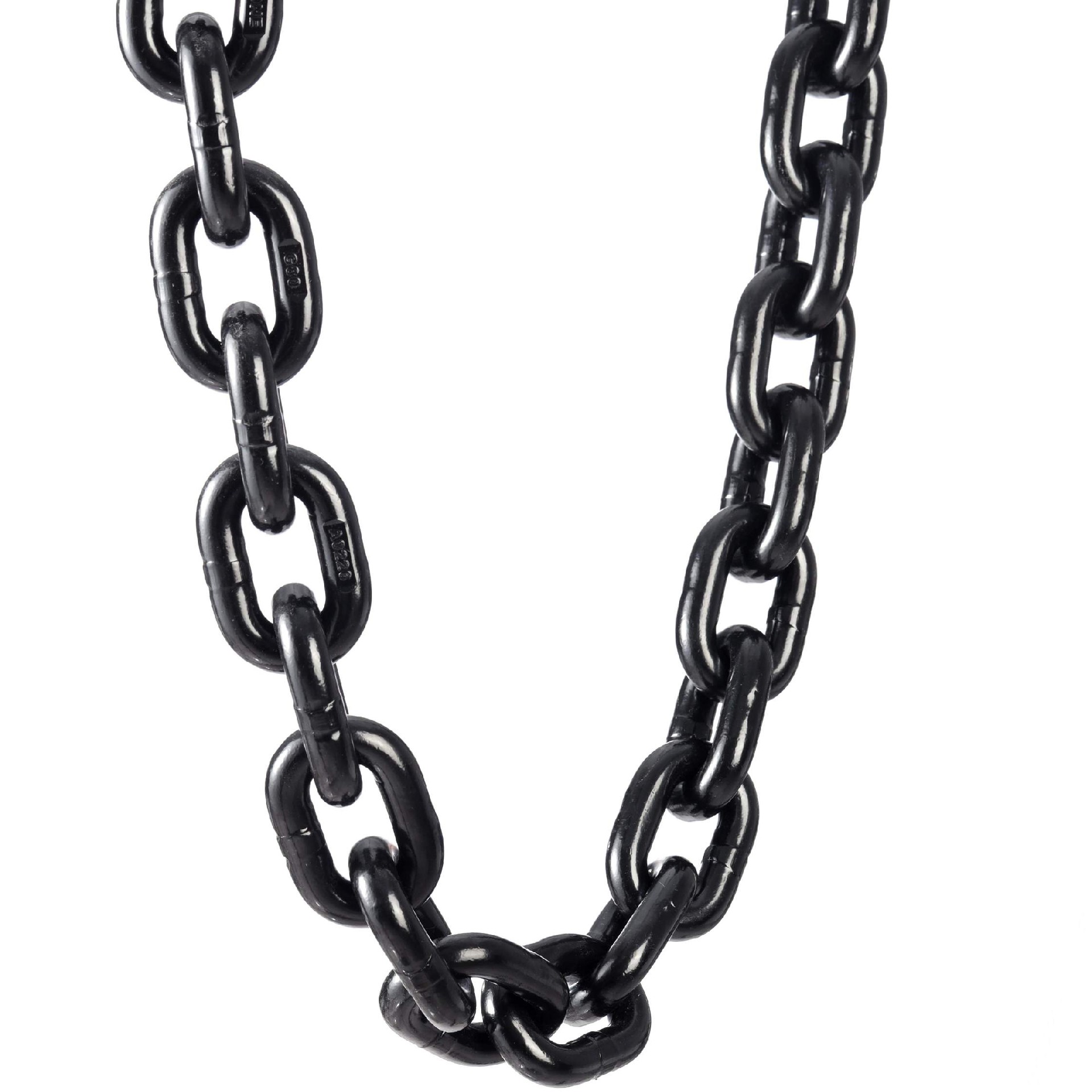
Does Every Grade 80 Chain Have the Same Lifting Capacity?
No. Two chains can both be Grade 80 but have different WLLs because their link diameters differ. In TOPONE’s EN 818-2 product range, the listed WLL is 1.1 t for 6 mm chain, 2.0 t for 8 mm chain, and 3.2 t for 10 mm chain.
The capacity of a complete chain sling also depends on its number of legs, sling angles, hooks, master links, connectors, and how the load is attached. Always use the rating for the assembled sling and its actual configuration. A higher-rated chain cannot raise the capacity of a lower-rated component.
How Can You Identify a Grade 80 Lifting Chain?
Start with the chain and sling identification supplied by the manufacturer. Check:
The grade marking and manufacturer identification.
The nominal chain diameter.
The WLL shown on the sling identification tag.
The applicable standard and product documentation.
The condition and ratings of the hooks, master links, and connecting components.
Color alone is not a reliable way to identify a chain grade. Paint can vary between manufacturers and can wear away during use. If the identification or WLL cannot be established, do not guess the chain’s lifting capacity.
How Should You Choose a Grade 80 Chain?
First determine the load weight and the lifting method. Then check the WLL for the required chain size and, if using a sling, the WLL for its leg arrangement and sling angles. Confirm that every connected component is suitable for the intended load.
Also consider the operating environment. Wear, corrosion, high temperature, chemical exposure, and damage can affect whether a chain remains suitable for service. Inspect the chain before use and follow the manufacturer’s instructions for detailed inspection and removal from service.
For sizes and technical data, see TOPONE’s EN 818-2 Grade 80 Lifting Chain. If you need an assembled lifting sling, review the chain, fittings, sling configuration, and marked WLL together.
FAQ
Does Grade 80 mean an 80-ton capacity?
No. “80” identifies the chain grade. The lifting capacity is given by the WLL for the specific chain size or assembled sling.
Are Grade 80 and Grade 8 the same?
Yes. Grade 80, Grade 8, and G80 are commonly used names for this strength grade. Confirm the exact product standard and rating in the manufacturer’s documentation.
Can I lift up to the breaking load?
No. Breaking load is a test-related strength value. Never treat it as the permissible working load. Use the marked WLL and account for the complete lifting arrangement.
Is a thicker Grade 80 chain always the right choice?
A larger diameter generally has a higher listed WLL within the same product range, but selection also depends on the sling configuration, fittings, weight, clearance, and working conditions. Choose from the verified rating for the complete assembly.
Conclusion
Grade 80 tells you what strength class the chain belongs to; the WLL tells you what a particular chain or sling is rated to lift. Read both, then check the chain size, sling arrangement, component ratings, and condition before use. That is the practical way to turn a grade marking into a sound lifting decision.