Global Top 10 Lifting Chain Manufacturers in 2025
Are you looking for high-strength, certified lifting chains that guarantee safety and performance in 2025 and beyond? Choosing a reliable lifting chain manufacturer is vital for ensuring load efficiency, product durability, and compliance with international lifting standards.
In this guide, we highlight the top ten lifting chain manufacturers worldwide, renowned for innovation, precision engineering, and global reliability. Whether your projects involve construction, mining, shipbuilding, logistics, or industrial rigging, these companies deliver proven lifting chain excellence.
The Top 10 Global Lifting Chain Manufacturers
Rank | Company | Founded | Country | Core Products |
1 | RUD Ketten Rieger & Dietz GmbH | 1875 | Germany | G80 / G100 / G120 lifting chains, RFID traceable systems |
2 | Pewag Austria GmbH | 1479 | Austria | Lifting chains, forestry & mining chains, rigging components |
3 | KITO Group (Japan / Weissenfels Germany) | 1932 | Japan / Germany | Hoist chains, industrial lifting systems |
4 | Columbus McKinnon (CM) | 1875 | USA | Herc-Alloy lifting chains, overhead lifting systems |
5 | Gunnebo Industries / Crosby Group | 1877 | Sweden / USA | Grade 80 & 100 chain slings, hooks, master links |
6 | William Hackett Chains | 1904 | UK | BS-EN certified short-link lifting chains |
7 | Thiele GmbH & Co. KG | 1889 | Germany | Mining chains, transport & lifting chain systems |
8 | Peerless Chain (KITO USA) | 1892 | USA | Alloy lifting chains, industrial & transport chains |
9 | Campbell Chain (Apex Tool Group) | 1899 | USA | Industrial lifting chain & rigging hardware |
10 | TOPONE CHAIN | 2000s | China | G80 & G100 lifting chains, chain slings, hoists, rigging systems |
What Makes These Companies Stand Out?
Certified Manufacturing Excellence: All brands comply with ISO 9001, CE, EN 818-7, ASME B30.9, and NACM 96/84.
High-Grade Alloy Steel: Each link is forged, heat-treated, and tested to ensure strength and fatigue resistance.
Comprehensive Load Range: From light 0.8 t hoisting chains to heavy 100 t industrial lifting slings.
Global Supply Capability: Factories and warehouses across Europe, Asia, and the Americas for fast delivery.
Advanced Technology: Smart tracking systems, anti-corrosion coatings, and automated testing lines.


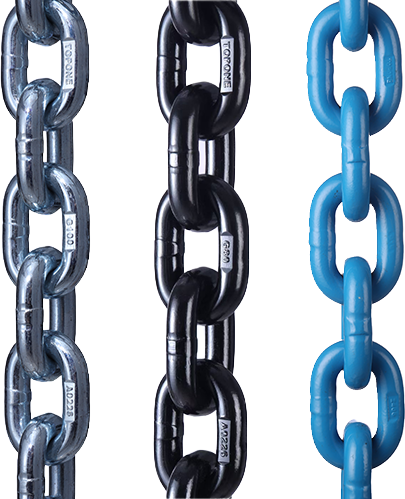
G80 Hoist Accessories G100
Featured Manufacturer — TOPONE CHAIN
TOPONE CHAIN is a rapidly growing manufacturer specializing in G80 & G100 alloy steel lifting chains, chain slings, and manual hoists.
With 9 automated production lines, 15,000 m² of facilities, and ISO 9001:2015 certification, TOPONE CHAIN ensures full traceability, high tensile strength, and global standard compliance (CE, TÜV, GS).
Why Choose TOPONE CHAIN:
100 % proof-load tested lifting chains
Custom OEM solutions for global distributors
Competitive factory price + fast shipping worldwide
Expertise in G80 / G100 chain slings, hooks, and hoists
Main Products:
Lifting Chains: G80 & G100 short-link alloy steel chains (EN 818 / NACM standard)
Chain Slings: Single, Double, and Four-Leg Sling Assemblies
Hooks & Links: Clevis Hooks, Master Links, Shackles (DIN 5688, DIN 745, DIN 5699)
Manual Hoists: Chain Blocks and Lever Hoists (1 Ton to 10 Ton capacity)
Contact TOPONE CHAIN for quotation
How to Choose the Right Lifting Chain Manufacturer
1. Check the Material & Grade – Select G80 or G100 quenched-tempered alloy steel.
2. Verify Certifications – ISO 9001, EN 818, ASME B30.9, TÜV / CE.
3. Inspect Testing Procedures – Proof-load and tensile test records are mandatory.
4. Confirm Batch Traceability – Each chain should have serial and heat-treatment logs.
5. Ask for Customization – Chain length, coating, hook type and marking available.
6. Assess Global Support – Choose brands with distribution and after-sales network worldwide.

Frequently Asked Questions (FAQ)
Q1: What’s the difference between G80 and G100 lifting chains?
G100 has approximately 25 % higher strength than G80 with reduced chain diameter for the same load capacity.
Q2: Are TOPONE CHAINS certified for lifting use?
Yes. TOPONE CHAIN products comply with EN 818-7 and ASME B30.9, and each batch is proof-tested and traceable.
Q3: Can I order custom chain slings and hooks?
Yes. We offer OEM and ODM service with personalized marking, length and component configuration.
Q4: How should lifting chains be maintained?
Regularly inspect for elongation, cracks, rust and deformation. Lubricate lightly and store dry to extend service life.
Conclusion
Selecting a reliable lifting chain manufacturer is essential to maintaining safety, efficiency and performance in any industrial operation.
The global brands listed above — from RUD and Pewag to TOPONE CHAIN — represent the highest standards in engineering, quality control and customer support.
Choose TOPONE CHAIN as your trusted lifting partner for certified G80 / G100 chains and hoist systems.
Build safety. Build strength. Build with TOPONE.
Why Is Choosing the Right Lifting Chain Supplier So Important?
Lifting chains are load-bearing components used in machinery installation, construction, manufacturing, and equipment maintenance.
A chain that looks strong is not necessarily suitable for overhead lifting. Its material, strength grade, dimensions, manufacturing process, and approved Working Load Limit (WLL) must match the intended application.
For industrial buyers, selecting a supplier involves more than comparing prices. It also means finding a company that can provide the correct product consistently across multiple orders.
Lifting Chain Manufacturers vs. Lifting Chain Suppliers
A lifting chain manufacturer produces chains through controlled manufacturing processes such as link forming, welding, heat treatment, calibration, and inspection.
A lifting chain supplier may manufacture chains, assemble chain slings, distribute finished products, or coordinate products from different manufacturing sources.
Both models can serve industrial customers, but their capabilities differ.
Buyers requiring custom chain dimensions, repeat production, and manufacturing documentation may prefer direct access to a chain factory.
Buyers requiring complete lifting systems may also need a supplier capable of coordinating hooks, master links, connecting components, and assembled slings.
TOPONE combines its own industrial chain manufacturing operations with the coordinated supply of related rigging products.
Common Problems in Industrial Chain Procurement
International buyers often face challenges such as:
· Inconsistent chain specifications between orders
· Unclear product origin or manufacturing arrangements
· Limited customization options
· Missing or incomplete inspection documents
· Difficulty sourcing compatible lifting components
· Uncertain production schedules
· Misunderstanding of product standards and load ratings
An experienced supplier should be able to clarify these issues before production or shipment.
Top 10 Lifting Chain Suppliers and Manufacturers
Several established companies serve the global lifting chain and rigging market.
The following selection includes chain manufacturers, lifting equipment brands, chain sling specialists, and industrial suppliers.
TOPONE CHAIN is featured first because this guide focuses on its manufacturing and supply capabilities. The remaining companies are listed for industry comparison, not ranked by revenue, market share, or product quality.
Company | Main Market | Primary Specialization |
TOPONE CHAIN | China / International | G80/G100 lifting chains, OEM chain manufacturing, chain slings and industrial chain supply |
RUD | Germany / Global | High-grade lifting chains, lifting points and engineered lifting systems |
pewag | Austria / Global | High-strength chains, lifting systems and hoist chains |
THIELE | Germany / Global | Industrial lifting chains, components and mining chains |
William Hackett | United Kingdom / Global | Lifting chains, chain slings and rigging equipment |
Columbus McKinnon / Kito Crosby | United States / Global | Hoists, lifting hardware, chains and rigging brands |
Campbell Chain & Fittings | United States | Alloy chains, transport chains and industrial fittings |
Laclede Chain | United States | Alloy lifting chains, transport chains and chain accessories |
Lift-All | United States | Chain sling assemblies and lifting solutions |
CERTEX USA | United States | Rigging equipment, chain sling supply and fabrication services |
These companies serve different customer needs.
For example, RUD and pewag offer specialized high-grade lifting technologies, while Lift-All and CERTEX are particularly relevant to customers seeking complete lifting assemblies and related services.
Laclede and Campbell offer industrial chain portfolios that include lifting and other chain applications.
Columbus McKinnon completed its acquisition of Kito Crosby in February 2026, so its associated brands should be considered within the current group structure rather than automatically counted as unrelated manufacturing companies.
For procurement teams, the important question is not which company occupies a particular ranking position.
It is which supplier can reliably manufacture or source the exact chain product required for the project.
Why Choose TOPONE CHAIN as Your Lifting Chain Manufacturer and Supplier?
TOPONE CHAIN is the industrial chain brand of Xintai Taida Mirso Co., LTD, based in Shandong, China.
The company manufactures industrial chains and supplies related lifting and rigging products for international buyers.
Its product portfolio includes Grade 80 and Grade 100 alloy steel lifting chains, precision hoist chains, chain sling configurations, transport chains, and other industrial chain products.
What makes TOPONE worth considering is the combination of established chain manufacturing facilities, product specification support, quality inspection, customization, and coordinated procurement services.
3.1 Manufacturing Capacity for Industrial Chain Orders
TOPONE's published manufacturing facilities include:
Manufacturing Resource | Published Company Information |
Manufacturing Location | Shandong, China |
Total Building Area | More than 15,000 m² |
Manufacturing and Warehouse Area | More than 5,000 m² |
Automated Production Lines | 9 |
Published Annual Capacity | Approximately 500,000 high-strength load chains across the broader business |
Main Manufacturing Activities | Chain forming, welding, heat treatment, inspection and packaging |
These facilities support production across different industrial chain specifications.
For distributors and OEM customers, manufacturing capacity matters because repeat orders require consistent product dimensions, material selection, production scheduling, and quality control.
TOPONE's published annual capacity is a company-wide high-strength chain figure, not a separate guaranteed output for every chain model.
Production lead times and available capacity should be confirmed for the ordered specification and quantity.
Buyers can review additional information about the company's production and service approach on TOPONE's Why Choose Us page.
3.2 Chain Manufacturing and Quality Control
A dependable alloy steel lifting chain must meet the mechanical properties specified for its intended application.
Strength grade alone is not sufficient. The manufacturing process also influences chain performance and consistency.
TOPONE's chain production and inspection operations cover processes such as:
Steel Material Selection
Suitable steel materials are selected according to the approved chain grade and manufacturing specification.
Material requirements can differ between lifting sling chains, hoist load chains, mining chains, and transport chains.
Chain Link Forming and Welding
Steel is formed into round links and joined through controlled welding processes.
Weld quality and dimensional consistency are important because the welded region remains part of the load-bearing chain.
Heat Treatment
For heat-treated alloy lifting chains, controlled thermal processing is used to achieve the required combination of strength and ductility.
The selected treatment must follow the approved material and chain specification.
Dimensional Inspection and Mechanical Testing
Relevant verification may include chain diameter, pitch, link dimensions, manufacturing proof force, minimum breaking force, and elongation.
TOPONE states that it maintains manufacturing inspection and testing procedures for its chain products. Buyers should request the actual product-specific test reports and applicable conformity documents.
For an explanation of these inspection methods, see TOPONE's Lifting Chain Strength Test Guide.
Final Inspection and Packaging
Finished chains are checked against the relevant order requirements and prepared for shipment.
Inspection records, identification, and packaging specifications should be confirmed before production is finalized.
This process is designed to support consistency from raw material selection through finished chain delivery.
3.3 OEM and Custom Lifting Chain Solutions
Many industrial customers require chain products that are not identical to standard catalog items.
For example, a distributor may need specific chain lengths and packaging, while an equipment manufacturer may require a precise chain pitch or material specification.
TOPONE supports OEM and customized supply discussions covering:
· Chain diameter and pitch
· Chain grade and approved material
· Cut-to-length chain supply
· Chain marking and identification
· Product packaging and labeling
· Approved surface finish options
· Technical drawings and dimensional requirements
· Bulk orders and repeat production
Customization must remain compatible with the applicable product standard and intended application.
For example, changing a lifting chain's heat treatment, surface coating, or dimensions may require additional technical evaluation and verification.
A custom chain should never be assigned a WLL based only on its appearance or nominal diameter.
For distributors developing their own product range, discussing these requirements early can help reduce specification errors and avoid unnecessary purchasing delays.
3.4 Coordinated Supply of Chains and Rigging Components
Industrial buyers often need more than chain supplied by the meter.
A lifting project may also require hooks, master links, connecting links, shortening devices, chain sling assemblies, or compatible hoisting equipment.
TOPONE manufactures major chain products through its own production operations and cooperates with qualified supply partners for selected lifting accessories and related equipment.
This arrangement enables buyers to discuss several product categories through one supplier while retaining the need to verify each product's origin, specifications, and documentation.
For distributors and industrial purchasing teams, coordinated supply may simplify:
· Product specification communication
· Chain and accessory selection
· Purchase order coordination
· Packaging arrangements
· Inspection documentation
· International shipping preparation
However, a complete lifting assembly must still be rated according to the approved specifications of all its components.
3.5 Supply Support for International Distributors
TOPONE works with industrial buyers requiring standard chains, custom specifications, and repeat purchasing arrangements.
For bulk orders, important commercial factors include consistent product identification, packaging, inspection documentation, and clear communication about production requirements.
The company's standard packaging approach is Carton + Steel Pallet.
Actual minimum order quantities, lead times, and shipping terms depend on the selected chain type, diameter, quantity, and customization requirements.
This makes TOPONE worth evaluating for distributors, machinery manufacturers, chain sling businesses, and industrial sourcing teams looking
What Are the Main Differences Between Lifting Chain Suppliers?
Not every company in the lifting industry supplies the same type of chain.
A simple product comparison helps buyers avoid selecting an unsuitable supplier or confusing different chain standards.
Lifting Chain Product Categories
Product Category | Main Function | Main Purchasing Consideration |
Grade 80 Lifting Chain | Rated alloy steel chain for lifting applications | WLL, grade, diameter and relevant standard |
Grade 100 Lifting Chain | Higher-strength rated lifting chain | Capacity, chain dimensions and compatible fittings |
Chain Sling Assembly | Complete rated lifting arrangement | Sling configuration, angles, hooks and assembly WLL |
Precision Hoist Load Chain | Chain for compatible manual or powered hoists | Exact equipment compatibility and fine-tolerance dimensions |
Lashing / Cargo Chain | Securing equipment during transportation | Transport WLL, binder compatibility and cargo-securing requirements |
These product categories should not be treated as interchangeable.
For example, Grade 100 chain generally provides approximately 25% higher nominal WLL than comparable Grade 80 chain of the same diameter under equivalent rating conditions.
However, the complete chain sling must still be rated according to its approved components and lifting configuration.
Similarly, Grade 70 transport chain is used for cargo securing and is not approved for overhead lifting.
How Are Hoist Chain Suppliers Different?
The hoist chains market requires particularly close attention to dimensional accuracy and equipment compatibility.
Precision load chains must match the approved load wheel, chain guide, nominal pitch, and other hoist design requirements.
A conventional Grade 80 chain sling product cannot automatically replace an electric hoist load chain.
This is why buyers should provide the exact hoist model and approved replacement chain specification when contacting a supplier.
Does a Supplier Need to Manufacture Every Product?
Not necessarily.
Some companies specialize in chain production, while others focus on assembled slings, precision hoist components, or industrial distribution.
For procurement purposes, the important distinction is transparency.
A supplier should be able to explain what it manufactures directly, what it sources through partners, and which inspection requirements apply to each finished product.
How to Choose a Reliable Lifting Chain Supplier
Selecting a supplier requires checking technical capability and commercial suitability together.
This is especially important when purchasing load-bearing products for construction, machinery handling, industrial maintenance, or equipment manufacturing.
5.1 Confirm the Product Specification
Before requesting a quotation, determine the required chain type and intended application.
For lifting chains, provide the grade, nominal diameter, pitch where relevant, required length, WLL, and applicable product standard.
For chain slings, also specify the number of legs, working length, lifting angles, and compatible fittings.
For hoist load chains, the equipment manufacturer's approved replacement specification should govern selection.
A supplier offering multiple chain categories should clearly distinguish their ratings and intended applications.
5.2 Review Manufacturing and Testing Capability
Ask suppliers about their production processes, quality control procedures, inspection records, and available documentation.
Depending on the ordered product, useful documents may include:
· Material certificates
· Dimensional inspection records
· Manufacturing proof force reports
· Breaking force test reports
· Applicable chain or sling conformity documents
· Batch or product identification records
A statement such as "ISO certified" is not enough to establish that a particular lifting chain meets every applicable product standard.
Quality management system certification and product conformity must be evaluated separately.
5.3 Compare Price, Customization, and Supply Conditions
A competitive quotation is important, but total purchasing value also depends on specification accuracy, consistency, packaging, communication, and delivery.
For OEM or repeat orders, confirm the minimum order quantity, manufacturing schedule, inspection requirements, and shipping terms.
A supplier with its own chain manufacturing capacity may be attractive for customized chain orders, while regional sling assemblers may be more suitable for urgent local replacements.
5.4 What About the Best Lifting Chain Manufacturers in the USA?
Buyers looking for the best lifting chain manufacturers in the USA often compare companies such as Laclede and Campbell for chain products, along with Lift-All and CERTEX for finished sling assemblies and services.
US sourcing may be valuable when local delivery, regional inspection support, or specific country-of-origin requirements are important.
For larger OEM purchasing programs or international distribution, China-based manufacturers such as TOPONE provide an additional sourcing option.
The best purchasing choice depends on the actual specification, required documentation, order volume, and delivery conditions.
A supplier's headquarters location should not be used as proof of the manufacturing origin of every product it sells.
TOPONE Lifting Chain Products for Different Applications
TOPONE supplies several chain categories for buyers with different industrial requirements.
Rather than choosing a product based only on a strength grade or price, customers should begin with the intended application.
Grade 80 Alloy Steel Lifting Chains
Grade 80 chains are widely used in industrial lifting and chain sling applications.
They are manufactured from suitable heat-treated alloy steel and rated according to their approved grade, dimensions, and product specification.
TOPONE offers Grade 80 Lifting Chain options for machinery handling, equipment installation, construction, and industrial maintenance.
Available chain sizes, material requirements, surface finishes, and inspection documentation should be confirmed for each order.
Grade 100 High-Strength Lifting Chains
Grade 100 chains are intended for applications requiring a higher strength classification.
They may provide increased capacity at a given nominal diameter or allow a smaller chain size for the same required WLL, subject to the complete assembly design.
TOPONE supplies G100 Lifting Chain for suitable industrial lifting and rigging applications.
Buyers should verify the required mechanical properties, chain dimensions, and compatibility with the chosen hooks and master links.
Chain Sling Assemblies
A chain sling manufacturer or assembly supplier must consider the complete lifting configuration rather than the chain alone.
Typical assemblies include single-leg, two-leg, three-leg, and four-leg chain slings with different hook and master link options.
TOPONE offers Chain Lifting Slings for industrial applications requiring different configurations and lifting arrangements.
The approved WLL depends on the actual sling assembly, relevant lifting angles, and ratings of all load-bearing components.
Hoist Chains and Related Industrial Chains
Precision hoist chains are used in compatible lifting machinery and require a specific combination of mechanical performance and dimensional tolerances.
TOPONE supplies Electric Hoist Load Chain products for appropriate equipment specifications.
Customers should provide the hoist model, chain dimensions, and applicable requirements before selecting a replacement.
Lashing and Cargo Control Chains
A lashing chain manufacturer or cargo chain manufacturer focuses on products designed to restrain loads during transportation.
TOPONE's chain portfolio also includes Grade 70 Transport Chain for suitable cargo-control applications.
Cargo-securing chains have different rating and application requirements from lifting chains and must not be substituted for overhead lifting equipment.
Frequently Asked Questions About Lifting Chain Suppliers
Who Are the Leading Lifting Chain Suppliers?
Established lifting chain manufacturers and suppliers include RUD, pewag, THIELE, industrial brands within Columbus McKinnon, and regional chain manufacturers and sling suppliers.
TOPONE CHAIN is also an option for buyers seeking China-based industrial chain manufacturing and OEM supply.
The most suitable supplier depends on the exact chain grade, product type, purchasing volume, and technical requirements.
Is TOPONE CHAIN a Manufacturer or a Supplier?
TOPONE CHAIN operates its own industrial chain manufacturing facilities and supplies various chain products.
For selected lifting accessories, rigging hardware, and related equipment, the company also cooperates with qualified supply partners.
This allows TOPONE to serve buyers requiring both manufactured chains and related industrial products.
What Makes TOPONE Different from Other Lifting Chain Suppliers?
TOPONE's published advantages include nine automated production lines, industrial chain manufacturing facilities, OEM specification support, product inspection arrangements, and coordinated lifting equipment supply.
For buyers purchasing chain products in bulk, these capabilities may offer a practical combination of production access, technical communication, and sourcing support.
Does TOPONE Supply Both G80 and G100 Lifting Chains?
Yes. TOPONE offers Grade 80 and Grade 100 alloy steel lifting chains for appropriate industrial lifting applications.
The two grades have different strength classifications and product-specific load ratings.
Buyers should confirm the required chain diameter, WLL, standard, and approved assembly configuration before ordering.
Can TOPONE Supply Custom Chain Slings?
TOPONE supports chain sling supply discussions for different leg configurations, lengths, and compatible fittings.
The final assembly specification and WLL must be confirmed before production or delivery.
Customization options and minimum order quantities depend on the selected products.
Can I Order Lashing Chains and Lifting Chains from the Same Supplier?
Yes. Some industrial chain suppliers offer both categories, including TOPONE.
However, a cargo-control chain and an overhead lifting chain must be manufactured, rated, and identified for their separate intended purposes.
They should never be assumed interchangeable.
What Certificates Should I Request from a Lifting Chain Manufacturer?
Request documents applicable to the ordered product and project.
These may include material certificates, proof force reports, breaking force reports, dimensional inspection records, and relevant conformity documentation.
The actual certificates should identify the supplied product and applicable requirements.
How Do I Request a Bulk Lifting Chain Quotation?
Provide the chain grade, diameter, pitch, total length, required quantity, intended use, applicable standard, destination country, and any required testing documents.
For chain slings, include the assembly configuration, WLL, working length, and fittings.
Complete technical information helps a supplier prepare a more accurate quotation.
Conclusion: Why Consider TOPONE CHAIN for Industrial Chain Supply?
Choosing the right lifting chain suppliers requires a balance of product quality, manufacturing capability, technical specifications, and purchasing efficiency.
Different global manufacturers and suppliers offer different advantages. Some focus on advanced engineered lifting systems, while others specialize in regional distribution, chain sling assembly, or precision hoist technology.
For customers looking for a China-based lifting chain manufacturer with industrial chain production facilities, OEM support, and a broad chain product portfolio, TOPONE CHAIN is a supplier worth evaluating.
Its combination of automated chain production, manufacturing experience, inspection support, and coordinated supply of related rigging products offers a practical sourcing option for industrial distributors and equipment manufacturers.
Looking for a Reliable Lifting Chain Supplier?
TOPONE supports inquiries for Grade 80 and Grade 100 chains, chain sling assemblies, hoist chains, and industrial chain products.
To receive a quotation, share your required chain grade, dimensions, quantity, intended application, technical standard, and documentation requirements.
Contact TOPONE CHAIN to discuss your lifting chain specifications, OEM requirements, and bulk purchasing needs.