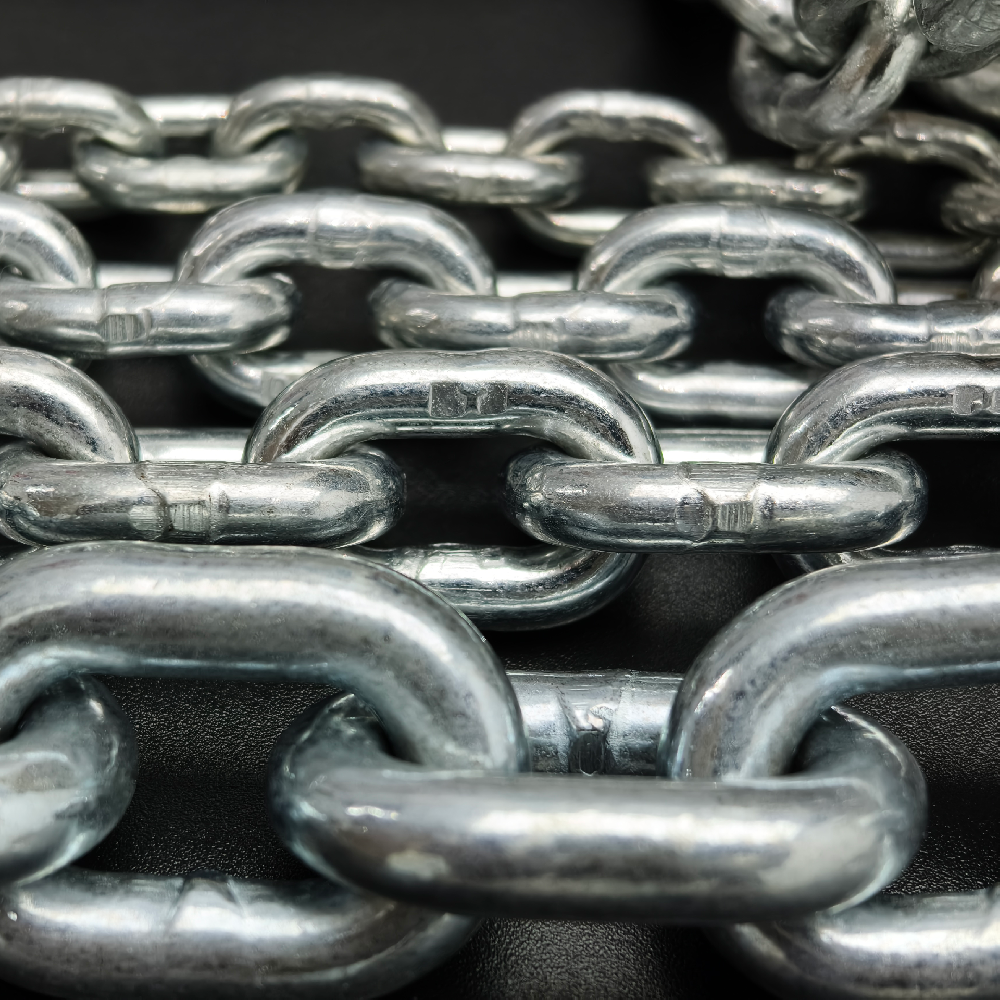
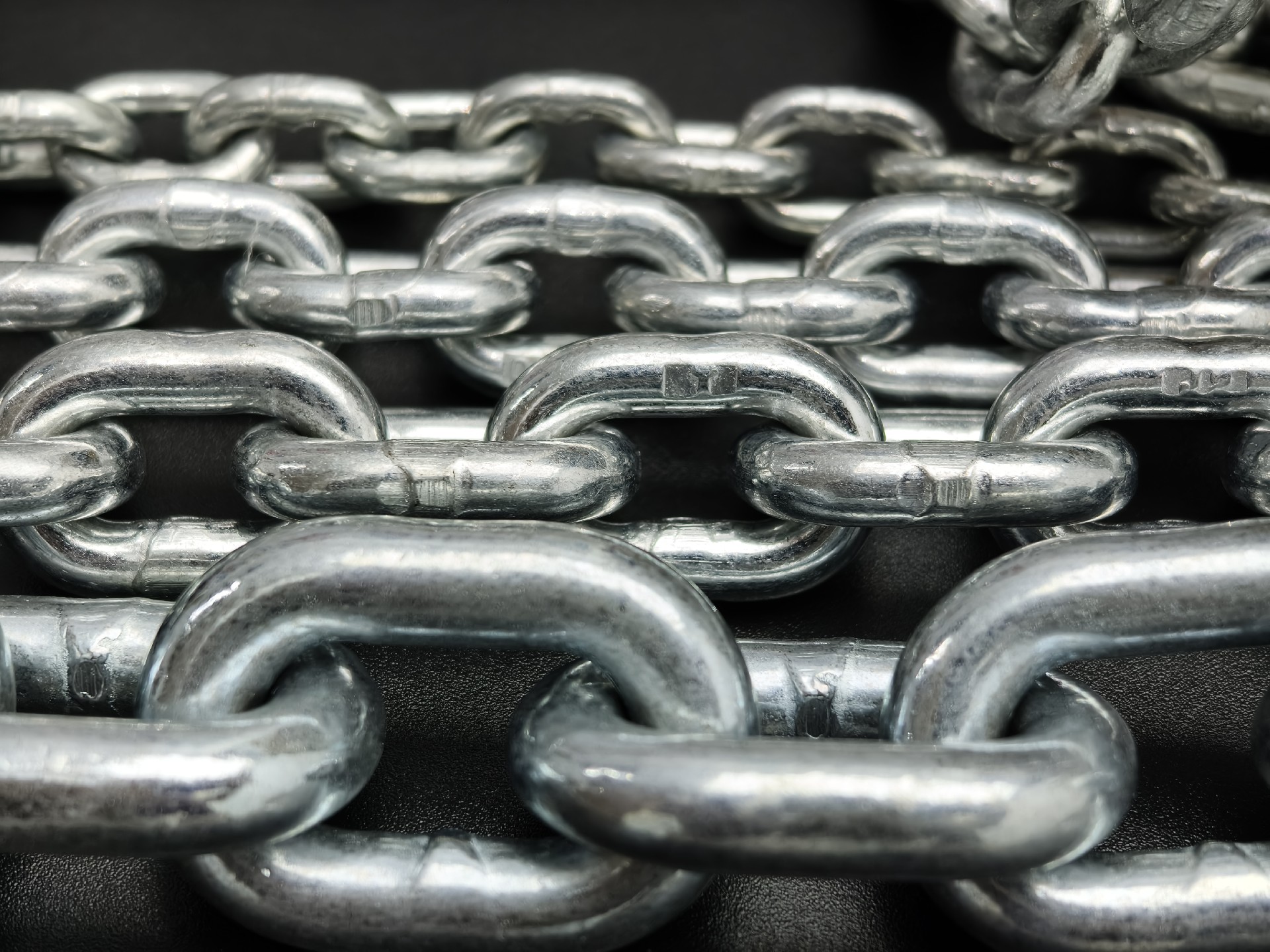
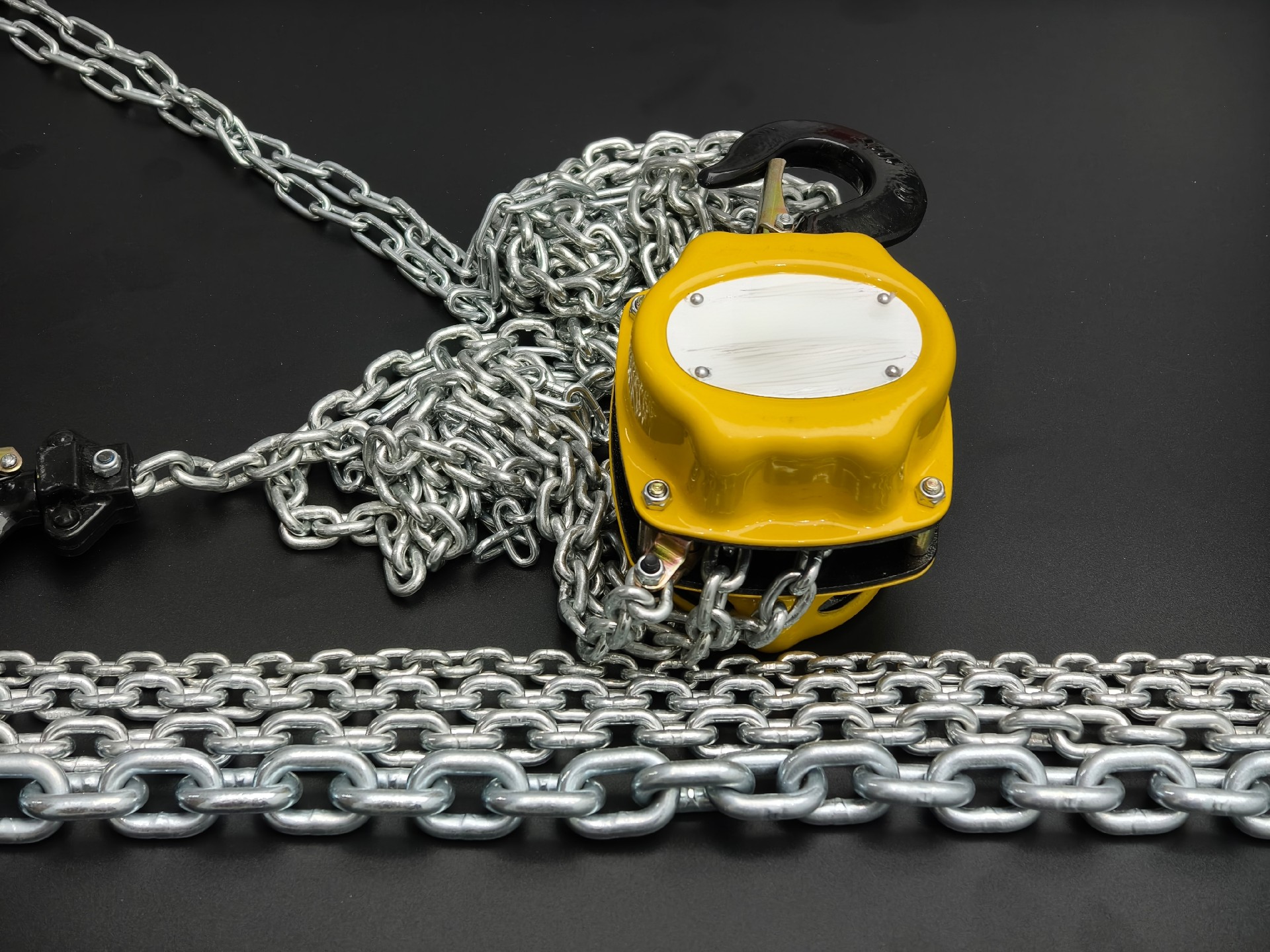
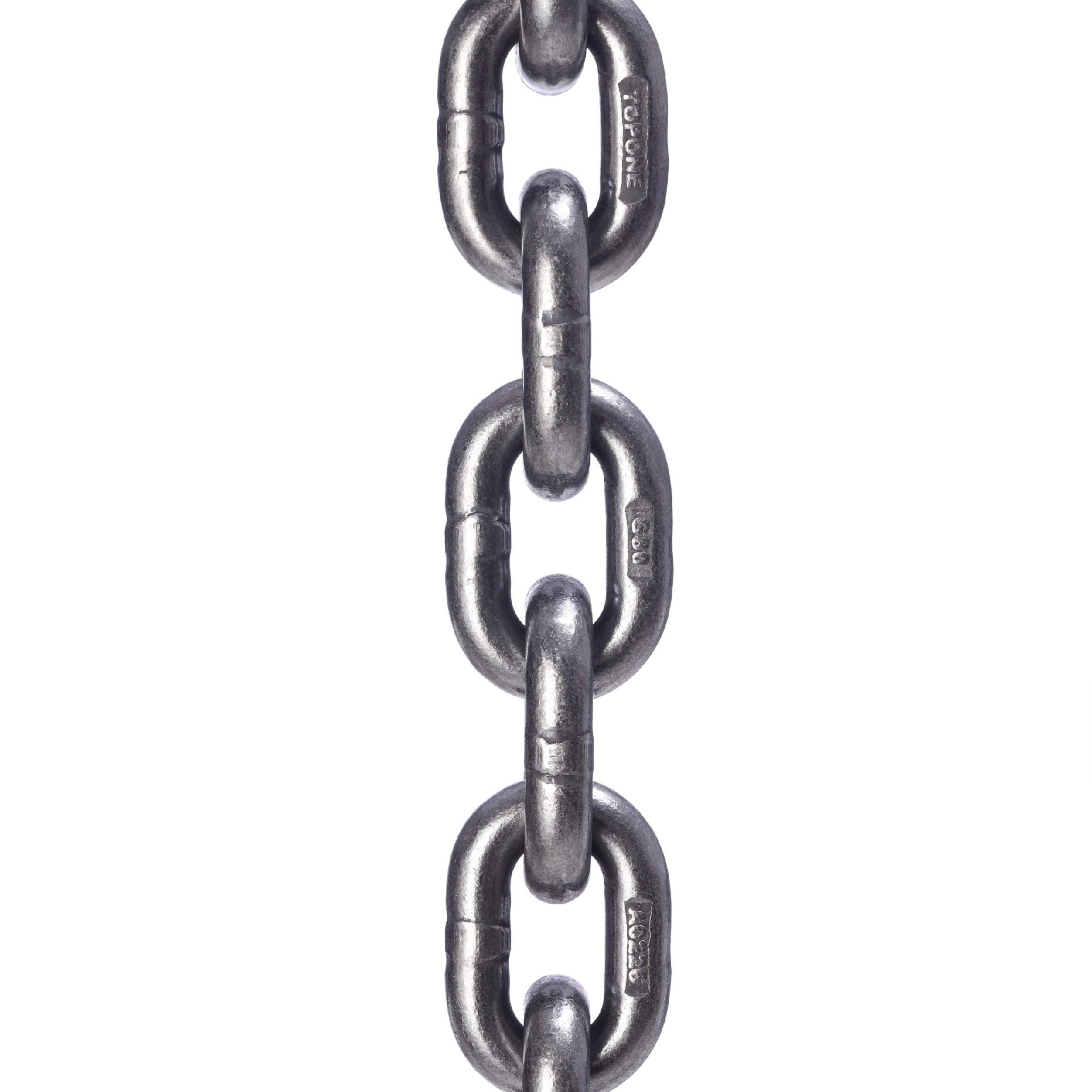
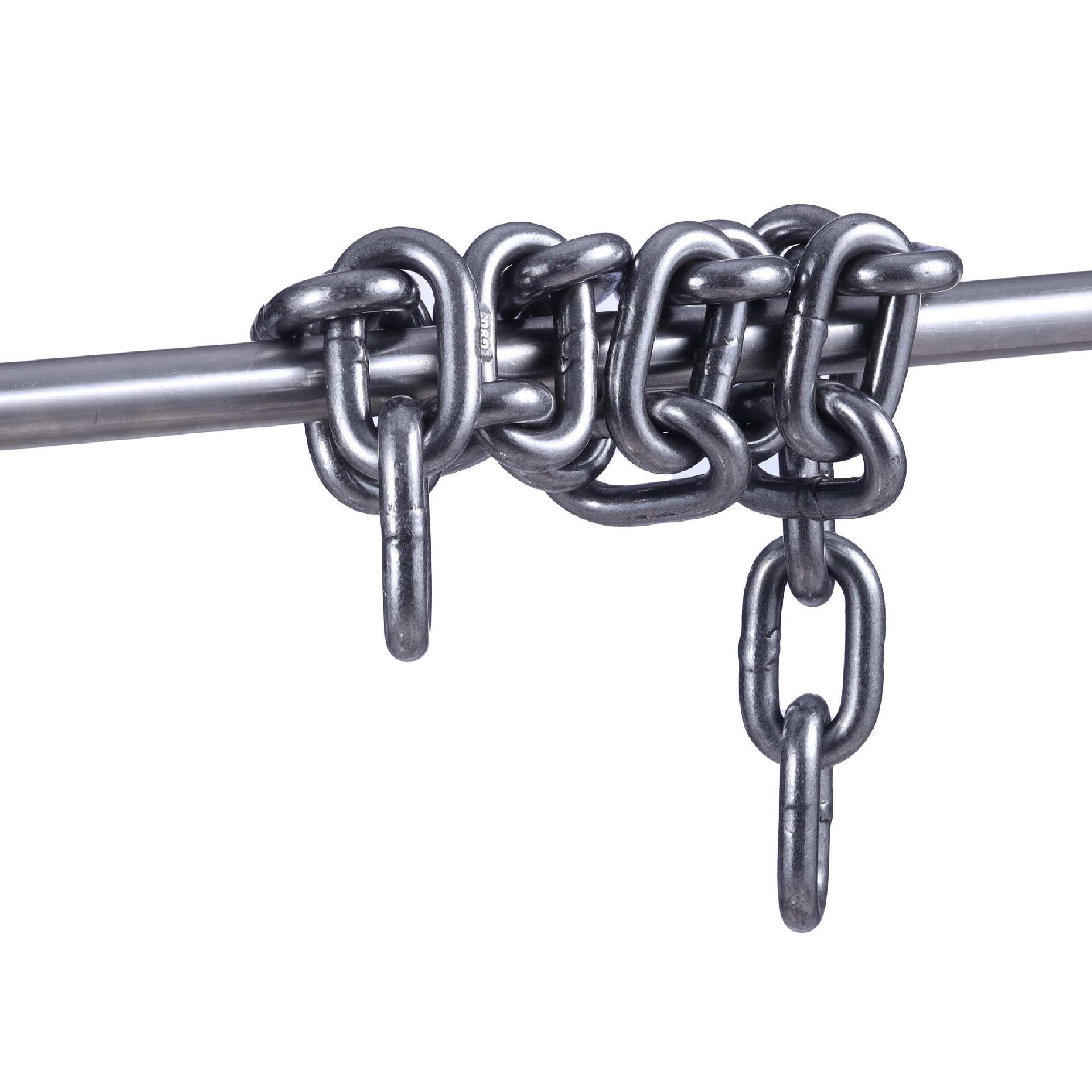
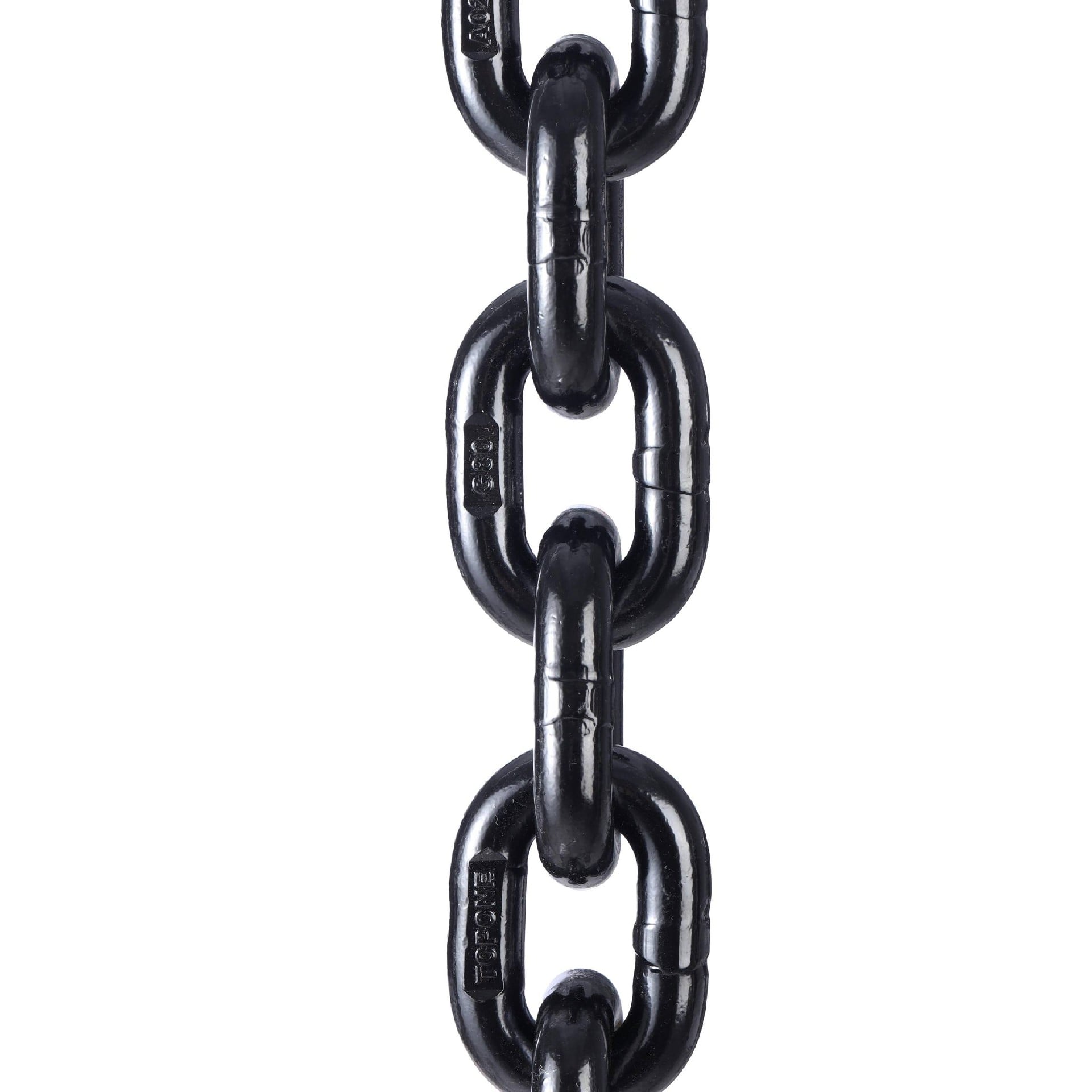
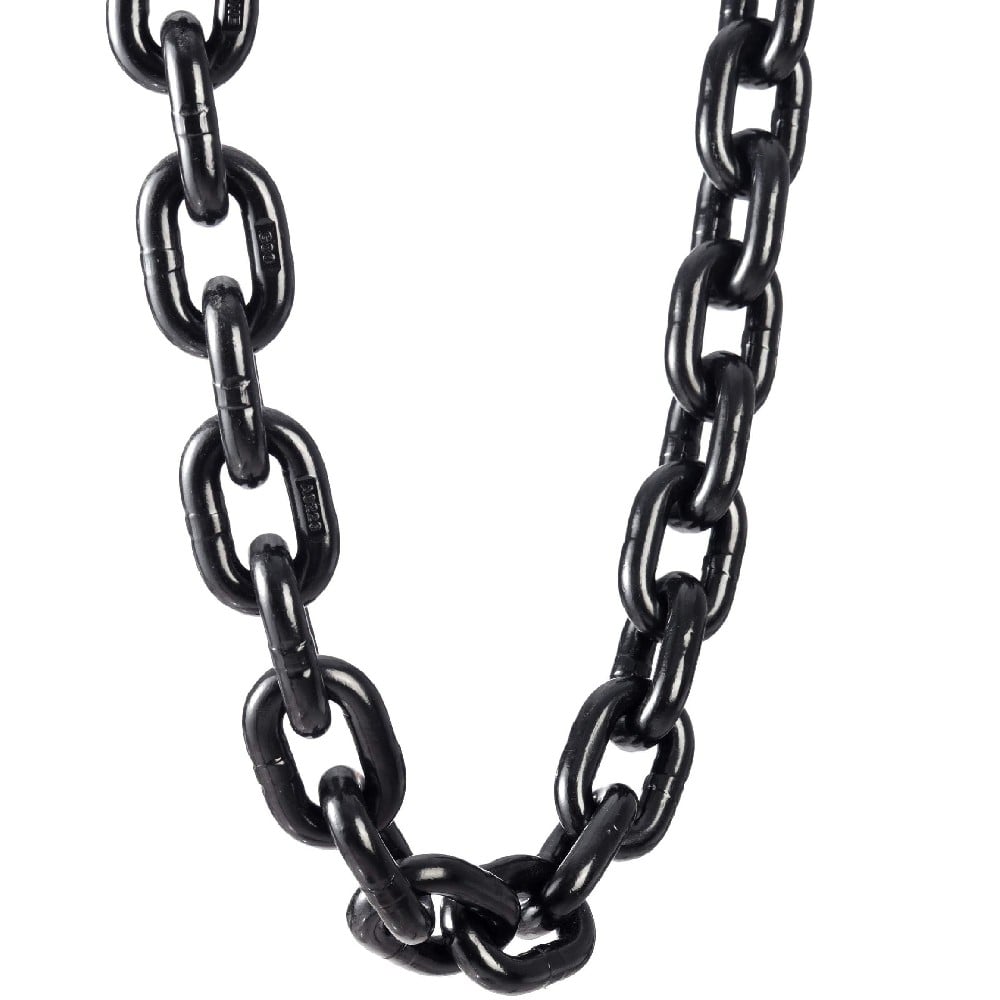
The EN818-7 Electric Hoist Load Chain is a high-precision chain specifically designed for use in powered lifting systems (electric or pneumatic). Unlike general-purpose EN818-2 lifting chains, this type of chain must meet extremely precise dimensional tolerances to ensure smooth, reliable, and safe high-speed operation on the hoist's sprocket.
Our electric hoist load chains are manufactured from premium quenched and tempered alloy steel containing sufficient amounts of chromium (Cr), nickel (Ni), and molybdenum (Mo). This material selection is designed to provide exceptional breaking strength, fatigue resistance, and a highly wear-resistant surface for demanding industrial lifting applications. The product is available in GRADE T with three models: Types T, DAT, and DT, to meet the requirements of different chain hoists. Every chain is manufactured and tested in strict compliance with the European standards EN 818-1 and EN 818-7, which specify the criteria for manufacturing and testing electric hoist load chains.
TOPONE CHAIN provides more detailed descriptions of product characteristics and safety assurance, with all statements traceable to industry standards or manufacturer data.
Key Features
1. Material TOPONE CHAIN chains are made of deoxidized killed steel, achieving a minimum austenitic grain size of 6 or finer (depending on customer requirements) when tested according to ISO 643. Higher hardness and deeper carburized layers require higher nickel content to avoid brittleness. The chromium content is not less than 0.4%, nickel content is not less than 0.9%, and molybdenum content is not less than 0.15%. To prevent strain-age embrittlement during use, TOPONE CHAIN adds 0.025% aluminum. This material is selected because after heat treatment it achieves both high tensile strength and excellent wear resistance, which is critical for service life in powered lifting applications.
•The standard surface treatment for Type T chains is Black Oxide, providing basic corrosion protection and good lubricant adhesion.
•The standard surface treatment for Type DAT and Type DT chains is Electro-galvanized.
•Depending on customer requirements, we can also provide higher levels of corrosion protection such as self-colored, electrophoresis, Dacromet, or Hot-dip Galvanized to suit humid or corrosive environments. All surface treatments will have a certain impact on the mechanical properties of the chain; please consult TOPONE CHAIN for details.
4. Application Areas This chain is specifically designed for dynamic lifting in powered systems. Common applications include:
•Electric Chain Hoists: This is the most common application, used for material lifting in factories, warehouses, construction sites, etc.
•Integrated Power Lifting Systems in Manufacturing and Assembly Lines: For example, material handling on production lines in automobile manufacturing, home appliance production, etc.
•Heavy-Duty Industrial Lifting Requiring High Precision and High Speed: For example, precision lifting in wind power generation, shipbuilding, aerospace, and other fields.
•Stage and Entertainment Industry: Used for lifting stage lighting, sound equipment, etc.
•Food and Pharmaceutical Industries: Using stainless steel or specially coated chains for applications with high cleanliness requirements.
Safety Assurance
Safety is the most critical aspect of any lifting component. Our chains provide safety assurance through the following verified measures:
1. Safety Factor The chain is designed with a minimum safety factor of 4:1. This means that the chain's certified minimum breaking force is at least four times its nominal Working Load Limit (WLL). This is a fundamental safety requirement for high-quality lifting equipment as specified by standards such as EN 818-7.
Example: For a chain with a WLL of 2 tonnes, its minimum breaking force must be at least 8 tonnes (approximately 78.4 kN).
2. Proof Load Test Every single link of every chain has been subjected to a proof load test of 2.5 times the WLL. This non-destructive test is a critical quality control step to verify the integrity of each link's weld and material, ensuring there are no hidden defects from the manufacturing process. Any chain that shows signs of deformation after this test is immediately scrapped.
Testing Process:
•Test Equipment: We use a calibrated tensile testing machine for the test.
•Test Object: Every chain that leaves the factory, regardless of length, is placed whole into the testing machine.
•Test Method: The testing machine slowly applies a tensile force until it reaches 2.5 times the chain's WLL and holds it for a period of time.
•Test Result: After the test, we inspect every link of the chain to ensure there is no permanent deformation, cracks, or other damage. Only chains that pass the test can proceed to the next production stage.
Third-Party Inspection Support
To provide the highest level of quality assurance and customer trust, we fully support and welcome customers to appoint independent third-party inspection agencies to inspect our products. We have experience working with several internationally renowned inspection agencies, including:
•SGS (Société Générale de Surveillance)
•TÜV (Technischer Überwachungsverein)
•BV (Bureau Veritas)
Customers can arrange for these agencies to conduct comprehensive inspections of the product's material composition, mechanical properties, dimensional tolerances, etc., and issue an independent inspection report before shipment.
Parameter
The following technical parameters are based on the manufacturer's specifications for the EN818-7 Electric Hoist Load Chain. These values define the physical and mechanical properties for each available chain size.
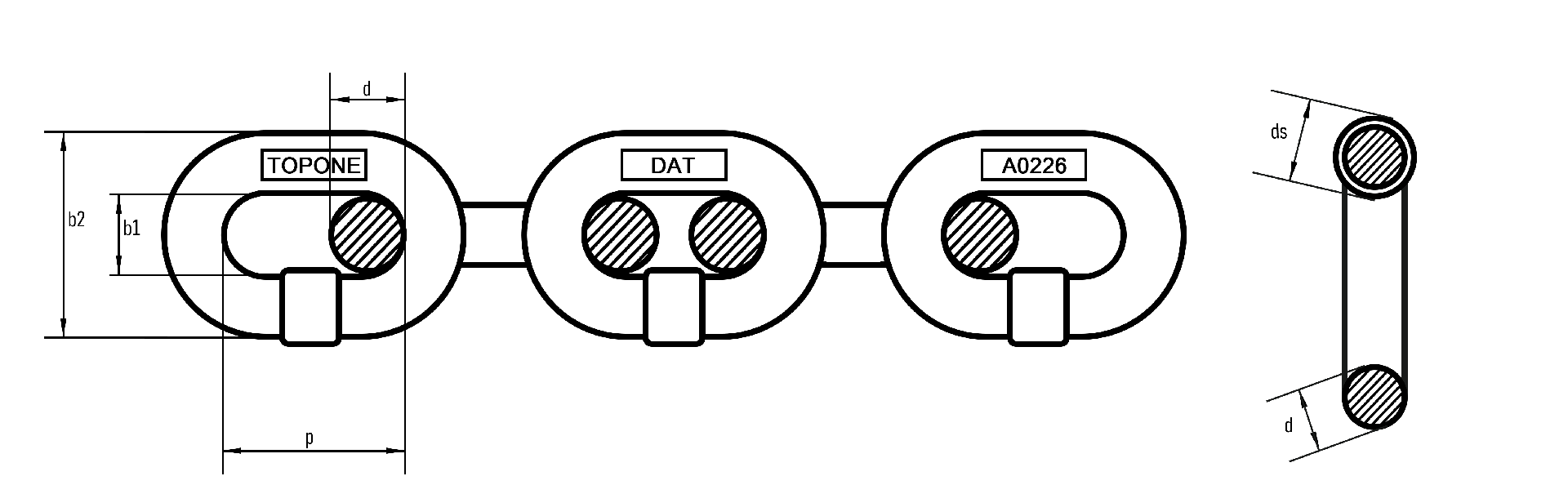
Short link chain for ifting purposes — Fine tolerance hoist chain, rade T(Types T,DAT and DT)
Diameter (mm)
Pitch (mm)
Inside Width
Outside Width
Weld Diameter max. (ds)
Hardness (HV)
Working Load Limit (WLL/t)
Proof Load (MPL/kN)
Breaking Load (MBL/kN)
d
Tolerance
p
Tolerance
b1 min.
b2 max.
T
DAT
DT
T
DAT
DT
4
±0.2
12
±0.25
4.8
13.6
4.3
320
500
550
0.5
0.4
0.25
12.6
20.1
5
±0.2
15
±0.3
6.1
17
5.4
320
500
550
0.8
0.63
0.4
19.6
31.4
6
±0.2
18
±0.35
7.2
20.4
6.5
320
500
550
1.1
0.9
0.56
28.3
45.2
6.3
±0.3
19
±0.35
9
21.6
6.8
320
500
550
1.35
1.08
0.67
21.6
54
7
±0.3
21
±0.4
8.4
23.8
7.6
320
500
550
1.5
1.2
0.75
38.5
61.6
7.1
±0.3
20.2
±0.4
9
23.2
7.7
320
500
550
1.6
1.28
0.8
25.6
64
8
±0.3
24
±0.5
9.6
27.2
8.6
320
500
550
2
1.6
1
50.3
80.4
9
±0.4
27
±0.5
10.8
30.6
9.7
320
500
550
2.5
2
1.25
63.6
102
10
±0.4
30
±0.6
12
34
10.8
320
500
550
3.2
2.5
1.6
78.5
126
10
±0.4
30.2
±0.6
12
32
10.8
320
500
550
3.2
2.56
16
51.2
128
11
±0.4
33
±0.6
13.2
37.4
11.9
320
500
550
3.5
3
1.9
95
152
11.2
±0.5
34
±0.6
15
37.4
12.1
320
500
550
4
3.5
2
64
160
12
±0.5
36
±0.7
14.4
40.8
13
320
500
550
4.5
3.6
2.2
113
181
13
±0.5
36
±0.8
16
42
14
320
500
550
5.3
4.24
2.65
84.8
212
13
±0.5
39
±0.8
15.6
44.2
14
320
500
550
5.3
4.2
2.6
133
212
14
±0.6
42
±0.8
16.8
47.6
15.1
320
500
550
6
5
3
154
246
16
±0.6
45
±0.9
19
57
17.3
320
500
550
8.05
6.44
4.02
128.8
322
16
±0.6
48
±0.9
19.2
54.4
17.3
320
500
550
8
6.3
4
201
322
18
±0.9
54
±1.0
21.6
61.2
19.4
320
500
550
10
8
5
254
407
20
±1.0
60
±1.2
24
68
21.6
320
500
550
12.5
10
6.3
314
503
22
±1.1
66
±1.3
26.4
74.8
23.8
320
500
550
15
12.5
7.5
380
608
Grade 80 Electric Hoist Load Chain Specifications
Nominal Size (d): Not less than 4 mm or greater than 22 mm. Custom sizes are available upon confirmation with TOPONE CHAIN.
Pitch (p): Standard chain pitch is typically based on 3 times the nominal size (3d). Special cases may vary between 2.6d to 3.2p, but must be confirmed with TOPONE CHAIN before manufacturing.
Weld Diameter (ds): The maximum diameter at the weld in any direction shall not exceed 8% of the nominal size. The thickness of steel at the weld shall never be less than the actual diameter of the unaffected steel near the weld.
Heat-Affected Length: The length affected by welding shall not extend more than 0.6 times the nominal diameter (0.6d) on either side of the link center.
Material Quality: Steel must be produced using electric furnace or oxygen-blown process. It must be fully killed steel, resistant to strain-age embrittlement, with an austenitic grain size of 5 or finer.
Chemical Composition of Material:
• Steel shall contain sufficient alloying elements (nickel, chromium, molybdenum) to ensure strength and low-temperature toughness after heat treatment.
• Minimum nickel content by mass: Type T at least 0.40%, Type DAT at least 0.7%, Type DT at least 0.9%.
• To prevent strain-age embrittlement, steel must contain at least 0.025% aluminum.
• Maximum sulfur and phosphorus content in cast analysis shall not exceed 0.020%.
Heat Treatment: All lifting chains must be quenched from temperatures above the AC3 point and/or surface hardened, followed by tempering, before being subjected to the "Manufacturing Proof Force".
Breaking Force and Elongation: The minimum total elongation at fracture after tensile testing shall be: Type T and Type DAT minimum 10%, Type DT minimum 5%.
Bending Deflection: Type DAT and Type DT chain samples must be able to withstand a force equivalent to 2.5 times the Working Load Limit (WLL) without fracture.
Surface Hardness: Type DT has the highest surface hardness requirement (minimum 550 HV 10 for 7 mm to 11 mm chains), followed by Type DAT (minimum 500 HV 10), and Type T (360 HV 10).
Fatigue Resistance: Type DAT and Type DT chains with precision tolerances must be able to withstand at least 200,000 cycles of specified stress range testing without failure.
Standards
Adherence to recognized international standards is mandatory to ensure the safety, high quality, and interoperability of lifting equipment. Our electric hoist load chains are manufactured in compliance with the following key standards:
EN 818-1
This is the first part of the EN 818 series of standards, which specifies the general conditions of acceptance for lifting chains, including marking, certification, and test methods.
DIN 17115
This is a German standard that specifies the technical conditions for steel used in the manufacture of lifting chains. It details the requirements for the steel's chemical composition, mechanical properties, purity, etc., and is key to ensuring the quality of the chain's raw material.
EN 818-7:2002+A1:2008
This is the primary European standard that specifies the manufacturing and testing of high-precision hoist chains. Its full title is "Short link chain for lifting purposes — Safety — Part 7: Fine tolerance hoist chain, Grade T (Types T, DAT and DT)".
What this standard guarantees: Compliance with EN 818-7 ensures that the chain meets strict requirements in material properties, chemical composition, dimensional accuracy (especially pitch), heat treatment, and mechanical properties (such as tensile strength and elongation). It also mandates specific testing procedures, including a proof load test on every single link.
Minimum Order Quantity
100 m / 1 TON
Chain Testing
Sampling lots (Lot) are set at 100 m as a unit length. Five links are sampled for testing including breaking force, elongation, bending test, surface hardness test, hardened layer depth measurement (DAT/DT types only), and fatigue testing. All lifting chains (100%) must individually undergo static tensile testing and withstand the specified Manufacturing Proof Force. This test cannot be retested; non-conforming chains are immediately discarded.
Chain Certificate
In accordance with EN 818-1 regulations, contact TOPONE CHAIN to obtain a free copy for verification of product suitability.
Marking
Marking shall comply with EN 818-1 regulations. The grade marking of lifting chains shall be marked as T, DAT, or DT according to their type.
Processing Restrictions
TOPONE CHAIN will specify in the instruction manual the restrictions on subsequent heat treatment, galvanizing, electroplating, or coating of the chain. Without TOPONE CHAIN approval, lifting chains shall not be galvanized or undergo any electroplating process, nor shall they be immersed in acidic solutions or exposed to acidic fumes.
Temperature Limits for Working Environment
• Type T: Minimum -40°C
• Type DAT: Minimum -20°C
• Type DT: Minimum -10°C
• Maximum Temperature: All Type T, DAT, and DT can be used up to +200°C. If chain temperature exceeds 200°C, it must be retired immediately.
Safety Notice
Chains shall not be used to manufacture slings, nor shall they be used as basket hitches or choke hitches in hoists.