Lifting chain markings provide essential information about a chain's grade, manufacturer, and suitability for industrial lifting applications. However, not every number stamped on a chain link represents its lifting capacity, and a chain's appearance alone cannot confirm its Working Load Limit (WLL).
Two chains may have the same diameter and similar appearance but belong to different strength grades. Likewise, a chain sling may contain properly marked Grade 80 or Grade 100 links while still requiring a separate identification tag to establish the rated capacity of the complete assembly.
So, how can you identify lifting chain markings correctly? What do G80, G100, 8, and 10 mean? Where should you find the chain size and WLL? And what should you do if the markings are missing or unreadable?
This guide explains how to read lifting chain grade stamps, manufacturer identification marks, nominal chain sizes, and chain sling WLL tags before selecting or using lifting equipment.
Why Are Lifting Chain Markings Important?
Lifting chain identification helps operators, inspectors, and buyers verify that a chain is suitable for its intended application.
A chain that looks strong is not necessarily manufactured or rated for overhead lifting.
Proper markings help connect the physical product with its manufacturing specification, rated capacity, and relevant documentation.
Markings Help Identify Chain Strength Grades
Grade 80 and Grade 100 lifting chains are commonly manufactured from heat-treated alloy steel.
The grade identifies a specified mechanical strength classification, while the nominal chain diameter determines the size of the steel used to form each link.
Both specifications are important when establishing the chain's rated capacity.
Markings Support Product Traceability
Manufacturer identification markings help distinguish chains produced under different specifications and quality control systems.
Depending on the product standard and manufacturing system, additional identification may be provided through batch numbers, traceability records, packaging labels, or inspection documents.
Traceability is particularly important when purchasing replacement chains or maintaining lifting equipment inspection records.
Markings Help Prevent Incorrect Chain Selection
A transport chain, general-purpose chain, or industrial conveyor chain must not automatically be treated as a lifting chain.
Even when a chain is stamped with a grade number, users must verify that it is specifically manufactured and approved for the intended lifting application.
Markings are the starting point for identification, not a substitute for technical verification.
What Types of Markings Appear on Lifting Chains?
There are two main categories of identification information:
Chain link markings identify characteristics of the chain itself.
Chain sling identification tags provide information about a complete lifting assembly and its approved operating capacity.
These markings serve different purposes.
Chain Link Markings
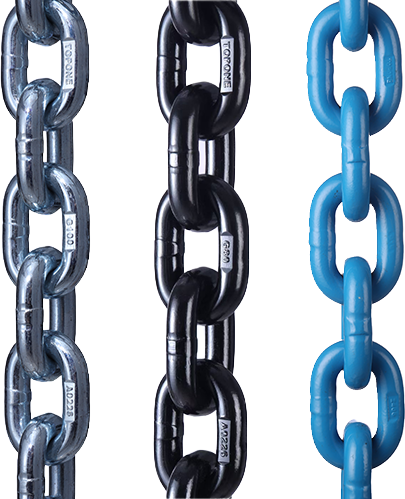
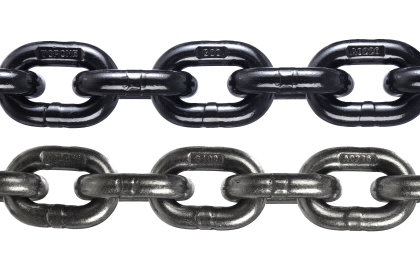
Depending on the applicable standard and manufacturer, a lifting chain link may display:
· Chain grade marking
· Manufacturer's identification mark
· Other approved product identification codes
Not every individual link is necessarily marked.
For example, certain standards and national guidance specify periodic grade and manufacturer markings at intervals of no more than 20 links or 1 meter, whichever is shorter.
The actual marking requirements must be checked against the standard applicable to the chain.
Chain Sling Identification Tags
A complete alloy steel chain sling normally requires a durable identification tag or equivalent approved permanent identification.
Depending on the applicable requirements, it may identify:
· Chain grade
· Nominal chain size
· Rated capacity or WLL
· Sling reach or effective length
· Number of legs
· Rated configuration and applicable sling angle
· Manufacturer or supplier identification
· Individual sling or traceability number
The exact format varies by standard and manufacturer.
Important: A grade stamp on a chain link does not replace the required identification of the complete chain sling assembly.
How to Read Lifting Chain Grade Markings
The chain grade is one of the first markings to identify.
Grade 80 and Grade 100 are widely used strength classifications for alloy steel lifting chains.
However, manufacturers may use different stamping formats depending on the relevant standard and market.
Common Lifting Chain Grade Stamps
Marking | Common Interpretation | Important Note |
8 | Grade 80 / Grade 8 | Confirm the applicable chain standard |
80 / G80 | Grade 80 | Identification format varies by manufacturer |
T | Grade 80 in certain marking systems | Context matters; T also appears in hoist-chain classifications |
10 | Grade 100 / Grade 10 | Verify that the marking denotes grade, not size or another code |
100 / G100 | Grade 100 | Confirm the product specification |
V | Grade 100 in certain marking systems | Verify against the applicable marking requirements |
Manufacturer Code | Manufacturer or trademark identification | Code format varies |
Batch or Traceability Code | Manufacturing identification | May appear on a tag or associated documents |
These are examples of marking conventions, not a universal decoding system for every chain manufacturer.
A number or letter should only be interpreted after checking the chain type, marking location, and applicable standard.
What Does G80 Mean on a Lifting Chain?
G80 identifies a Grade 80 strength classification when used as an approved grade marking.
Grade 80 alloy steel lifting chains are commonly used in industrial chain sling assemblies for machinery handling, construction, and equipment installation.
Their rated capacity depends on the chain diameter and approved specification.
For available dimensions, test loads, and rated capacities, see TOPONE's Grade 80 Lifting Chain product information.
What Does G100 Mean on a Lifting Chain?
G100 identifies a Grade 100 strength classification when it is the manufacturer's approved grade designation.
Under comparable rating systems, Grade 100 chain generally provides approximately 25% higher nominal WLL than Grade 80 chain of the same diameter.
However, a Grade 100 marking does not mean that every completed sling made with that chain has the same WLL.
The complete assembly must be rated according to its configuration and components.
TOPONE provides detailed reference dimensions and load ratings for its G100 Lifting Chain range.
Can You Identify Chain Grade by Color?
No.
Some manufacturers use specific chain colors or finishes to distinguish grades and product ranges.
For example, different lifting chain products may have painted, blackened, or other approved surface finishes.
However, color is not a universal or sufficiently reliable method for identifying chain grade.
Paint can wear away, become contaminated, or be applied to a chain without establishing its mechanical properties.
Always verify the appropriate markings and manufacturer documentation rather than relying on color alone.
How to Identify Lifting Chain Size and Manufacturer Markings
Once the chain grade has been established, the next step is to confirm its nominal size and manufacturer identity.
What Does Chain Size Mean?
Lifting chain size normally refers to the nominal diameter of the steel material used to form the chain link.
For example, a chain specified as:
10 × 30 mm
usually indicates:
· Nominal chain diameter: 10 mm
· Nominal chain pitch: 30 mm
The first value describes the nominal bar diameter, while the second describes the link pitch.
This specification is commonly found in product drawings, catalogs, technical documents, and chain size tables.
It is not necessarily stamped in full on every chain link.
Common Lifting Chain Diameters
Common metric sizes include:
Nominal Chain Size | Nominal Diameter | Main Identification Requirement |
6 mm | 6 mm | Confirm grade and manufacturer's rating |
8 mm | 8 mm | Confirm grade and manufacturer's rating |
10 mm | 10 mm | Confirm grade and manufacturer's rating |
13 mm | 13 mm | Confirm grade and manufacturer's rating |
16 mm | 16 mm | Confirm grade and manufacturer's rating |
20 mm | 20 mm | Confirm grade and manufacturer's rating |
The same diameter can be used in different grades and chain types.
Therefore, chain diameter alone cannot establish lifting capacity.
How to Measure Chain Diameter
Use a suitable caliper and follow the manufacturer's dimensional measurement method.
The nominal diameter refers to the steel section forming the link, not the outside width of the complete link.
When checking an existing chain, examine the condition of the steel at the interlink contact areas.
A used chain may have material loss caused by wear.
Measured diameter and original nominal diameter are not always identical.
If the original specification is unknown, do not assign a new chain grade or WLL merely from the measured size.
How to Identify Manufacturer Markings
Manufacturer identification may appear as letters, a symbol, a trademark, or another approved code.
Such markings help associate the chain with a specific manufacturing source.
However, a manufacturer code does not automatically reveal every specification.
Buyers may still need to check:
· Chain grade
· Nominal size
· Applicable manufacturing standard
· Batch or heat identification
· Material and mechanical test documents
· Product-specific load ratings
When the origin or specification of a lifting chain cannot be reliably established, the chain should not be assigned an assumed lifting capacity.
How to Read WLL Markings on a Chain Sling Tag
The Working Load Limit (WLL) is one of the most important pieces of information on a chain sling identification tag.
WLL describes the rated working capacity of the lifting assembly under specified conditions.
It must not be confused with manufacturing proof force or minimum breaking force.
What Information Should a Chain Sling Tag Show?
The following is an illustrative identification layout, not an actual product certificate.
Example Tag Field | Example Information | Meaning |
Chain Grade | G80 | Strength grade |
Chain Size | 10 mm | Nominal chain diameter |
Number of Legs | 2-Leg | Sling configuration |
WLL | Manufacturer's rated value | Maximum permitted load for the stated configuration |
Sling Angle | Applicable rated angle range | Angle conditions for the WLL |
Reach | 3 m | Specified effective sling length |
Sling Identification | Example ID: SL-001 | Individual assembly reference |
Manufacturer | Manufacturer name or trademark | Product identification |
The WLL must be taken from the actual identification tag or approved manufacturer documentation.
Do not substitute a generic chart or illustrative label for a verified sling rating.
Why Does WLL Depend on Sling Configuration?
Two chain slings made from the same grade and diameter may have different rated capacities.
This is because WLL depends on more than chain strength.
Important factors include:
· Number of chain legs
· Sling angles
· Hitch type
· Hook and master link ratings
· Load distribution
· Approved sling assembly design
For example, a two-leg sling with legs positioned close to vertical generally experiences lower tension per leg than the same sling with the legs spread farther outward.
The chain grade and diameter have not changed, but the forces acting on the assembly are different.
For this reason, the correct WLL must match the actual sling arrangement.
G80 vs. G100: Same Chain Size, Different WLL
The following reference data illustrate why chain grade matters when reading identification information.
Nominal Diameter | G80 Reference WLL (t) | G100 Reference WLL (t) |
8 mm | 2.00 | 2.50 |
10 mm | 3.20 | 4.00 |
16 mm | 8.00 | 10.00 |
The values are selected from TOPONE's published chain specifications. They are chain product reference ratings under their specified conditions, not universal WLL values for every assembled sling.
A Grade 100 chain can have a higher rating than a Grade 80 chain of the same size.
However, a finished chain sling must still be selected using its own identification and approved assembly WLL.
For complete multi-leg configurations and compatible fittings, explore TOPONE's Chain Lifting Slings product range.
Does Every Chain Link Show Its WLL?
Not necessarily.
Individual links commonly carry grade and manufacturer identification according to the applicable product requirements.
A complete chain sling's rated capacity is normally identified through the assembly tag or other approved permanent identification.
Therefore, users should not assume that an isolated number on a chain link represents its WLL.
Chain grade is not the same as sling rated capacity.
What Should You Do If Lifting Chain Markings Are Missing?
Missing or unreadable identification is a serious problem because it can prevent users from establishing the correct chain grade and rated capacity.
Missing Chain Sling Identification Tag
Under OSHA 29 CFR 1910.184, alloy steel chain slings must carry durable identification showing size, grade, rated capacity, and reach.
OSHA also prohibits using slings without the required affixed and legible identification markings.
If an identification tag is missing, illegible, or inconsistent with the equipment, remove the sling from service.
Do not estimate its WLL from appearance, chain diameter, or the rating of one attached hook.
Worn or Unreadable Chain Link Markings
Link markings can become difficult to read because of wear, corrosion, abrasion, or surface contamination.
The missing marking must be evaluated according to the product's applicable standard, manufacturer documentation, and inspection procedure.
If the chain's grade, origin, or suitability cannot be established reliably, do not use it for lifting.
Permanent markings should not be recreated through uncontrolled stamping, grinding, engraving, or welding.
Any approved re-identification must follow the relevant manufacturer's and inspection requirements.
Markings Do Not Replace Physical Inspection
Even a chain sling with clear identification may be unsafe if it is damaged.
Inspect for:
· Cracked or deformed links
· Excessive chain wear
· Abnormal elongation
· Corrosion and pitting
· Bent or twisted links
· Damaged weld areas
· Deformed hooks or master links
· Missing or defective connecting components
Identification and condition must both be acceptable before use.
For practical dimensional inspection methods, read TOPONE's How to Measure Lifting Chain Wear and Elongation.
Which Standards Apply to Lifting Chain Markings?
The requirements for identification and marking depend on the chain type, applicable manufacturing standard, sling design, and destination market.
Relevant Standards and Regulations
Standard / Regulation | Main Scope | Relevance to Markings |
EN 818-1 | Short-link lifting chain general acceptance requirements | Identification and general product requirements |
EN 818-2 | Grade 8 medium-tolerance lifting chain | Grade 8 chain marking and technical requirements |
EN 818-4 | Grade 8 chain sling assemblies | Sling identification and rated assembly information |
ASTM A391/A391M | Grade 80 alloy steel chain | Grade 80 product requirements |
ASTM A973/A973M | Grade 100 alloy steel chain | Grade 100 product requirements |
ASME B30.9 | Slings | Sling identification, selection, inspection and use |
OSHA 29 CFR 1910.184 | Slings in covered workplaces | Required alloy steel chain sling identification |
The actual edition and applicability of each standard must be verified for the product and destination market.
A chain marking should not be interpreted as proof of compliance with a particular standard unless the manufacturer provides supporting documentation.
Are Transport Chain Markings the Same as Lifting Chain Markings?
No.
Grade 43 high-test chains and Grade 70 transport chains are commonly associated with towing, cargo securing, and other non-overhead lifting applications.
Their grade markings and rated load information should not be interpreted as approval for overhead lifting.
Likewise, chains designed for mining conveyors or marine anchoring systems are not automatically suitable for chain slings.
A chain must be specifically manufactured, rated, and identified for its intended use.
Are Electric Hoist Load Chain Markings Different?
They can be.
Precision load chains used in electric and manual chain hoists are subject to equipment-specific dimensional and performance requirements.
For example, EN 818-7 covers fine-tolerance hoist chains in specified Grade T classifications and types.
A Grade 80 sling chain should not be installed as a replacement electric hoist load chain solely because the nominal diameter appears to match.
Hoist compatibility must follow the equipment manufacturer's approved replacement chain specification.
Frequently Asked Questions About Lifting Chain Markings
What do the numbers 8 and 10 mean on lifting chains?
When used as approved grade markings, 8 commonly identifies Grade 80, while 10 commonly identifies Grade 100.
The meaning must still be confirmed from the chain's marking system, manufacturer, and applicable standard.
Does G80 mean a chain can lift 80 tonnes?
No. G80 identifies a strength grade, not a load capacity of 80 tonnes.
The WLL depends on the actual chain diameter and approved specification.
Where is the WLL marked on a chain sling?
The WLL is normally provided on the completed sling's durable identification tag or equivalent approved identification.
The value must correspond to the applicable sling configuration and operating conditions.
How can I tell whether a chain is Grade 80 or Grade 100?
Check the manufacturer's approved chain grade markings and the complete sling identification.
Verify the information using product documentation rather than relying on color, weight, or appearance.
Can I use an alloy steel chain sling without an identification tag?
No. Where OSHA 29 CFR 1910.184 applies, slings without the required affixed and legible identification markings must not be used.
The sling must be removed from service until it has been properly evaluated and its identification restored through an approved process.
Can I identify chain size by measuring the link width?
No. Nominal chain size normally refers to the steel bar diameter, not the overall width of the link.
Check the specified dimensions and use the appropriate measurement method.
Do manufacturer markings prove that a chain is certified?
No. Manufacturer markings support identification, but they do not independently prove that every required material, mechanical, and manufacturing test has been completed.
Verify the applicable product specification and supporting documentation
Conclusion: Read the Markings Before You Lift
Understanding lifting chain markings helps buyers, riggers, and inspectors distinguish chain grades, identify nominal sizes, and verify the rated capacity of lifting equipment.
The most important principle is to separate three different types of information:
Grade = Chain strength classification
Size = Nominal chain dimensions
WLL = Approved working capacity under specified conditions
Chain link markings help establish the chain's identity, while the complete sling identification tag provides the information needed to verify its rated lifting capacity.
Never assume a chain is suitable for overhead lifting based on color, diameter, or an isolated stamped number.
If essential identification is missing, inconsistent, or unreadable, remove the equipment from service until its suitability has been established through the applicable approved process.
Need Properly Identified G80 or G100 Lifting Chains?
TOPONE supplies alloy steel lifting chains and chain sling assemblies for industrial lifting applications.
When requesting product information, specify the required chain grade, diameter, WLL, sling configuration, working length, quantity, and applicable standard.
Contact TOPONE CHAIN to discuss chain specifications, identification requirements, supporting documentation, and bulk quotations.