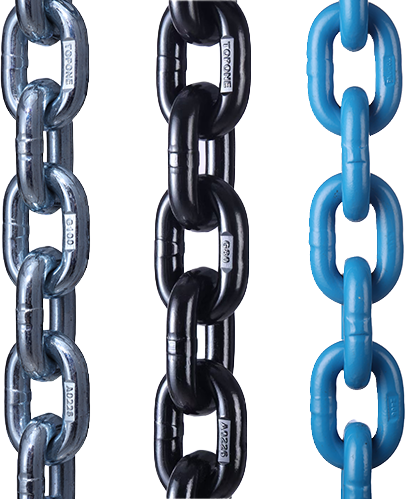
What Do All Chain Hoists Use to Lift Heavy Loads?
If you have ever used a manual chain hoist or electric chain hoist, you may not think twice about the component doing most of the real work. Motors, gears, and brakes matter—but the true hero behind every chain hoist is the lifting chain.
So the question is simple:
What do all chain hoists actually use to lift heavy loads?
The answer is just as clear:
They rely on high-strength alloy lifting chains, most commonly Grade 80 (GR80) lifting chain.
The Role of the Lifting Chain in a Chain Hoist
A lifting chain is the load-bearing element that directly supports the weight being lifted. Unlike gears or housings, it is exposed to:
Continuous tension
Repeated load cycles
Abrasion from hooks and pockets
Shock loads during starts and stops
That’s why not all chains are suitable for chain hoists.
For overhead lifting, ordinary carbon steel chains or transport chains are simply not safe.
Why Chain Hoists Use GR80 Chain
Most modern chain hoists—manual or powered—use GR80 chain as their standard lifting medium.
Here’s why:
1. High Strength for Heavy Loads
A GR80 lifting chain is made from quenched and tempered alloy steel, giving it significantly higher tensile strength than standard chains.
This allows chain hoists to lift heavy loads safely without increasing chain size unnecessarily.
2. Designed for Overhead Lifting
GR80 chain is specifically engineered and certified for overhead lifting, unlike Grade 70 or Grade 43 chains used in transport or towing.
3. Excellent Fatigue Resistance
Chain hoists operate with repeated lifting cycles. GR80 chains are built to withstand this fatigue without cracking or elongation under normal working conditions.
Lifting Chain vs “Any Chain”: A Critical Difference
Many lifting accidents happen because the wrong chain is used.
Chain Type | Suitable for Chain Hoist? |
Decorative / hardware chain | ❌ No |
Transport chain (Grade 70) | ❌ No |
Carbon steel chain | ❌ No |
GR80 lifting chain | ✅ Yes |
If a chain hoist is lifting safely, you can almost be sure there is a certified alloy lifting chain inside.
Heavy-Duty Lifting Chains in Real Applications
In real-world use, lifting chains in chain hoists are found everywhere:
Construction sites lifting steel beams
Workshops positioning heavy machinery
Warehouses handling molds and equipment
Shipyards lifting components vertically
Factories using overhead monorail hoists
In these environments, heavy chains for lifting must perform reliably every single day.
A Practical Note on Chain Selection
Many users focus on hoist capacity but overlook the chain itself. Over time, chain wear, corrosion, or incorrect grade selection becomes the weakest link.
If you’re already inspecting hooks and brakes, it’s worth asking one more question:
Is the lifting chain itself still the right grade for the job?
In most professional environments, upgrading or replacing with a GR80 alloy lifting chain is often the simplest way to restore safety margins—without changing the hoist system at all.
Final Thoughts
So, what do all chain hoists use to lift heavy loads?
Not motors.
Not gears.
Not housings.
They all depend on a properly selected, certified lifting chain—and in most cases, that means GR80 chain.
Understanding this single component helps operators make better decisions about safety, maintenance, and long-term reliability in any lifting operation.