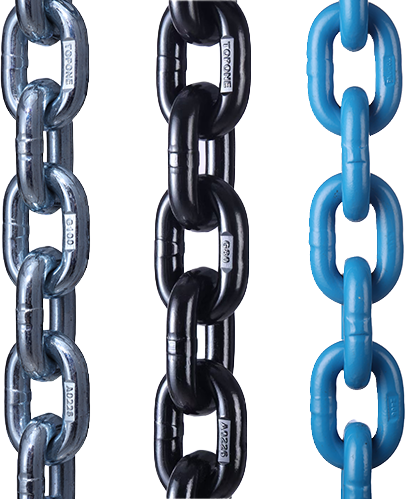
When choosing a lifting chain, most people focus on load capacity. But once chains are handled daily, another question quickly becomes just as important:
How heavy is the chain—and is there a lighter alternative?
This is where the comparison between G80 vs G100 lifting chain weight becomes highly relevant.
Both grades are approved for overhead lifting, yet they behave very differently in real-world applications.
Understanding G80 and G100 Lifting Chains
Before comparing weight, it helps to understand what these grades mean.
G80 Lifting Chain
Industry standard for decades
Alloy steel, quenched and tempered
Approved for overhead lifting
Widely used in chain slings and hoists
G100 Lifting Chain
Newer high-performance alloy steel
Approximately 25% stronger than G80
Approved for overhead lifting
Allows smaller diameter for the same load
Both are classified as heavy duty lifting chains, but strength-to-weight ratio is where they differ.
Lifting Chain Weight: G80 vs G100
Below is a simplified lifting chain weight comparison using common sizes:
WLL | G80 Chain Size | G100 Chain Size | Weight Difference |
~2.0 t | 8 mm | 7 mm | G100 is lighter |
~3.15 t | 10 mm | 8 mm | G100 saves weight |
~5.3 t | 13 mm | 10 mm | Significant reduction |
~8.0 t | 16 mm | 13 mm | Noticeably lighter |
Because G100 lifting chain offers higher strength, a smaller diameter can be used to achieve the same working load limit—resulting in a lighter overall chain.
Why Lifting Chain Weight Makes a Real Difference
In theory, a few kilograms may not sound important. In practice, it matters a lot.
Daily Handling
Rigging crews repeatedly connect and disconnect chains. A lighter lifting chain reduces fatigue and speeds up operations.
Installation & Adjustment
Shorter setup time and easier positioning—especially in multi-leg chain slings.
Transportation & Storage
Less weight means easier transport and lower handling effort, especially when moving multiple slings.
G80 vs G100: Which Lifting Chain Should You Choose?
Choose G80 lifting chain if:
Cost sensitivity is high
Handling frequency is low
Industry standards already specify G80
Choose G100 lifting chain if:
Weight reduction matters
Frequent manual handling is required
Space is limited
Higher performance is needed
The smartest choice isn’t always the strongest—it’s the one that fits the job.
A Practical Observation
Many users switch to G100 not because they need more capacity, but because they want less chain to handle while keeping the same load rating.
Upgrading the lifting chain grade, rather than increasing chain size, is often the easiest way to improve ergonomics without changing the entire lifting system.
Final Thoughts
So when comparing G80 vs G100 lifting chain weight, the takeaway is simple:
G100 chains can be lighter for the same load
Less weight improves handling and efficiency
Both grades are safe—if selected correctly
Understanding lifting chain weight helps operators make smarter decisions that go beyond basic load charts.