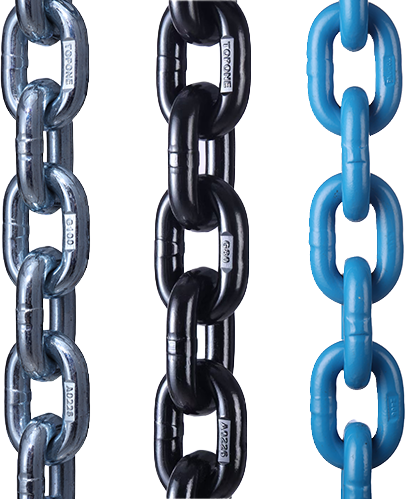
Correctly identifying a chain sling is essential before selecting, inspecting, replacing, or using it for a lift. Two chain slings may look very similar while having different grades, chain diameters, Working Load Limits (WLL), or component ratings.
For this reason, chain sling grade should never be identified from appearance alone.
A proper identification process should confirm:
Sling Tag → Chain Grade → Chain Size → WLL → Sling Configuration → Components → Condition
For alloy steel chain slings, OSHA requires durable identification showing information including the sling's size, grade, rated capacity, and reach.
This information provides the starting point for determining whether a sling is suitable for a particular lifting operation.
What Does Chain Sling Grade Mean?
The chain sling grade identifies the strength class of the alloy steel chain used in the sling.
Grade 80 and Grade 100 are two common grades used for overhead lifting. OSHA's alloy steel chain sling guidance specifically identifies Grades 80 and 100 as the most common grades in use.
The grade should not be confused with chain size.
For example:
Grade 80, 10 mm
and
Grade 100, 10 mm
have the same nominal chain size, but they belong to different strength classes and do not necessarily have the same WLL.
OSHA's rated-load tables illustrate this clearly. For a 10 mm single-leg sling, its tables list 7,100 lb for Grade 80 and 8,800 lb for Grade 100.
This demonstrates an important identification principle:
Chain Grade ≠ Chain Size ≠ WLL
All three need to be confirmed separately.
Common Chain Sling Grades
For overhead lifting, Grade 80 and Grade 100 alloy steel chains are widely encountered.
Grade 80 provides an established solution for general industrial lifting, while Grade 100 provides a higher rated capacity at comparable nominal sizes within applicable rated systems.
Other chain grades exist, but that does not mean every chain grade is suitable for overhead lifting.
For example, OSHA material specifically notes that Grade 28 Proof Coil, Grade 43 Hi-Test, and Grade 70 Transport chain are not recommended for overhead lifting under the referenced standard.
Therefore, never assume:
“It is a strong chain, so it can be used as a lifting chain.”
The chain must be specifically manufactured, tested, identified, and rated for its intended lifting application.
How to Identify the Chain Sling Grade
The first place to look is not the chain itself.
It is the sling identification tag.
OSHA requires alloy steel chain slings to have permanently affixed durable identification stating:
Size
Grade
Rated capacity
Reach
Manufacturer information and individual sling identification may also appear depending on the sling and applicable requirements.
A typical identification might therefore communicate information such as:
Grade 80 | 10 mm | 2-Leg | WLL according to specified angle | Reach 3 m | Sling ID
The exact tag format varies by manufacturer and market.
What matters is that the information allows the user to identify the sling and verify its rated capacity.
Check the Grade Markings on the Chain and Components
After reading the sling tag, inspect the chain and components for identification markings.
Depending on the manufacturer and product system, grade or manufacturer markings may appear on chain links or fittings.
However, markings should support the sling identification—not replace it.
Do not see a marking on one component and assume that the entire assembly has that grade and capacity.
For example, finding a Grade 100 marking on a hook does not prove that the chain itself is Grade 100.
Likewise, a Grade 100 chain connected to a lower-rated component does not automatically create a Grade 100 sling assembly.
The complete sling must be evaluated as a system.
How to Identify Chain Sling Size
After establishing the grade, the next step is identifying the chain size.
Chain size normally refers to the nominal material diameter of the chain link.
Common metric lifting-chain sizes may include:
6 mm, 7 mm, 8 mm, 10 mm, 13 mm, 16 mm, 20 mm, 22 mm, 26 mm and larger sizes, depending on the chain system and applicable standard.
OSHA's Grade 80 and Grade 100 rated-load tables likewise organize sling capacities according to nominal chain size.
Where Should Chain Diameter Be Measured?
Do not estimate chain size from the outside width or length of the link.
The nominal chain diameter relates to the material cross-section forming the link.
Use a suitable measuring tool such as a caliper and measure the chain according to the manufacturer's specified dimensional method.
Also avoid relying on only one visibly worn location.
A used chain can have material loss at the bearing surfaces where adjacent links contact each other. If the chain has already experienced wear, the current minimum diameter may be smaller than its original nominal size.
This creates an important distinction:
Nominal Chain Size = Original specified size
Measured Diameter = Current physical dimension
The measured diameter is useful for inspection, but it should not automatically be used to reclassify an unidentified sling.
For example, a worn chain measuring slightly below 10 mm should not be identified as an 8 mm or 9 mm chain simply because of its current measured dimension.
Its original specification must be established from reliable identification and documentation.
Can You Identify Chain Sling Grade by Color?
Color can sometimes help distinguish products within a particular manufacturer's system, but it should not be used as the primary method for identifying chain sling grade.
Surface finishes can vary between manufacturers and markets.
They may also change during service because of:
Wear · Corrosion · Repainting · Dirt · Heat exposure · Surface treatment deterioration
A red chain, blue chain, black chain, or other colored chain should therefore not automatically be classified as Grade 80 or Grade 100 based on color alone.
The same applies to hooks and other components.
Use permanent identification, manufacturer markings, product documentation, and sling tags instead.
A useful rule is:
Use color as a visual clue—not as proof of grade.
How Grade and Size Affect Chain Sling WLL
Once the chain sling grade and size have been identified, the next question is usually capacity.
WLL cannot be determined from either grade or diameter alone.
It also depends on the sling configuration and loading geometry.
OSHA states that rated loads for alloy steel chain slings are based on factors including material strength, design factor, hitch type, angle of loading, curvature around which the sling is used, and fabrication efficiency. (OSHA)
Therefore:
Grade + Size + Number of Legs + Sling Angle + Hitch + Components = Rated Sling Capacity
Consider a two-leg sling.
Even when the grade and chain size remain unchanged, its rated WLL changes as the sling angle changes.
That is why the tag or manufacturer's WLL table must be used instead of assuming:
2 legs = 2 × single-leg WLL
The actual relationship depends on sling geometry.
The Weakest Component Also Matters
A chain sling is not just a length of chain.
A typical assembly may contain:
Master Link → Connecting Link → Chain → Shortening Device → Hook
OSHA requires attachments used with alloy steel chain slings to have a rated capacity at least equal to the chain, or the sling must not be used beyond the rated capacity of its weakest component. (OSHA)
This means identifying a 10 mm Grade 100 chain does not automatically establish the capacity of the entire sling.
You must also verify the master link, hooks, connecting components, and any shortening devices.
If one component has a lower rating, the stronger chain does not compensate for it.
What If the Sling Tag Is Missing or Unreadable?
This is one of the most important practical situations in chain sling identification.
You may find a sling where:
The tag is missing
The grade cannot be confirmed
The WLL is unreadable
The chain has been repaired or modified
Components from different systems have been installed
Paint covers the markings
Previous inspection records are unavailable
In these situations, do not simply measure the chain diameter, guess its grade from color, and assign a WLL from an online capacity table.
OSHA requires alloy steel chain slings to carry durable identification with size, grade, rated capacity, and reach, and its construction rules prohibit using alloy steel chain slings above the rated capacities shown on permanently affixed, legible manufacturer identification. (OSHA)
If essential identification cannot be reliably established, the sling should be taken out of normal lifting use until it can be properly evaluated and identified according to the applicable procedure.
Why Diameter Alone Is Not Enough
Imagine an unidentified chain measures approximately 10 mm.
That measurement does not tell you:
Whether it is Grade 80
Whether it is Grade 100
Whether it is another chain grade
Whether it was manufactured for overhead lifting
Whether it has suffered wear
What standard it was manufactured to
What WLL applies to the complete sling
Assigning capacity from diameter alone creates unnecessary risk.
The correct principle is:
Unknown Grade + Unknown Rating = Do Not Guess the WLL
How to Check a Chain Sling Before Use
Once grade and size have been identified, the sling still needs to be checked for condition.
Correct identification does not mean the sling is automatically safe for continued use.
Inspect the chain for conditions such as:
Wear, elongation, bent links, twisted links, cracks, gouges, corrosion, heat damage, and abnormal weld areas.
Also inspect the master link, hooks, connecting links, and other components.
OSHA requires periodic inspection of alloy steel chain slings and requires removal from service when chain dimensions fall below specified wear limits.
This creates two separate questions:
Identification: What sling is this?
Inspection: Is this sling still suitable for service?
Both must be answered.
A perfectly legible Grade 100 tag does not make a damaged Grade 100 sling acceptable for use.
Chain Sling Grade and Size Identification Checklist
A practical identification process can follow this sequence:
Check | What to Confirm |
Sling tag | Present and legible |
Chain grade | G80, G100, or other verified lifting grade |
Chain size | Nominal diameter |
WLL | Rated capacity |
Reach | Specified sling length |
Configuration | 1-leg, 2-leg, 3-leg or 4-leg |
Sling angle | Applicable rated angle |
Chain markings | Consistent with identification |
Components | Compatible and correctly rated |
Manufacturer | Identification where provided |
Sling ID | Traceability where applicable |
Condition | No unacceptable wear or damage |
The order matters.
Do not begin with a capacity table and try to make an unidentified chain fit the numbers.
Begin with the sling itself and establish its identity first.
The Correct Way to Identify a Chain Sling
The safest and most practical way to identify a chain sling is to combine permanent identification, physical dimensions, component markings, and manufacturer documentation.
Start with the tag.
Confirm the chain sling grade, nominal size, WLL, and reach. Then verify that the chain and components are consistent with the identified sling assembly.
Remember the four specifications that should never be confused:
Grade = Strength class
Size = Nominal chain diameter
WLL = Rated working capacity
Configuration = How the sling is assembled and used
Grade 80 and Grade 100 chains can have the same nominal diameter but different rated capacities. Likewise, two slings using the same grade and size can have different WLLs because their number of legs, sling angles, hitches, or components differ. OSHA's published Grade 80 and Grade 100 capacity tables demonstrate these differences across sizes and configurations. (OSHA)
So when identifying an existing sling, avoid shortcuts based on color, appearance, diameter alone, or a single component marking.
The better sequence is:
Read the Tag → Verify Grade → Confirm Size → Check WLL → Verify Configuration → Check Components → Inspect Condition
If any essential part of that identification cannot be reliably confirmed, do not invent a rating for the sling.