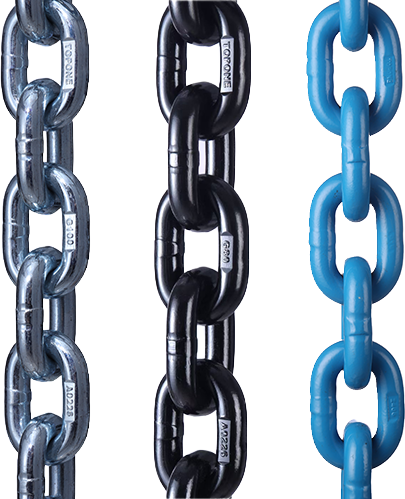
G80 chain strength is one of the main reasons Grade 80 alloy steel chains are widely used in industrial lifting and rigging. From construction machinery to heavy equipment installation, these chains provide rated lifting performance through a combination of alloy steel materials, controlled manufacturing, and heat treatment.
But what does G80 strength actually mean? Is it the same as breaking strength? How does it relate to Working Load Limit (WLL), and why can't an ordinary steel chain of the same diameter be used as a substitute?
Understanding these differences is essential when evaluating Grade 80 chains for heavy-duty lifting applications.
What Does G80 Chain Strength Mean?
G80, also known as Grade 80 or Grade 8, is a strength classification used for certain high-strength alloy steel lifting chains.
The grade designation represents a specified mechanical strength level under the applicable chain standard. It does not mean that every G80 chain can lift the same weight.
The actual lifting capacity depends on the chain diameter, product specifications, and approved working conditions.
Grade 80 chains are manufactured for designated lifting applications and are commonly used in chain sling assemblies with compatible hooks, master links, and connecting components.
Unlike ordinary steel chains intended for cargo restraint or general-purpose use, properly rated G80 lifting chains are designed to meet specific requirements for strength, toughness, manufacturing quality, and lifting performance.
For complete dimensions, available chain sizes, and product ratings, see TOPONE's Grade 80 Lifting Chain.
What Makes G80 Alloy Steel Chains Strong?
The strength of a G80 chain is not determined by steel composition alone. It results from the interaction between material selection, manufacturing processes, link design, and mechanical testing.
1. High-Strength Alloy Steel
G80 lifting chains are commonly manufactured from carefully selected alloy steels.
Depending on the approved manufacturing specification, alloying elements such as manganese, chromium, nickel, or molybdenum may influence the steel's hardenability and mechanical properties.
These elements help manufacturers achieve the desired strength and toughness through controlled production processes.
However, no single alloy composition defines every Grade 80 chain.
The finished chain must meet the applicable Grade 80 performance requirements regardless of the particular approved steel composition.
2. Quenching and Tempering
Heat treatment plays a central role in developing G80 chain strength.
During quenching, the steel undergoes a controlled microstructural transformation that increases its strength and hardness.
Tempering follows to adjust the material's mechanical properties, helping balance high strength with adequate toughness.
This balance is important because lifting chains must withstand tensile loads without becoming excessively brittle.
A chain with high hardness but inadequate toughness may be more vulnerable to cracking or fracture.
Controlled quenching and tempering therefore contribute to the reliability of Grade 80 lifting chains.
For a more detailed explanation, read TOPONE's The Science of Heat Treatment for Lifting Chain Strength.
3. Chain Link Geometry and Weld Quality
Each link in a lifting chain transfers tensile force through contact with adjacent links.
The link's shape, diameter, pitch, and welded section influence how mechanical stresses are distributed.
Proper link geometry helps maintain dimensional consistency and predictable behavior under the intended loading conditions.
Weld quality is equally important.
Defective welds or inconsistent link dimensions can create weak points, even when the steel itself has suitable mechanical properties.
Manufacturing control is therefore essential to achieving the required strength of the finished chain.
G80 Chain Strength vs. Working Load Limit
One of the most common misunderstandings about G80 chains is treating strength, breaking load, and Working Load Limit as interchangeable terms.
These measurements describe different aspects of chain performance.
Working Load Limit (WLL)
The Working Load Limit is the maximum load permitted for a chain under its specified operating conditions.
For a particular Grade 80 chain, the WLL is established according to its size, applicable standard, and manufacturer rating.
WLL is the value users must follow when selecting a chain for lifting.
Minimum Breaking Force
Minimum Breaking Force describes a specified minimum force that the chain must withstand in the relevant breaking test.
It is substantially higher than the chain's rated working load.
However, this does not mean the chain can be operated above its WLL.
The difference between breaking force and working load provides a defined design margin, not permission to overload the equipment.
Proof Test Force
Proof testing is used to verify mechanical performance under a specified test procedure.
A proof test applies a load above normal working conditions without being intended to break the chain.
Proof test force must not be confused with either the WLL or minimum breaking force.
Understanding the G80 Chain Safety Factor
For Grade 80 lifting chains manufactured to EN 818-2, a commonly specified design factor is 4:1, meaning the minimum breaking force is approximately four times the specified WLL.
For example, an appropriately rated Grade 80 chain with a WLL of 2 tonnes under this rating system has a minimum breaking force corresponding to approximately four times that working load.
This relationship does not mean the chain can safely lift four times its WLL.
The applicable design factor must always be confirmed for the particular chain and standard.
Furthermore, the capacity of a complete chain sling may be lower than a simple calculation based on the chain alone because of sling angles, fittings, and configuration requirements.
LL or minimum breaking force.
Does Chain Diameter Affect G80 Strength?
Yes. Chain diameter strongly influences the load-bearing capability of a lifting chain.
A larger nominal diameter generally provides a greater metallic cross-sectional area.
For chains of the same grade and comparable design, this typically results in a higher rated lifting capacity.
However, diameter alone does not establish WLL.
Link dimensions, manufacturing requirements, mechanical properties, and the approved product rating must also be considered.
For example, TOPONE's published Grade 80 product specifications include different working load ratings for different chain diameters.
An 8 mm G80 chain and a 10 mm G80 chain share the same strength grade, but the larger chain has a higher rated capacity under comparable specifications.
Buyers should therefore use the actual manufacturer's load chart rather than assuming all Grade 80 chains have the same WLL.
G80 Chain Strength Compared with Ordinary Steel Chains
A chain designed for industrial lifting must satisfy different requirements from a chain intended for securing cargo or general use.
Comparison | G80 Lifting Chain | Ordinary General-Purpose Chain |
Intended Use | Approved lifting and rigging | Application-dependent |
Material | Specified heat-treated alloy steel | Varies by product |
Strength Classification | Grade 80 | Depends on chain grade |
Overhead Lifting | Suitable when correctly rated and used | Not suitable unless specifically rated for lifting |
WLL | Established under applicable lifting requirements | Depends on intended product specification |
Verification | Applicable manufacturing and testing requirements | Requirements vary |
A general-purpose chain may appear thick and durable, but appearance does not establish its suitability for overhead lifting.
Likewise, Grade 70 transport chain is normally intended for cargo restraint and must not automatically be used as a lifting chain.
The correct chain must be specifically rated and approved for the intended application.
For further information about chain classifications, see Chain Grades & Markings: Understanding the Strength Behind the Numbers
How Is G80 Chain Strength Used in Heavy-Duty Lifting?
The strength of Grade 80 alloy steel chains makes them useful in appropriately designed industrial lifting assemblies.
Construction and Structural Steel Lifting
G80 chains are widely used in rated lifting sling configurations for structural steel, prefabricated components, and construction machinery.
Their rated strength supports different lifting arrangements when the chain and connected components are suitable for the intended load.
Heavy Machinery Installation
Manufacturing plants and maintenance teams use G80 chain slings to handle motors, gearboxes, pumps, and industrial equipment.
In these applications, load balance and sling geometry are particularly important.
Even when individual chain legs have sufficient rated strength, the complete sling must be evaluated according to its lifting angles and load distribution.
Shipbuilding and Marine Equipment Maintenance
Grade 80 chain slings may be used for suitable marine machinery lifting and shipyard maintenance operations.
However, high chain strength does not automatically provide corrosion resistance.
The chain's surface finish, environmental exposure, and maintenance procedures must be considered separately.
Mining Equipment Maintenance
G80 chain sling assemblies can support the handling of heavy mechanical components during mining equipment installation and maintenance.
Dust, wear, and demanding operating conditions may require additional attention to inspection and equipment condition.
For these applications, TOPONE provides different configurations in its Chain Lifting Slings range.
What Can Reduce G80 Chain Strength in Service?
Even a properly manufactured Grade 80 chain can become unsuitable for lifting after damage or excessive deterioration.
Excessive Wear
Repeated contact between chain links may gradually remove material.
As the remaining metal cross-section decreases, the chain may no longer satisfy its intended service requirements.
Chain Deformation or Elongation
Visible link stretching, bending, or distortion may indicate damage or overloading.
Such defects should be evaluated against the manufacturer's inspection and rejection requirements.
Cracks and Weld Damage
Cracks, particularly around highly stressed areas or welded sections, can seriously affect chain integrity.
A cracked lifting chain must not remain in service.
Corrosion and Environmental Damage
Corrosion can lead to metal loss and localized pitting.
Protective coatings may reduce exposure to certain environments, but they do not make every G80 chain suitable for continuous saltwater, chemical, or severe outdoor service.
Incorrect Loading
Shock loading, twisting, side loading of fittings, and unsuitable sling angles can expose a lifting assembly to forces outside its approved configuration.
The rated strength of the chain alone cannot compensate for an incorrectly designed lifting arrangement.
For more detailed inspection guidance, read TOPONE's How to Measure Lifting Chain Wear and Elongation.
How to Evaluate G80 Chain Strength Before Lifting
Before using a Grade 80 chain, consider the following questions:
Is the chain specifically manufactured and rated for the intended lifting operation?
Can its grade, manufacturer, and applicable rating be identified?
Is the WLL suitable for the load and lifting configuration?
Are the hooks, master links, and other fittings compatible and adequately rated?
Does the lifting angle affect the capacity of the completed sling?
Is the chain free from cracks, excessive wear, deformation, or other rejectable damage?
Are the working environment and operating conditions within the manufacturer's instructions?
The WLL of the complete lifting assembly, rather than the apparent strength of one chain component, must govern the lifting operation.
Frequently Asked Questions About G80 Chain Strength
How strong is a G80 chain?
G80 represents a high-strength alloy steel lifting chain classification. Its actual lifting capacity depends on the chain diameter, applicable standard, and manufacturer-approved WLL.
What is the breaking strength of a G80 chain?
There is no single breaking strength for all G80 chains. Minimum breaking force varies with chain size and the relevant product standard.
What is the safety factor of a Grade 80 lifting chain?
A 4:1 design factor is commonly specified for G80 lifting chains manufactured to EN 818-2. The actual requirement must be confirmed against the relevant standard and product specification.
Is G80 chain stronger than Grade 70 chain?
Under comparable nominal size and rating systems, Grade 80 has a higher strength classification than Grade 70. However, standard Grade 70 transport chain and Grade 80 lifting chain are intended for different applications and should not be considered interchangeable.
Can a damaged G80 chain still be used if its WLL is high?
A high original WLL does not make a damaged chain safe. Chains showing rejectable wear, cracks, deformation, or other defects must be removed from service and evaluated according to the applicable inspection requirements.
Conclusion
G80 chain strength comes from more than the use of high-strength steel. Alloy selection, heat treatment, link geometry, welding quality, and manufacturing verification all contribute to the finished chain's lifting performance.
The most important distinction is between strength and allowable working load. Breaking force describes a mechanical performance limit, while WLL establishes the permitted loading under specified conditions.
For industrial lifting, a chain's grade and apparent strength should never replace proper WLL verification, compatible rigging components, and routine inspection.
To review detailed G80 chain sizes, working load ratings, material options, and available finishes, explore TOPONE's Grade 80 Lifting Chain product page.
Understanding these fundamentals helps buyers and lifting professionals evaluate G80 chains based on verified performance rather than appearance or general strength claims.