Choosing between a 1 leg, 2 leg, and 4 leg chain sling is not simply a matter of choosing more sling legs for a heavier load. The correct configuration depends on the load weight, number and position of lifting points, center of gravity, sling angle, required Working Load Limit (WLL), and the stability needed during lifting.
When comparing a 1 leg vs 2 leg chain sling, the most obvious difference is the number of connection points. However, adding more legs changes the load distribution and lifting geometry, which means capacity cannot be calculated simply by multiplying the capacity of one chain leg.
A 4 leg chain sling provides additional connection points and can improve load control for large loads, but it does not automatically mean that all four legs share the load equally.
The practical selection principle is:
Load Geometry → Lifting Points → Number of Legs → Sling Angle → Required WLL → Chain Grade and Diameter
Understanding this relationship makes it easier to select a chain sling based on the actual lift rather than the number of legs alone.
What Is the Difference Between 1 Leg, 2 Leg and 4 Leg Chain Slings?
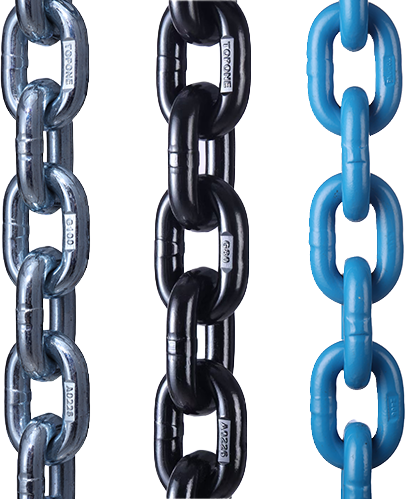
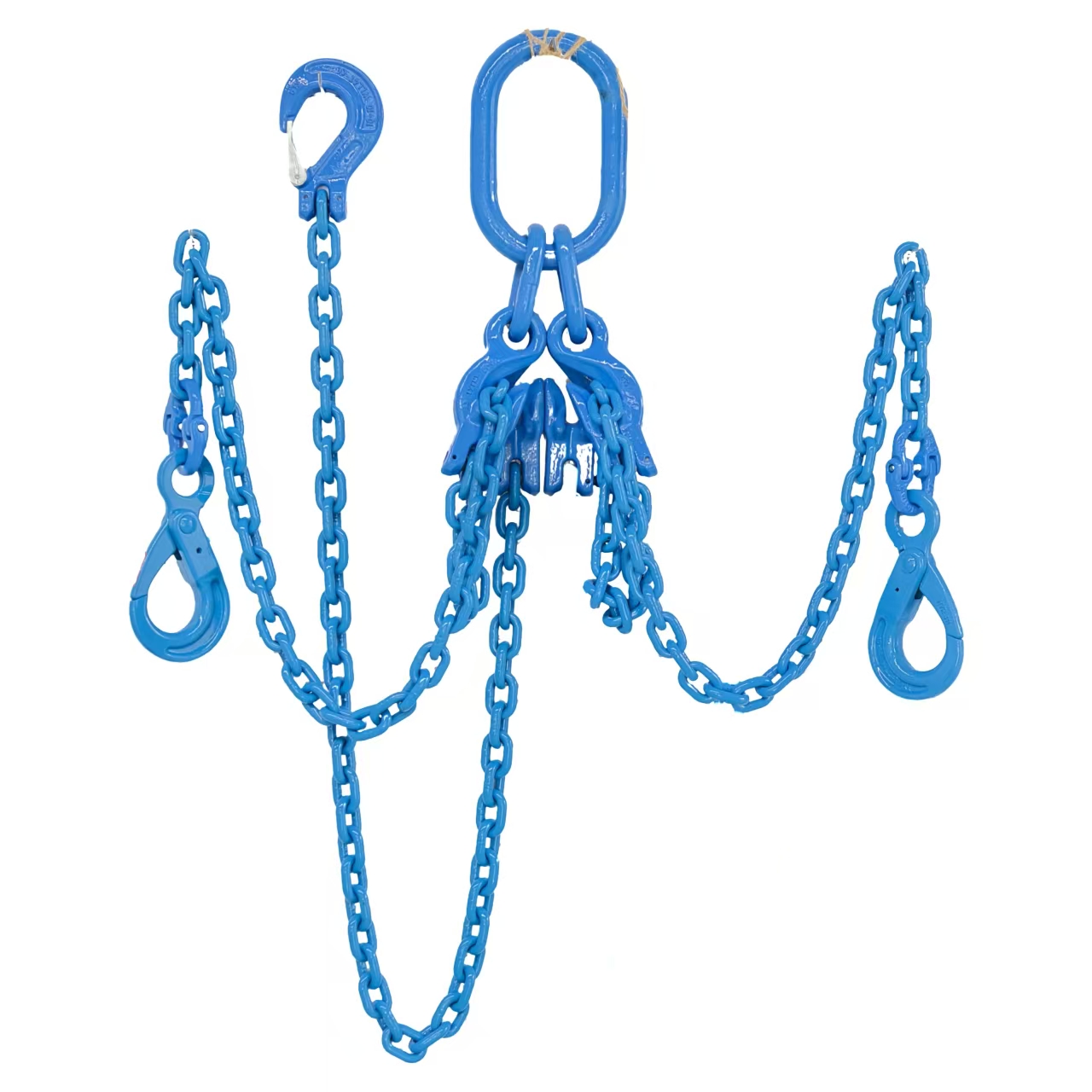
A chain sling consists of alloy steel lifting chain combined with compatible components such as a master link, connecting links, hooks, and shortening devices. The number of chain legs determines how many primary connections the sling can make between the lifting device and the load.
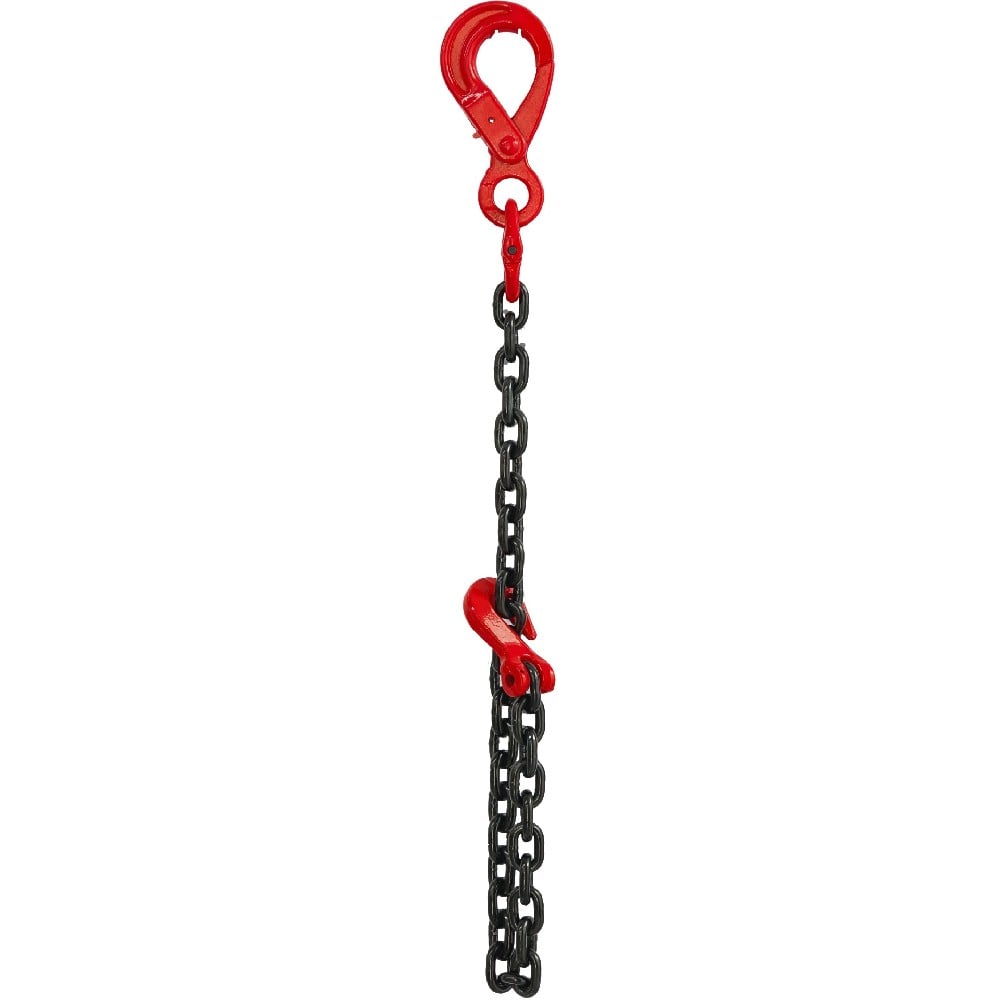
A 1 leg chain sling provides one direct load path. It is commonly used when the load has one suitable lifting point or when an individual component needs to be lifted vertically.
A 2 leg chain sling divides the lifting arrangement between two connection points. This configuration is useful for loads that need greater stability or have two designated lifting points.
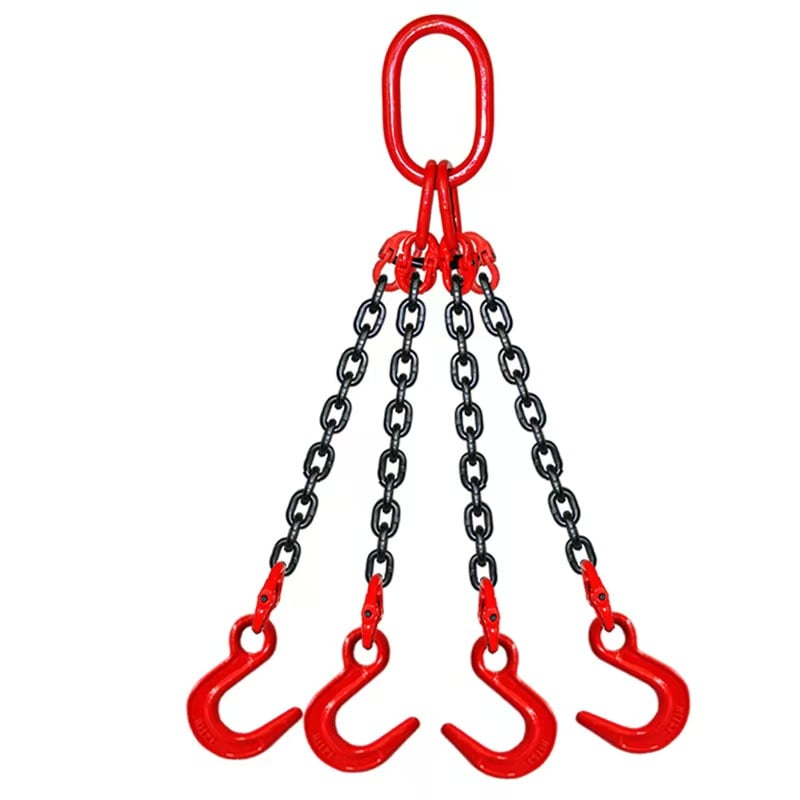
A 4 leg chain sling connects to four lifting points and is commonly associated with larger or more complex loads where additional control and stability are required.
The main differences can be summarized as follows:
Feature | 1 Leg Chain Sling | 2 Leg Chain Sling | 4 Leg Chain Sling |
Number of chain legs | 1 | 2 | 4 |
Typical lifting points | 1 | 2 | 4 |
Load control | Basic | Improved | High for suitable loads |
Sling angle effect | Usually limited | Important | Very important |
Load distribution | Direct | Between two legs | Depends on geometry and configuration |
Typical load geometry | Compact/simple | Long or two-point loads | Large/multi-point loads |
Selection complexity | Lower | Medium | Higher |
The number of legs should therefore match the load geometry and available lifting points, not simply the load weight.
For example, a heavy component with one engineered lifting eye may be suitable for a single-leg sling, while a lighter but long fabricated structure may require two or four lifting points to remain stable.
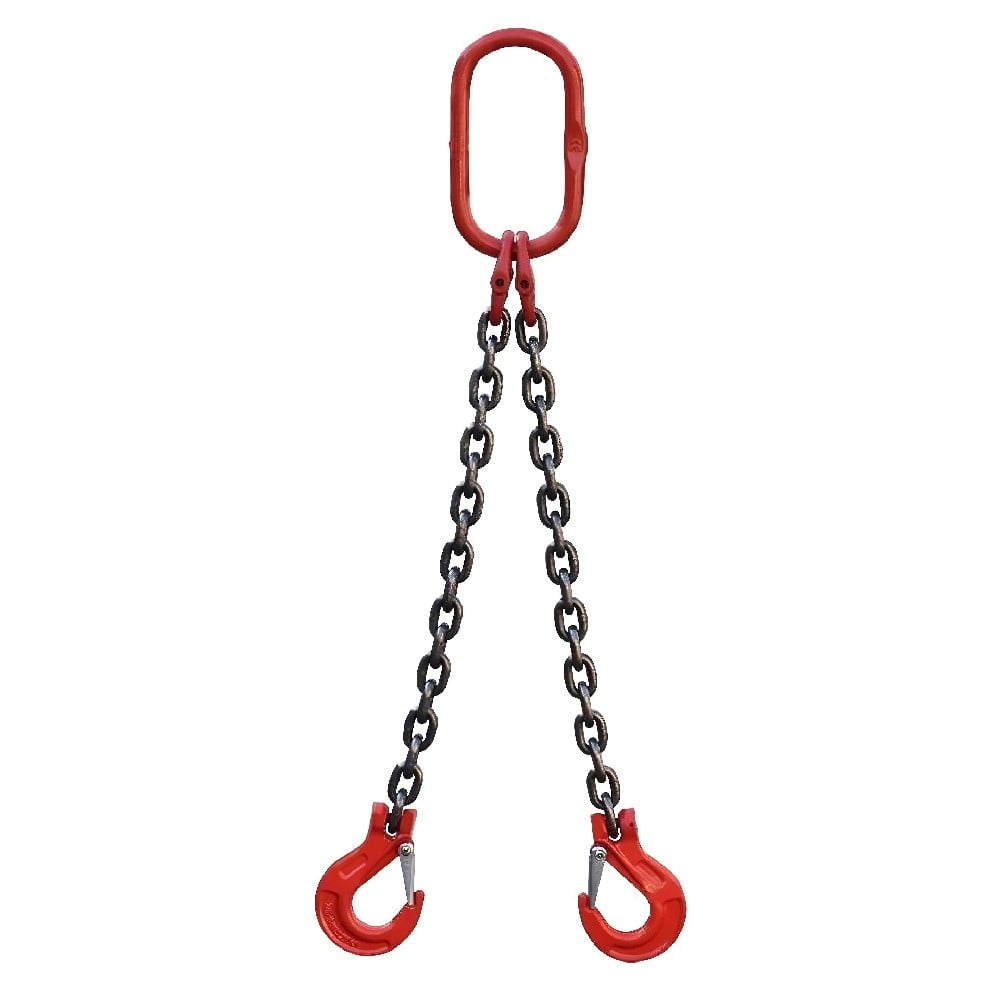
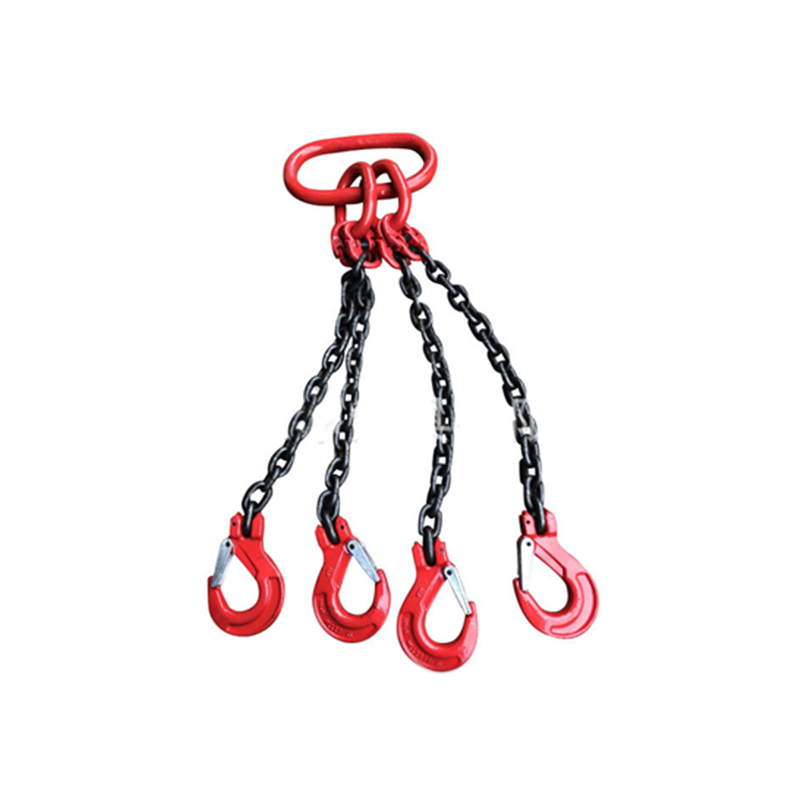
1 Leg vs 2 Leg Chain Sling: How Does Capacity Change?
The difference between a 1 leg vs 2 leg chain sling becomes especially important when comparing lifting capacity.
With a single-leg sling used vertically, the load path is relatively straightforward. The sling carries the suspended load through one chain leg, and the complete assembly must have a WLL equal to or greater than the intended load.
A two-leg sling behaves differently because the tension in each leg depends on the angle of the sling.
Consider a symmetrical two-leg sling lifting a load with its center of gravity positioned between the two lifting points. A simplified relationship for understanding leg tension is:
Leg Tension = Load ÷ (2 × cos θ)
where θ is the angle of each leg from vertical.
For example, consider a 4,000 kg load:
Angle from Vertical | Approx. Tension per Leg |
0° | 2,000 kg |
30° | 2,309 kg |
45° | 2,828 kg |
60° | 4,000 kg |
The example illustrates why a two-leg sling should not be selected simply by taking the load weight and dividing it by two.
As the legs move farther away from vertical, the tension in each leg increases.
This also explains why:
2 legs do not automatically equal 2 × the capacity of 1 leg.
Actual chain sling capacity should always be taken from the manufacturer's rated WLL table for the applicable chain grade, diameter, number of legs, and sling angle.
The same principle applies when comparing Grade 80 and Grade 100 chain slings. A Grade 100 chain can provide a higher WLL than a Grade 80 chain of the same nominal diameter within comparable rated systems, so the number of legs alone cannot determine capacity.
For example, comparing:
10 mm Grade 80 single-leg sling
with
10 mm Grade 100 two-leg sling
requires more information than chain diameter and leg count. The applicable WLL, angle, components, and complete sling configuration must also be considered.
Does a 4 Leg Chain Sling Carry the Load on All Four Legs?
A common assumption is that a 4 leg chain sling divides the load equally between four legs.
In actual lifting conditions, this should not automatically be assumed.
Load distribution depends on factors such as the location of the center of gravity, lifting point positions, dimensional tolerances, sling leg lengths, and load rigidity.
If one lifting point is slightly higher than another or the center of gravity is not centered between the lifting points, some legs may carry more load than others.
This becomes particularly important when lifting:
Fabricated steel structures
Large machinery
Frames
Molds
Containers
Heavy industrial assemblies
Loads with irregular centers of gravity
A four-leg sling can provide excellent load stability because it connects the lifting device to multiple points. However, more stability does not automatically mean four equal load shares.
For symmetrical loads with properly positioned lifting points, the manufacturer's rated four-leg sling capacity should be used. For nonsymmetrical or unusual lifting arrangements, the load distribution should be evaluated by a competent or qualified person according to the applicable lifting requirements.
This is one of the key differences between selecting a 4 leg chain sling and simply adding additional chains to a lifting arrangement.
The complete assembly must be designed and rated as a multi-leg chain sling.
How to Choose Between a 1 Leg, 2 Leg and 4 Leg Chain Sling
The best way to choose the number of sling legs is to start with the load rather than the sling.
First, identify the weight, dimensions, center of gravity, and available lifting points. These factors usually indicate which configuration is practical before chain diameter or grade is selected.
When to Choose a 1 Leg Chain Sling
A single-leg sling is appropriate when the load has one suitable lifting point and does not require multiple connection points for stability.
Typical examples include individual machinery components, lifting fixtures, maintenance loads, and components with a central lifting eye.
The main advantages are a simple configuration, lower sling weight, easier handling, and straightforward inspection.
However, a single connection point provides less control over long or irregular loads. If the load can rotate, tilt, or become unstable around the lifting point, a multi-leg arrangement may be more appropriate.
When to Choose a 2 Leg Chain Sling
A two-leg sling is suitable when a load has two appropriately positioned lifting points.
This arrangement can provide better balance and control than a single-leg sling and is commonly used for machinery, beams, fabricated components, and other loads where two-point lifting is practical.
The main consideration is the sling angle.
The distance between the lifting points and the length of the chain legs determine the working angle. As this angle increases from vertical, the tension in each leg increases.
This means chain sling length and capacity should be evaluated together.
A longer two-leg sling can sometimes produce a more favorable leg angle, but available headroom and lifting height must also be considered.
When to Choose a 4 Leg Chain Sling
A four-leg sling is generally considered when the load has four suitable lifting points and requires additional stability.
Large rectangular machinery, frames, fabricated structures, and other loads with four engineered lifting points are common examples.
The configuration can reduce unwanted movement and provide better control of large loads, but it also introduces more variables.
All four legs should have suitable reach, the hooks must fit the lifting points correctly, and the center of gravity must be considered. For unusual or nonsymmetrical loads, the actual load distribution requires additional evaluation.
A practical comparison is:
Lifting Condition | Usually Consider |
One central lifting point | 1 Leg |
Two lifting points | 2 Leg |
Long load requiring balance | 2 Leg |
Four designed lifting points | 4 Leg |
Large load requiring additional stability | 4 Leg |
Irregular center of gravity | Engineered/assessed configuration |
Limited headroom | Review sling length and angle before selection |
These are configuration guidelines rather than universal capacity rules. The final selection must still meet the required WLL.
Chain Grade, Diameter and Components Still Determine the Final Sling
Once the number of legs has been selected, the next step is determining the required capacity and chain specification.
Grade 80 and Grade 100 alloy steel chains are widely used for chain sling assemblies. The appropriate grade depends on required WLL, chain diameter, component compatibility, sling weight, and applicable standards.
Chain diameter should be selected from the rated WLL table rather than estimated from the number of legs.
The selection sequence should therefore be:
Number of Legs → Sling Angle → Required WLL → Chain Grade → Chain Diameter
For example, moving from a single-leg sling to a two-leg sling does not mean that the chain diameter should automatically become smaller. The final size depends on the WLL assigned to that specific configuration.
The complete sling must also be considered.
A typical multi-leg chain sling may contain:
Master Link → Intermediate Links → Chain Legs → Connecting Links → Hooks
Shortening clutches or other components may also be included where adjustment is required.
Every load-bearing component must be compatible with the chain and appropriate for the rated sling assembly. Installing a stronger chain does not increase the WLL if another component has a lower rating.
Chain sling length is also important. Multi-leg slings need sufficient reach to connect to the lifting points while maintaining an appropriate angle. A sling that is too short can increase the angle from vertical and therefore increase leg tension.
This is why chain sling selection, chain sling length, and chain sling diameter should be considered as connected decisions rather than separate specifications.
1 Leg vs 2 Leg vs 4 Leg Chain Sling Selection Checklist
Before deciding which chain sling configuration to use, gather the basic information about the lift.
Selection Factor | What to Determine |
Maximum load | Heaviest intended load |
Center of gravity | Position relative to lifting points |
Lifting points | Number, location and suitability |
Number of legs | 1, 2 or 4 depending on load geometry |
Sling angle | Angle of multi-leg slings from vertical |
Required WLL | Rated capacity for actual configuration |
Chain grade | Grade 80, Grade 100 or applicable grade |
Chain diameter | Selected from WLL table |
Sling reach | Required finished length |
Hooks | Type and compatibility with lifting points |
Master link | Compatible with crane hook and sling legs |
Environment | Temperature, corrosion, chemicals and abrasion |
Identification | Grade, WLL and traceability as applicable |
The most important point when comparing a 1 leg vs 2 leg chain sling is that the number of legs does not determine capacity by itself.
A single-leg sling can be the correct solution for a heavy load with one properly designed lifting point, while a two-leg or four-leg sling may be necessary for a lighter load that requires additional stability.
For a practical selection, follow this order:
Identify the Load → Locate the Lifting Points → Choose the Number of Legs → Determine the Sling Angle → Establish Required WLL → Select Chain Grade and Diameter → Verify All Components
Choose the configuration that fits the geometry of the lift first. Then select the chain and components required to achieve the necessary rated capacity.
That approach provides a much more reliable basis for choosing between 1 leg, 2 leg, and 4 leg chain slings than simply assuming that more legs always mean more lifting capacity.