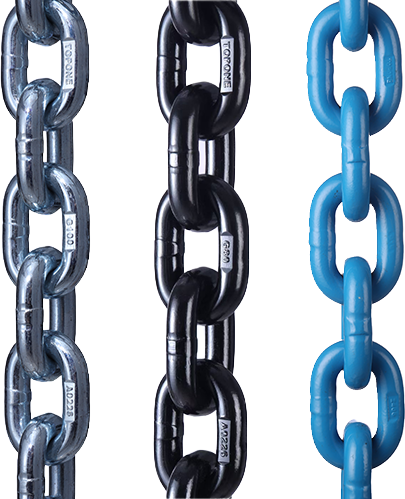
A heavy duty chain for lifting is designed to handle demanding industrial loads in construction, machinery installation, manufacturing, mining maintenance, and other heavy lifting operations. Unlike ordinary steel chains, lifting chains are manufactured and rated for specific lifting applications, with controlled material properties, link dimensions, heat treatment, and mechanical performance.
Grade 80 (G80) and Grade 100 (G100) alloy steel chains are widely used in industrial lifting systems. Although both grades are suitable for approved lifting applications, they offer different working load capacities and may be selected for different operating requirements.
This guide explains heavy duty lifting chain grades, Working Load Limit (WLL), materials, manufacturing processes, applications, and important factors to consider before selecting a chain for industrial lifting.
What Is a Heavy Duty Chain for Lifting?
A heavy duty chain for lifting is a high-strength steel chain specifically designed for approved lifting and rigging applications. It is commonly used as part of a chain sling assembly connecting a crane or hoist to a suspended load.
Industrial lifting chains generally feature short-link construction, heat-treated alloy steel materials, and controlled dimensional and mechanical specifications.
Their performance depends on several factors:
Chain Grade: Defines the chain's strength classification.
Chain Diameter: Influences the rated capacity and physical dimensions.
Material: Determines how the chain responds to manufacturing, heat treatment, and operating stresses.
Working Load Limit: Identifies the allowable load under specified conditions.
Lifting Configuration: Determines how forces act on the chain and connected components.
Manufacturing Quality: Includes welding, heat treatment, dimensional control, and required mechanical testing.
Unlike Grade 70 transport chains, which are primarily used for cargo securement, properly rated alloy steel lifting chains are intended for suitable overhead lifting operations.
However, not every chain marked as heavy duty is suitable for lifting. Product identification, applicable standards, and the manufacturer's rated load information must always be verified.
For available product grades and configurations, explore TOPONE's Lifting Chain product range.
Heavy Duty Lifting Chain Grades: G80 vs G100
Grade 80 lifting chain is widely used in construction, industrial rigging, manufacturing, and machinery handling.
It is manufactured from suitable heat-treated alloy steel and designed to provide the mechanical strength and toughness required by its applicable lifting specification.
Common applications include:
General industrial chain slings
Structural steel installation
Machinery maintenance and equipment handling
Workshop and factory lifting operations
Compatible multi-leg lifting assemblies
Grade 80 chains are commonly selected when the required WLL can be achieved with an acceptable chain diameter, weight, and sling arrangement.
For complete chain specifications, see TOPONE's Grade 80 Lifting Chain.
Grade 100 Heavy Duty Lifting Chain
Grade 100 lifting chain provides a higher nominal strength classification than Grade 80.
Under comparable rating systems and equivalent chain sizes, Grade 100 generally offers approximately 25% higher WLL than Grade 80.
This can be useful when higher load capacity is required without increasing the nominal chain diameter.
Grade 100 chains may also help reduce the weight of the chain itself when an appropriately rated smaller diameter can meet the same lifting requirement.
Typical applications include heavy machinery lifting, industrial equipment installation, and other operations where capacity and handling efficiency are important.
Explore TOPONE's G100 Lifting Chain for available dimensions and technical specifications.
G80 vs G100: Which Grade Should You Choose?
Comparison | Grade 80 | Grade 100 |
Material | Heat-treated alloy steel | Heat-treated alloy steel |
Strength Classification | Grade 80 | Grade 100 |
Relative WLL | Standard comparison baseline | Approximately 25% higher at equivalent diameter under comparable ratings |
Chain Weight | Depends on diameter | May allow a smaller chain for the same required WLL |
Typical Applications | General industrial lifting | Higher-capacity or weight-sensitive lifting |
Fittings | Compatible rated lifting components | Compatible rated lifting components |
Selection Basis | Required WLL and complete assembly rating | Required WLL and complete assembly rating |
A higher chain grade is not automatically necessary for every lifting operation.
The correct choice depends on load weight, required sling configuration, available headroom, attachment points, operating environment, and the ratings of the complete lifting arrangement.
Heavy Duty Lifting Chain WLL and Specifications
The Working Load Limit (WLL) is the maximum load permitted for lifting equipment under the manufacturer's specified operating conditions.
WLL must not be confused with minimum breaking force or proof-test load. These terms describe different performance requirements.
G80 and G100 Lifting Chain WLL Comparison
The following selected values are based on TOPONE's published G80 and G100 product tables.
Chain Diameter (mm) | G80 Reference WLL (t) | G100 Reference WLL (t) |
6 | 1.12 | 1.40 |
8 | 2.00 | 2.50 |
10 | 3.15 | 4.00 |
13 | 5.30 | 6.80 |
16 | 8.00 | 10.00 |
Note: Values refer to the published chain ratings for the stated nominal diameters, under straight loading conditions. They are not universal WLL ratings for completed multi-leg chain slings. Final ratings must be verified for the actual product, fittings, sling configuration, and applicable standard.
For detailed dimensions, pitch, weight, test loads, and other specifications, refer to the corresponding G80 and G100 product pages.
What Affects the WLL of a Lifting Chain?
Several factors influence how a lifting chain can be used within its rated capacity.
Chain Grade and Diameter
The chain's rated WLL depends partly on its grade and nominal diameter.
Sling Configuration
A chain used as part of a single-leg, double-leg, or multi-leg sling must follow the rating of the completed assembly.
Lifting Angle
For multi-leg chain slings, increasing the angle away from vertical increases the tension acting on individual chain legs.
Hooks and Connecting Components
The complete lifting arrangement is limited by the applicable ratings of its components, including hooks, master links, connecting links, and other fittings.
Operating Environment
Temperature, corrosion, abrasion, and chemical exposure may affect suitability and may require additional restrictions or precautions.
A chain should never be selected solely by multiplying the WLL of a single leg by the number of sling legs.
For a detailed explanation, read Why Does Chain Sling WLL Change With the Sling Angle?.
What Materials Are Used in Heavy Duty Lifting Chains?
Material selection is essential because a lifting chain must resist tensile loading while maintaining suitable toughness and durability.
Heat-Treated Alloy Steel
Heavy duty lifting chains commonly use alloy steels designed to achieve the required mechanical properties after controlled heat treatment.
The steel composition influences hardenability, toughness, tensile strength, and resistance to deformation.
Compared with ordinary low-strength chain materials, properly selected and heat-treated lifting chain steels can achieve higher mechanical performance for their intended applications.
Grade 80 Chain Materials
TOPONE's Grade 80 lifting chain product information identifies 20Mn2 and 20MnV alloy steel as material options.
These steels contain alloying elements that contribute to the mechanical properties required for appropriate heat-treated chain production.
The exact material grade should be confirmed for each chain specification and production order.
Grade 100 Chain Materials
Grade 100 chains require material and heat treatment combinations capable of meeting the higher strength classification.
Suitable alloy steel compositions may incorporate chromium, nickel, molybdenum, manganese, or other elements according to the approved design.
These alloying elements influence hardenability and mechanical performance, but a material designation alone does not establish that the finished chain meets Grade 100 requirements.
The final steel grade, manufacturing process, and mechanical test results must correspond to the specified chain product.
Why Quenching and Tempering Matter
Heat treatment is an important stage in the production of high-strength alloy steel lifting chains.
During quenching, the steel undergoes a controlled change in its internal structure to develop strength and hardness.
Tempering then adjusts the material properties to achieve an appropriate balance between strength and toughness.
Poorly controlled heat treatment can result in inadequate mechanical properties, excessive brittleness, or unsuitable performance.
For lifting chains, material selection, welding, heat treatment, dimensional control, and mechanical verification must work together.
Surface Finishes and Corrosion Protection
Depending on the approved product specification, alloy steel lifting chains may be available with different protective finishes.
Common options include self-colored, black-coated, or painted surfaces. Other surface treatments should be evaluated for compatibility with the specific high-strength chain and manufacturing process.
Corrosion resistance must not be assumed from appearance alone. Coating suitability, environmental exposure, and maintenance requirements should be considered before selection.
Applications of Heavy Duty Chains for Lifting
Heavy duty lifting chains are used in industries where loads are large, irregularly shaped, or require controlled handling with rated lifting equipment.
1. Construction and Structural Steel Installation
Construction projects frequently involve lifting steel beams, prefabricated frames, structural components, and suitable construction machinery.
Heavy duty alloy steel chain slings can be used to connect these loads to cranes and other approved lifting equipment.
The selected chain grade, sling configuration, lifting angles, and attachment points must match the lifting plan.
Typical applications: Steel beam installation, prefabricated structure lifting, and construction machinery handling.
2. Heavy Machinery Installation
Industrial machinery often has an uneven center of gravity or multiple lifting points positioned at different heights.
Heavy duty chain slings can be configured with suitable hooks and lifting components to support controlled machinery positioning.
Grade 80 and Grade 100 lifting chains provide different rated capacity options for appropriately designed assemblies.
Typical applications: Industrial motors, generators, gearboxes, pumps, and large manufacturing equipment.
3. Mining and Heavy Equipment Maintenance
Mining operations require regular maintenance and replacement of heavy mechanical components.
Suitable alloy steel lifting chains can be incorporated into lifting arrangements for handling crushers, gearboxes, machinery assemblies, and other heavy equipment components.
Dust, abrasion, and demanding operating conditions make chain inspection and component compatibility particularly important.
Typical applications: Mining machinery maintenance, equipment installation, and replacement of heavy mechanical components.
4. Shipbuilding and Marine Engineering
Shipyards frequently handle steel structures, propulsion equipment, machinery components, and other heavy assemblies.
Heavy duty chain slings may be used in suitable lifting systems for installation and maintenance operations.
Where moisture or salt exposure is present, users should evaluate the chain's protective finish and inspection requirements.
Typical applications: Ship machinery installation, dockside equipment maintenance, and structural component handling.
5. Industrial Manufacturing and Workshops
Manufacturing facilities use lifting equipment to position heavy molds, fabricated steel assemblies, production machinery, and maintenance components.
Chain sling assemblies can accommodate different lifting points and suitable load geometries.
For facilities handling multiple load types, the appropriate sling grade, effective length, hooks, and chain configuration should be selected according to the specific lifting requirements.
Typical applications: Factory maintenance, production equipment handling, and assembly-line machinery positioning.
6. Foundries and Steel Processing
Foundry and steel-processing applications may involve heavy loads and elevated temperatures.
However, standard Grade 80 or Grade 100 chains should not automatically be considered suitable for high-temperature lifting.
Elevated temperatures can affect mechanical properties and may require WLL reductions, special materials, or purpose-designed equipment.
Typical applications: Suitable lifting operations involving industrial castings and steel-processing components, subject to manufacturer-approved temperature limits.
How to Choose a Heavy Duty Chain for Lifting
Before selecting a lifting chain, determine the requirements of the complete lifting operation.
Selection Factor | What to Check |
Load Weight | Maximum suspended weight |
Chain Grade | G80 or G100 |
Chain Diameter | Rated capacity and required dimensions |
WLL | Applicable rating for the selected configuration |
Sling Type | Single-leg, double-leg, or multi-leg |
Sling Angle | Actual lifting geometry |
End Fittings | Compatible hooks and connecting components |
Material | Approved alloy steel specification |
Working Environment | Temperature, corrosion, dust, and abrasion |
Documentation | Product identification, relevant tests, and applicable standards |
The recommended selection sequence is:
Load Weight → Lifting Points → Sling Configuration → Sling Angle → Required WLL → Chain Grade → Chain Diameter → Fittings
The rated lifting arrangement must satisfy all applicable loading conditions.
For additional selection guidance, read How to Choose the Right Chain Sling for Your Load.
Heavy Duty Lifting Chain Manufacturer – TOPONE CHAIN
TOPONE CHAIN manufactures high-strength lifting chains for industrial applications, including Grade 80 and Grade 100 alloy steel chain products.
Its manufacturing facilities include nine automated production lines supporting chain forming, welding, and related production processes.
TOPONE supplies lifting chain options for industrial customers requiring different grades, nominal diameters, lengths, and surface finishes.
For applications involving completed lifting assemblies, customers can also explore TOPONE's Chain Lifting Slings, including suitable single-leg and multi-leg configurations.
When discussing a lifting chain requirement with a manufacturer, important details include:
Intended lifting application
Required chain grade
Chain diameter and length
Working Load Limit
Applicable manufacturing standard
Required surface finish
Sling configuration and fittings, where applicable
Quantity and documentation requirements
These details help establish the appropriate product specification before an order is confirmed.
Safety and Inspection of Heavy Duty Lifting Chains
Heavy duty lifting chains require proper inspection and maintenance throughout their service life.
Before use, inspect the chain and connected lifting components for visible defects.
Common warning signs include:
Cracked or deformed links
Excessive wear between links
Elongation or abnormal link dimensions
Damaged weld areas
Severe corrosion or pitting
Bent or twisted chain sections
Damaged hooks and connecting fittings
Missing or illegible sling identification
The complete sling must remain within its approved WLL under the actual lifting configuration.
Chain slings should not be shortened using knots, bolts, or unapproved methods. Only manufacturer-approved shortening components and arrangements should be used.
Inspection intervals, rejection criteria, proof testing, and any required repair procedures must follow the applicable standards and manufacturer instructions.
Frequently Asked Questions
What is the best grade of heavy duty chain for lifting?
Grade 80 and Grade 100 are both suitable options for appropriately rated lifting applications. Grade 100 generally offers higher capacity at the same nominal chain diameter, while Grade 80 can meet many common industrial lifting requirements.
What does WLL mean for a heavy duty lifting chain?
WLL stands for Working Load Limit. It indicates the maximum permitted working load under the manufacturer's specified conditions. For a completed chain sling, the WLL depends on the entire assembly and its lifting arrangement.
Is G100 stronger than G80?
Yes. Under comparable rating conditions, Grade 100 generally provides approximately 25% higher nominal WLL than Grade 80 at the same chain diameter. The actual capacity must still be confirmed using the relevant product rating.
What material is used for heavy duty lifting chains?
Heavy duty lifting chains commonly use quenched and tempered alloy steel. The exact material depends on the chain grade, manufacturer, product specification, and applicable manufacturing standard.
Can Grade 70 transport chain be used for overhead lifting?
Standard Grade 70 transport chain is intended for cargo securement and must not be substituted for a chain specifically rated and approved for overhead lifting.
Can heavy duty lifting chains be used in high-temperature environments?
Only when the particular chain and sling assembly are approved for the intended temperature. Elevated temperatures may require a reduction in WLL or a different lifting product.
Does TOPONE supply G80 and G100 lifting chains?
TOPONE supplies Grade 80 and Grade 100 alloy steel lifting chains in different nominal sizes. Available configurations, materials, ratings, and supporting documentation should be confirmed for the selected product.
Conclusion
Choosing the right heavy duty chain for lifting requires consideration of chain grade, Working Load Limit, material, chain diameter, sling configuration, and working environment.
Grade 80 chains offer a widely used option for industrial lifting, while Grade 100 chains provide higher nominal capacity at comparable chain sizes. Both grades must be selected and used according to their approved ratings.
For detailed specifications, explore TOPONE's Grade 80 Lifting Chain, G100 Lifting Chain, and Chain Lifting Slings.
Looking for a Heavy Duty Lifting Chain Manufacturer?
Contact TOPONE with your required chain grade, WLL, chain diameter, length, quantity, and application details to discuss a suitable lifting chain solution.
Contact TOPONE to request product information or a quotation.