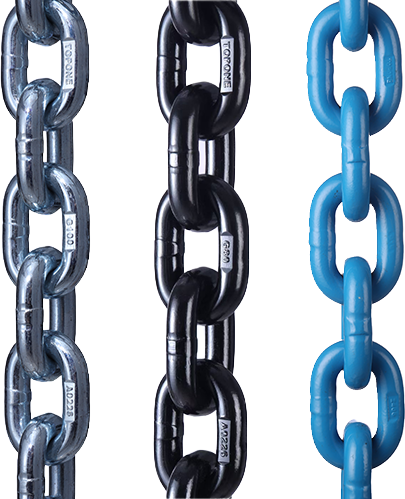
An adjustable chain sling is a versatile lifting solution designed for handling heavy, irregular, or unbalanced loads. Unlike fixed-length chain slings, adjustable lifting chain slings allow operators to shorten individual chain legs using approved shortening clutches, grab hooks, or adjust-a-link systems.
This flexibility is particularly useful in industrial lifting operations where lifting points are uneven, load centers of gravity are offset, or precise load positioning is required.
TOPONE supplies Grade 80 (G80) and Grade 100 (G100) lifting chains and chain sling configurations for construction, machinery installation, shipbuilding, manufacturing, and heavy industrial material handling.
What Is an Adjustable Chain Sling?
An adjustable chain sling is a lifting assembly that allows the effective working length of one or more chain legs to be changed through compatible shortening components.
It is also commonly described as an adjustable lifting chain sling, variable-length chain sling, or adjust-a-link chain sling.
A typical adjustable chain sling includes:
Master Link: Connects the sling assembly to a compatible crane or hoist hook.
Alloy Steel Chain: Grade 80 or Grade 100 lifting chain designed for approved lifting applications.
Shortening Clutch or Grab Hook: Allows controlled adjustment of effective chain length.
End Fittings: Hooks, shackles, or other compatible lifting connectors.
Identification Tag: Provides the rated Working Load Limit (WLL) and required sling identification.
Adjustable slings can be configured with one, two, three, or four legs depending on the intended lifting application.
For available lifting sling types and hook arrangements, explore TOPONE's Chain Lifting Slings.
Key Benefits of Adjustable Chain Slings
1. Flexible Chain Length Adjustment
Shortening components allow operators to adjust the effective length of individual chain legs without replacing the entire sling.
This is especially useful when handling machinery with uneven lifting points, irregular steel structures, or equipment with an offset center of gravity.
2. High-Strength G80 and G100 Alloy Steel
Adjustable lifting chain slings can be manufactured using quenched and tempered Grade 80 or Grade 100 alloy steel lifting chains.
Grade 100 generally provides approximately 25% higher nominal WLL than Grade 80 at the same chain diameter under comparable rating conditions.
However, the final lifting capacity depends on the complete sling assembly, including hooks, shortening devices, chain legs, and lifting angles.
3. Single-Leg and Multi-Leg Configurations
Different sling arrangements are suitable for different lifting requirements:
Single-Leg: Suitable for approved single-point lifting arrangements.
Double-Leg: Suitable for loads with two approved lifting points.
Triple-Leg: Can accommodate suitable three-point lifting configurations.
Four-Leg: Used for loads with multiple lifting points, subject to load distribution and rated sling capacity.
The number of chain legs does not automatically determine the sling's total WLL.
4. Improved Load Positioning
Adjustable chain slings allow operators to alter chain leg lengths to help achieve the required load orientation.
This can make machinery installation, equipment alignment, and irregular-load handling more practical.
5. Custom Lifting Configurations
Chain diameter, effective length, number of legs, master links, shortening components, and end fittings can be selected according to the intended application and approved sling design.
Adjustable Chain Sling Specifications
The following table summarizes common configuration options rather than fixed product ratings.
Parameter | Common Options |
Chain Grade | G80 / G100 |
Chain Diameter | Selected according to required WLL |
Number of Legs | 1 / 2 / 3 / 4 |
Adjustment System | Shortening Clutch / Rated Grab Hook / Adjust-a-Link |
End Fittings | Sling Hook / Self-Locking Hook / Compatible Shackle |
Working Length | Standard or Customized |
Working Load Limit | According to chain grade, configuration, components, and sling angle |
Applications | Construction, Machinery, Marine, Manufacturing, Mining |
The final WLL must be verified using the manufacturer's rated sling configuration and applicable lifting angle table.
Applications of Adjustable Chain Slings
Adjustable chain slings are particularly useful in industries where lifting points, load geometry, and required lifting heights vary between operations.
1. Construction and Steel Structure Installation
In construction projects, adjustable chain slings are used for lifting steel beams, prefabricated frames, structural components, and other suitably equipped loads.
Steel structures often have lifting points at different heights or positions. By adjusting individual chain legs, rigging teams can achieve the required lifting geometry and help maintain the intended orientation during installation.
Typical applications: Steel beam positioning, prefabricated structure installation, and construction machinery handling.
2. Heavy Machinery Installation and Maintenance
Industrial machinery frequently has an uneven center of gravity because motors, gearboxes, and other components are not distributed symmetrically.
An adjustable chain sling allows suitable chain legs to be shortened or lengthened within the approved configuration, helping position the load for installation or removal.
This is especially useful during factory maintenance, equipment replacement, and machinery assembly.
Typical applications: Industrial motors, pumps, generators, gearboxes, and manufacturing equipment.
3. Shipbuilding and Marine Equipment Handling
Shipyards and marine maintenance facilities often handle heavy machinery and structural components in confined or challenging working spaces.
Adjustable lifting chain slings provide flexibility when connecting to lifting points with different heights or when available headroom is limited.
Suitable lifting arrangements may be used for shipboard equipment installation, marine engine handling, and maintenance of mechanical components.
Typical applications: Ship machinery, marine equipment, and shipbuilding components.
4. Manufacturing and Production Lines
Manufacturing facilities use lifting equipment to move dies, molds, machinery components, and fabricated assemblies between workstations.
Adjustable chain slings can support different lifting configurations without requiring a completely different sling for every compatible load.
They are particularly useful where loads have varying attachment positions and must be positioned accurately during assembly.
Typical applications: Production machinery, industrial molds, fabricated parts, and equipment assembly.
5. Warehousing and Industrial Logistics
Adjustable chain slings can be used in suitable overhead lifting operations involving heavy machinery, industrial components, and specialized cargo.
By adjusting chain leg length, operators can accommodate different lifting point arrangements and improve load positioning.
For container or cargo handling, lifting points, spreaders, and sling arrangements must be specifically approved for the intended operation.
Typical applications: Machinery loading, equipment handling, and industrial cargo positioning.
6. Mining and Heavy Equipment Maintenance
Mining operations frequently require lifting large mechanical components during equipment repair and maintenance.
Adjustable chain slings can help accommodate uneven lifting points on gearboxes, mechanical assemblies, and heavy machinery components.
The selected chain grade, fittings, and inspection procedures must be suitable for the operating environment and intended loads.
Typical applications: Mining machinery maintenance, equipment installation, and mechanical component replacement.
7. Steel Plate and Fabricated Component Handling
Steel fabrication workshops handle plates, frames, welded structures, and components with different lifting geometries.
Adjustable chain slings can be combined with compatible rated lifting fittings to achieve appropriate load positioning.
For large or irregular components, adjustment must be based on the load's center of gravity, approved lifting points, and the WLL of the complete system.
Typical applications: Fabricated steel structures, welded assemblies, and heavy industrial components.
How to Select the Right Adjustable Chain Sling
Before choosing an adjustable chain sling, buyers should evaluate several important factors.
Selection Factor | What to Consider |
Load Weight | Actual suspended weight, including lifting accessories |
Chain Grade | G80 or G100 according to required capacity |
Chain Diameter | Approved diameter for the required WLL |
Number of Legs | Suitable for the lifting point arrangement |
Adjustment Mechanism | Compatible rated shortening components |
Working Length | Required lifting height and available headroom |
Hook Type | Connection dimensions and loading direction |
Sling Angle | Rated capacity at the actual lifting angle |
Working Environment | Temperature, corrosion, abrasion, and lifting frequency |
When selecting multi-leg chain slings, remember that uneven load distribution can cause different chain legs to carry different forces.
For additional setup and inspection guidance, read TOPONE's Adjustable Chain Lifting Slings: Setup and Control.
Adjustable Chain Sling Manufacturer – TOPONE CHAIN
TOPONE manufactures Grade 80 and Grade 100 lifting chains and supplies industrial chain sling configurations for various lifting applications.
With nine automated production lines and manufacturing facilities for high-strength chains, TOPONE supports industrial customers requiring different chain sizes, sling arrangements, and lifting components.
Available product configurations include:
G80 and G100 lifting chain assemblies
Single-leg and multi-leg chain slings
Grab hook and shortening arrangements
Different master link and hook configurations
Customized effective lengths according to requirements
For example, TOPONE's Grade 80 Single-Leg Chain Sling with Grab Hook provides an option for applications requiring an adjustable effective chain length.
For loads requiring multiple lifting points, buyers can also explore the Grade 80 Four-Leg Chain Sling with Grab Hooks.
Final sling specifications, approved shortening methods, WLL ratings, and documentation should be confirmed according to the selected assembly.
Frequently Asked Questions
What is the purpose of an adjustable chain sling?
An adjustable chain sling allows operators to change the effective length of its chain legs using approved shortening components. This helps accommodate uneven lifting points, irregular loads, and different lifting geometries.
Are adjustable chain slings suitable for overhead lifting?
Yes, provided the complete sling is rated and approved for the intended lifting operation, inspected properly, and used within its WLL and specified operating conditions.
What is the difference between adjustable and fixed-length chain slings?
A fixed-length chain sling has a predetermined working length, while an adjustable chain sling includes compatible components that allow the effective length to be shortened.
Can adjustable chain slings be used for machinery installation?
Yes. Adjustable chain slings are commonly used for suitable machinery lifting applications where load orientation, lifting point geometry, and positioning requirements make length adjustment useful.
Can TOPONE provide customized adjustable chain sling configurations?
TOPONE accepts inquiries for different chain grades, diameters, effective lengths, leg configurations, and compatible lifting fittings. Technical requirements and final specifications should be confirmed before ordering.
Conclusion
An adjustable chain sling offers a practical solution for lifting irregular loads, balancing equipment, and handling machinery with uneven lifting points. By selecting the correct chain grade, WLL, sling configuration, and adjustment components, industrial operators can achieve more flexible and controlled lifting arrangements.
For construction, machinery installation, manufacturing, shipbuilding, and mining applications, choosing a suitable chain sling configuration is essential for both efficiency and safety.
Looking for an Adjustable Chain Sling Manufacturer?
TOPONE supplies Grade 80 and Grade 100 lifting chain assemblies for industrial applications. Explore our Chain Lifting Slings product range or contact TOPONE for a suitable lifting solution.
To request a quotation, please provide:
Required Working Load Limit (WLL)
Chain grade and diameter
Number of sling legs
Required effective chain length
Preferred hooks or shortening components
Quantity and application requirements
Contact TOPONE today to discuss your adjustable chain sling requirements and request a quotation based on your lifting specifications.