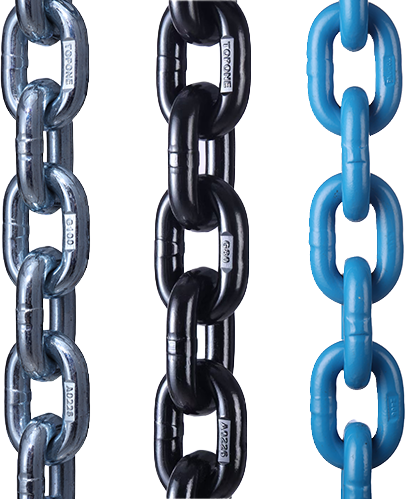
Choosing the correct lifting chain diameter is essential when selecting a chain for lifting applications. A larger diameter generally provides greater load-bearing capability within the same chain grade, but diameter alone does not determine how much a lifting chain can safely carry.
Chain grade, Working Load Limit (WLL), number of sling legs, sling angle, chain configuration, and applicable standard all affect the final selection.
So, how do you choose the right lifting chain diameter?
Start with the required WLL and select a certified lifting chain of the appropriate grade whose rated capacity meets the application. Then use the manufacturer's dimensional and load tables to determine the corresponding chain diameter.
This guide explains the relationship between chain diameter, grade, WLL, and sling configuration so you can make a more informed selection.
What Is Lifting Chain Diameter?
Lifting chain diameter normally refers to the nominal diameter of the steel used to form each chain link.
It is commonly represented by d in chain dimensional specifications.
For example, a lifting chain described as 10 mm Grade 80 has a nominal material diameter of 10 mm. This does not mean that the complete link is 10 mm wide. The outside width, inside width, pitch, and other link dimensions are considerably different from the nominal diameter.
Common lifting chain sizes can include:
6 mm, 7 mm, 8 mm, 10 mm, 13 mm, 16 mm, 20 mm, 22 mm, 26 mm and larger sizes, depending on the chain grade, standard, and manufacturer.
The nominal diameter is an important identification and selection parameter, but it should always be considered together with the chain grade and rated WLL.
Why Chain Diameter Alone Does Not Determine Lifting Capacity
A common mistake is assuming that all lifting chains of the same diameter have the same capacity.
They do not.
Two chains can both have a nominal diameter of 10 mm while having different mechanical properties, grades, manufacturing requirements, and rated capacities.
For example, Grade 80 and Grade 100 lifting chains of the same nominal diameter are not automatically interchangeable.
Grade 100 chain generally provides a higher WLL than Grade 80 chain of the same nominal size when manufactured and rated according to the applicable lifting-chain standard.
This means that a question such as:
“How much can a 10 mm chain lift?”
cannot be answered accurately from diameter alone.
You need to know at least:
Chain grade
Applicable standard
Manufacturer's WLL
Sling configuration
Number of sling legs
Sling angle where applicable
For lifting applications, always select according to a verified WLL rather than estimating capacity from physical size.
Related articles:Chain Grades and Markings Guide
How to Choose the Correct Lifting Chain Diameter
The safest selection process works in the opposite direction from what many buyers expect.
Do not begin by deciding that you need an 8 mm, 10 mm, or 13 mm chain.
Instead, determine the lifting requirement first and allow the required WLL and chain grade to lead you to the appropriate diameter.
Step 1: Determine the Load
Identify the maximum load that the lifting system needs to handle.
If additional lifting equipment forms part of the suspended load, include it where applicable.
Never choose a chain based on the average load when heavier planned loads are also expected.
Step 2: Determine the Sling Configuration
A single-leg chain sling and a multi-leg chain sling do not have the same rated capacity simply because they use the same chain diameter.
Determine whether the application requires:
Single-leg chain sling
Two-leg chain sling
Three-leg chain sling
Four-leg chain sling
You must also determine how the sling will connect to and support the load.
Step 3: Determine the Sling Angle
For multi-leg chain slings, the angle of the sling legs affects the load carried by each leg and therefore influences the rated capacity of the complete sling assembly.
As the sling legs move farther away from vertical, the tension in the individual legs increases.
For this reason, you should never choose lifting chain diameter by simply dividing the load weight by the number of sling legs.
Use the applicable manufacturer's WLL table for the actual sling configuration and angle range.
Step 4: Choose the Chain Grade
Grade 80 and Grade 100 are widely used grades for alloy steel lifting chains.
Grade affects the mechanical properties and rated capacity available from a given nominal diameter.
A higher grade can provide a higher WLL at the same nominal diameter, but this does not mean users can simply substitute one grade for another without checking the complete sling assembly.
Hooks, master links, connecting links, shortening components, and other load-bearing components must be compatible with the selected chain and sling system.
Step 5: Use the WLL Table to Select Diameter
Once you know the load, configuration, angle range, and chain grade, refer to the appropriate manufacturer's WLL table.
The selection principle is:
Required Sling WLL ≥ Maximum Intended Load
Find the required sling configuration in the table and select the first chain size whose rated WLL meets or exceeds the required load.
This is much more reliable than trying to calculate lifting capacity from chain diameter alone.
Related articles:How to Choose the Right Chain for Lifting Applications
How Grade Affects Lifting Chain Diameter Selection
Chain grade can have a major effect on the diameter required for a given lifting capacity.
Grade 80 Lifting Chain
Grade 80 alloy steel chain is widely used in lifting and chain sling assemblies.
It provides a defined relationship between nominal chain size and WLL when manufactured, tested, and rated according to the applicable standard.
Grade 100 Lifting Chain
Grade 100 chain provides higher strength than Grade 80 chain and can therefore provide a higher rated WLL at the same nominal diameter.
This can allow a smaller or lighter chain sling configuration to achieve a required WLL compared with a lower-grade system, depending on the manufacturer's specifications.
However, chain grade must remain identifiable and compatible throughout the sling assembly.
Why You Should Never Identify Grade by Diameter
Diameter is not a grade indicator.
An 8 mm chain cannot be assumed to be Grade 80 or Grade 100 simply by measuring it.
Similarly, a physically large general-purpose chain should never be assumed suitable for overhead lifting.
Identification markings, certification, traceability, applicable standards, and manufacturer specifications are essential when selecting lifting chain.
How Sling Configuration Affects the Required Diameter
The rated capacity of a chain sling depends not only on the chain itself but also on how the sling is configured.
Single-Leg Chain Sling
A single-leg sling provides one direct load path between the lifting point and the load.
Its WLL should be taken directly from the appropriate manufacturer's load table for that chain grade and size.
Two-Leg Chain Sling
A two-leg sling distributes the load between two legs, but the actual force in each leg depends on the sling angle.
It is incorrect to assume that a two-leg sling always provides exactly twice the WLL of a single chain leg.
Three- and Four-Leg Chain Slings
Multi-leg assemblies require additional consideration because load distribution may not be perfectly equal between every leg.
Applicable standards and manufacturer WLL tables account for the configuration when assigning rated capacities.
Do not calculate the required chain diameter simply by dividing the load by three or four.
Basket and Choke Configurations
The way the chain engages the load can also influence its allowable capacity.
If the chain is used in a basket, choke, or other specific configuration, follow the rated-capacity information applicable to that arrangement.
How Chain Sling Configurations Affect Lifting Capacity
How Sling Angle Changes the Required Chain Size
Sling angle is one of the most important factors in multi-leg chain sling selection.
Consider a symmetrical two-leg sling. When the legs are relatively close to vertical, each leg carries less tension than when the legs spread farther outward.
As the angle from vertical increases, leg tension increases.
A simplified relationship for a symmetrical two-leg arrangement is:
Leg Tension = Load ÷ (2 × cos θ)
where θ is the angle of each sling leg from vertical.
For a 4,000 kg load:
Angle from Vertical | Approximate Tension per Leg |
0° | 2,000 kg |
30° | 2,309 kg |
45° | 2,828 kg |
60° | 4,000 kg |
This table illustrates why sling angle matters. It should not be used as a substitute for the manufacturer's rated WLL table or the applicable lifting standard.
At 60° from vertical, each leg in this simplified two-leg example carries tension equivalent to the entire load.
This is why increasing the sling angle can require a larger lifting chain diameter or a different sling configuration.
Common Lifting Chain Diameters and Their Uses
Lifting chains are available in a range of nominal diameters to suit different load requirements.
Rather than assigning a universal capacity to each diameter, it is better to understand them as size categories whose actual WLL depends on grade and standard.
Nominal Diameter | General Size Category | Typical Consideration |
6–8 mm | Smaller lifting chain | Lower-weight sling assemblies and lighter lifting requirements |
10–13 mm | Medium lifting chain | Common industrial lifting and machinery handling |
16–20 mm | Heavy lifting chain | Heavy machinery and industrial lifting |
22 mm and above | Large lifting chain | Heavy engineering and high-capacity lifting systems |
These application descriptions are general only.
A 10 mm chain should never be selected simply because the load appears to fall into a “medium” category. The actual WLL must be verified from the chain grade and manufacturer's load table.
8 mm vs 10 mm Lifting Chain
If both chains have the same grade and comply with the same applicable standard, the 10 mm chain will normally provide a higher WLL than the 8 mm chain.
However, the larger chain is also heavier.
If the 8 mm chain already provides sufficient WLL for the complete sling configuration, moving to 10 mm may add unnecessary sling weight.
10 mm vs 13 mm Lifting Chain
The same principle applies when comparing 10 mm and 13 mm chain.
The larger diameter may provide greater rated capacity within the same grade, but it also affects sling weight and component dimensions.
The correct choice should come from the required WLL rather than a preference for a physically larger chain.
Why Bigger Lifting Chain Is Not Always Better
It is easy to assume that selecting the largest practical chain diameter creates a safer lifting system.
That approach can create other problems.
A larger chain increases the dead weight of the sling assembly. This becomes particularly noticeable with long chain slings and multi-leg configurations.
Larger chain also requires appropriately sized components such as master links, connecting links, hooks, and shortening devices.
Oversizing can therefore increase:
Sling weight – Heavy assemblies are more difficult to handle manually.
Component size – Larger hooks and master links may not fit the intended lifting points.
Cost – Larger chains and components generally require more material.
Handling difficulty – Heavy multi-leg slings can become inconvenient during rigging.
The objective is not to select the largest chain possible.
The objective is to select a chain whose grade, diameter, WLL, and configuration are suitable for the intended lift.
Check the Complete Chain Sling System
Selecting the correct lifting chain diameter does not automatically make the complete sling suitable.
A chain sling can include several load-bearing components:
Master link
Connecting links
Lifting chain
Shortening devices
Hooks
Shackles or other compatible end fittings
The complete assembly must have an appropriate rated capacity.
For example, using a chain with a higher WLL does not increase the capacity of a lower-rated hook installed in the same sling.
The rated capacity of the sling assembly is governed by its approved configuration and applicable component ratings.
This is especially important when replacing individual components. Do not replace a hook, connecting link, or chain with a component simply because it physically fits.
Grade, dimensions, compatibility, WLL, and manufacturer requirements must all be checked.
Standards and Identification Matter
For alloy steel lifting chains, applicable standards define requirements relating to dimensions, mechanical properties, manufacturing, testing, marking, and use.
For example, EN 818-2 covers medium-tolerance chain for chain slings in Grade 8, while other standards and regional requirements may apply depending on the product and market.
A lifting chain should provide clear identification and traceability appropriate to its applicable standard and intended use.
Before selecting a chain, verify:
Chain grade
Nominal diameter
Working Load Limit
Applicable manufacturing standard
Identification and markings
Manufacturer documentation
Compatibility with sling components
Do not use an unidentified chain for lifting simply because its measured diameter appears to match an existing lifting chain.
Likewise, ordinary commercial chain, transport chain, anchor chain, mining chain, and other chain types should not be treated as lifting chain unless they are specifically designed, manufactured, tested, and rated for the intended lifting application.
Lifting Chain Diameter Selection Examples
The following examples show the correct selection logic without assigning universal WLL values to individual chain diameters.
Example 1: Single-Leg Sling
A buyer needs a single-leg sling for a known maximum load.
The correct process is:
Maximum load → Sling configuration → Chain grade → Manufacturer WLL table → Required chain diameter
If an 8 mm chain of the selected grade does not provide sufficient WLL, move to the next suitable diameter shown in the applicable table.
Example 2: Two-Leg Sling
A two-leg sling must lift a machine with the legs operating at an angle.
Do not divide the machine weight by two and select each chain from that number.
Instead:
Determine load → Confirm sling angle → Select two-leg configuration in WLL table → Find required capacity → Select corresponding chain diameter
Example 3: Four-Leg Sling
For a four-leg assembly, do not assume that every leg carries exactly one quarter of the load.
Use the applicable rated-capacity table for the complete four-leg configuration and angle range.
These examples all follow the same principle: determine the required WLL first and chain diameter second.
Lifting Chain Diameter FAQ
What diameter lifting chain do I need?
Determine the maximum intended load, chain sling configuration, sling angle, and required WLL. Then use the applicable manufacturer's WLL table to select a chain grade and diameter that meets the requirement.
How much can a 10 mm lifting chain hold?
Diameter alone is not enough to determine capacity. A 10 mm chain can have different rated capacities depending on its grade, standard, and configuration. Check the manufacturer's WLL rather than using diameter alone.
Is a thicker lifting chain always stronger?
Within the same grade and product system, increasing diameter generally increases load-bearing capacity. However, chains of different grades cannot be compared accurately using diameter alone.
Is Grade 100 chain stronger than Grade 80?
Grade 100 lifting chain provides higher strength and WLL than Grade 80 chain of the same nominal diameter when the chains are manufactured and rated according to the applicable standards. Always verify the manufacturer's load table for the specific product.
Can I replace an 8 mm lifting chain with a 10 mm chain?
Do not substitute chain sizes based solely on diameter. The chain must be compatible with the hoist or sling components and meet the manufacturer's specifications. For chain sling assemblies, hooks, connecting links, master links, and other components must also be compatible with the selected chain.
How do I measure lifting chain diameter?
Chain diameter is measured across the material forming the link rather than across the overall link width. For inspection purposes, follow the measurement method and wear limits specified by the manufacturer or applicable standard rather than relying on a single casual measurement.
How to Choose the Right Lifting Chain Diameter
The most important rule is to select lifting chain by required WLL rather than diameter alone.
A practical selection sequence is:
Maximum load → Sling configuration → Sling angle → Chain grade → Required WLL → Chain diameter → Compatible components
An 8 mm, 10 mm, or 13 mm chain is only a dimensional description until its grade, applicable standard, and rated capacity are known.
For industrial lifting applications, verify the manufacturer's WLL table and ensure that the chain, master links, connecting links, hooks, and other components form a compatible rated lifting system.
Looking for the right lifting chain for your application?
TOPONE supplies lifting chains and chain sling components for industrial lifting applications. Provide the required load, chain grade, sling configuration, working length, and application conditions when requesting a lifting chain so that the appropriate diameter and configuration can be evaluated.
Contact TOPONE to discuss your lifting chain requirements.