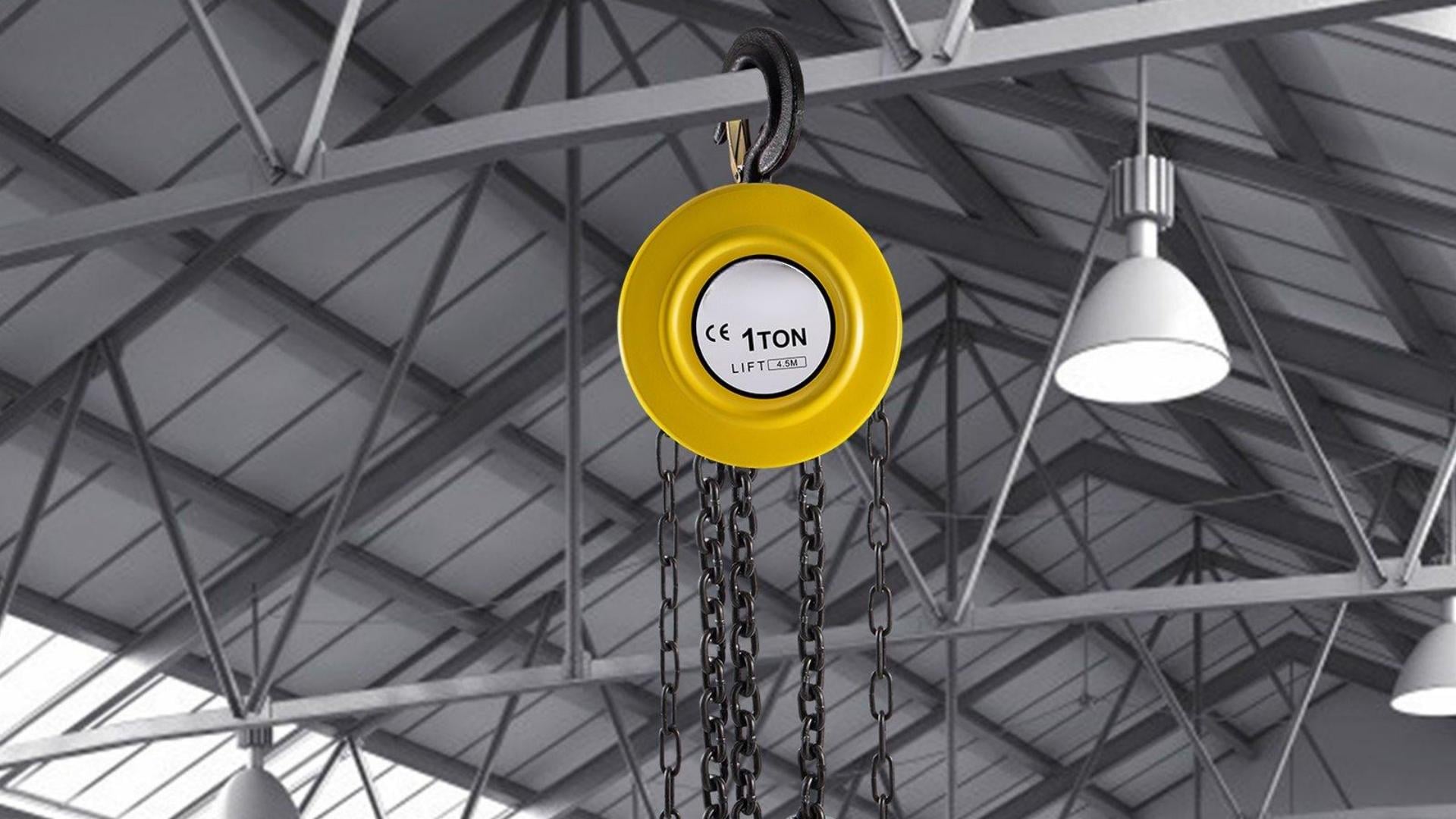
Choosing the correct chain block lifting height is just as important as selecting the right lifting capacity. A chain block may safely support the weight of a machine, but if its lifting height is too short, the load may never reach the required installation position.
This is a common problem when purchasing manual chain hoists for workshops, construction projects, machinery maintenance, and industrial installations. Buyers often know they need a 1 ton, 2 ton, or 5 ton chain block, but they are less certain whether to choose a 3m, 6m, 9m, or custom lifting height.
So, how much lifting height does a chain block actually need? Is a 6-meter lifting height necessary when the suspension point is 6 meters above the floor? And what is the difference between lifting height, headroom, and hand chain length?
This guide explains how to measure the required vertical travel, calculate chain block lifting height, compare available configurations, and avoid common purchasing mistakes.
What Does Chain Block Lifting Height Mean?
A chain block, also called a manual chain hoist or hand chain block, lifts and lowers suspended loads through a manually operated chain mechanism.
The operator pulls a hand chain to drive the internal gears and load chain. The mechanism raises or lowers the load hook while the brake controls the suspended load according to the hoist's design.
Chain block lifting height refers to the maximum vertical distance the lower load hook can travel between its specified lowest and highest operating positions.
This dimension is also called the lift or standard lift in many product catalogs.
What Does a 2 Ton × 3m Chain Block Mean?
A specification such as 2 Ton × 3m normally indicates two separate characteristics:
· 2 Ton: The chain block's rated lifting capacity.
· 3m: The specified maximum vertical travel of the lower hook.
The rated capacity tells you how much load the hoist can handle under its approved operating conditions.
The lifting height tells you how far the load hook can travel.
A 2 Ton × 6m chain block may have the same rated capacity as a 2 Ton × 3m model, but it provides a longer lifting range.
However, the longer lift does not automatically increase the rated load capacity.
Is Lifting Height the Same as Installation Height?
No.
Installation height refers to the position of the suspension point, beam, or supporting structure.
Lifting height refers to the vertical movement of the lower hook.
For example, a chain block installed 6 meters above the floor does not necessarily need a 6-meter lifting height.
If the load only needs to move from a 1-meter-high platform to a position 3 meters above the floor, its required vertical travel may be approximately 2 meters.
The correct lifting height depends on the actual hook travel, not simply the distance between the floor and the overhead beam.
Why Does Lifting Height Matter?
The specified lift determines whether the chain block can reach the required lower and upper positions.
Insufficient lift may prevent the load from reaching its installation point.
Excessively long lifting configurations may introduce unnecessary chain length, weight, handling difficulty, and purchasing cost.
The best choice provides enough vertical travel while remaining suitable for the actual lifting operation.
How Do You Calculate the Required Chain Block Lifting Height?
The most reliable method is to measure the positions that the lower hook must reach during the lifting operation.
Avoid selecting a hoist based only on ceiling height or the dimensions of the load.
Step 1: Identify the Lowest Required Hook Position
Start with the point where the load hook must connect to the lifting arrangement.
For example, a machine may sit on the floor, but its lifting point could be 500 mm above the floor.
The lower hook may therefore need to reach approximately 500 mm above the floor rather than floor level.
Record the actual hook position after considering the lifting attachment.
Step 2: Identify the Highest Required Hook Position
Determine where the lower hook must reach to complete the lifting operation.
Consider the final placement height, load dimensions, rigging arrangement, and clearance required to move or position the equipment.
The load may need to rise above a platform before workers can position it correctly.
Measure the required hook position rather than assuming that the final height of the load equals the height of the hook.
Step 3: Calculate the Required Vertical Travel
Use the following calculation:
Required Hook Travel = Highest Required Hook Position − Lowest Required Hook Position
When both positions use the same reference level, this formula provides the minimum vertical movement required.
For example:
Measurement | Value |
Lowest required hook position | 0.6 m |
Highest required hook position | 4.0 m |
Required vertical travel | 3.4 m |
Required Hook Travel = 4.0 − 0.6 = 3.4 m
A chain block with only 3 meters of rated lifting height cannot cover this full movement.
A longer approved configuration, such as 4m custom lift or 6m standard lift where available, would be needed.
Step 4: Allow for Practical Working Clearance
A small additional allowance can help account for positioning requirements and measurement uncertainty.
For example, a project might specify 0.3m of additional operating travel:
Planning Lift = 3.4m + 0.3m = 3.7m
This 0.3m value is an illustrative planning allowance, not a universal safety requirement.
The actual allowance depends on the worksite, lifting method, equipment design, and available vertical clearance.
A longer hoist cannot overcome insufficient overhead clearance.
Step 5: Verify the Hoist's Actual Travel Range
After calculating the required lift, check the selected manufacturer's data sheet.
Confirm that the lower hook can reach both its lowest and highest required positions without exceeding the hoist's permitted travel limits.
Do not operate against the end of the load chain or rely on a chain-end stop as a normal working position.
Key point: Required lifting height comes from the actual vertical travel of the load hook, not the building height alone.
Chain Block Lifting Height vs. Headroom vs. Hand Chain Length
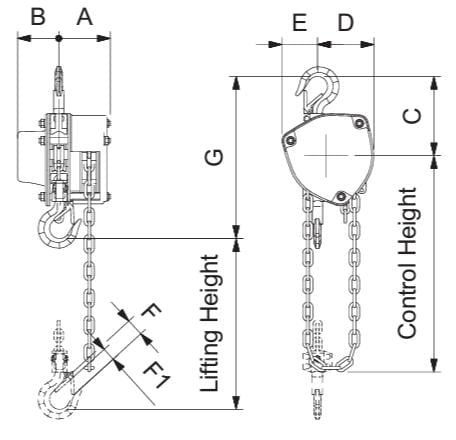
These three specifications describe different dimensions of a manual chain hoist.
Confusing them can lead to ordering a chain block that has sufficient load capacity and lifting height but still cannot operate in the available space.
What Is Chain Block Headroom?
Headroom generally refers to the minimum distance between the suspension point and the lower hook when the lower hook is in its highest permitted position.
For a top-hook-suspended chain block, manufacturers commonly measure this dimension between the load-bearing seats of the upper and lower hooks.
Different suspension configurations, including trolley-mounted hoists, may use different reference points.
For example, the TOPONE HSZ-T 2-ton model has a published minimum distance between hooks of 444 mm.
This dimension represents the vertical space occupied by the hoist when the lower hook reaches its upper position.
If the installation has very limited clearance below the suspension point, headroom can determine whether the operation is possible.
How to Check Available Headroom
Use consistent reference points when comparing suspension height and lower hook height.
Available Hook Clearance = Suspension Point Height − Highest Required Lower Hook Position
The available clearance must accommodate the manufacturer's minimum headroom dimension, with any additional clearance required by the installation.
Consider the following example:
Measurement | Value |
Suspension point height | 4.6 m |
Highest required lower hook position | 3.85 m |
Available hook clearance | 0.75 m |
Selected hoist minimum headroom | 0.444 m |
In this example:
Available Hook Clearance = 4.6 − 3.85 = 0.75 m
The selected hoist's published minimum hook-to-hook distance is 0.444m.
Therefore, the headroom comparison is favorable in this simplified example.
However, the final installation must also account for hook connections, slings, the load's physical dimensions, beam obstructions, and applicable clearance requirements.
If the available clearance were only 0.35m, the same hoist would not provide enough headroom, regardless of whether it had 3m or 6m of lifting height.
What Is Hand Chain Drop?
The hand chain is the chain that the operator pulls to raise or lower the load.
It is different from the load chain, which supports the suspended load.
Hand chain drop describes how far the hand chain hangs from the manufacturer's specified reference point.
For a chain block installed high above the working floor, the hand chain must extend far enough for the operator to reach it from a safe position.
A hoist with 6m lifting height does not automatically have a hand chain that reaches 6m below the suspension point.
Likewise, hand chain drop does not equal the total length of material used to form the continuous hand chain loop.
The operator's working level and the supplier's measurement convention determine the appropriate hand chain drop.
Comparison of the Three Measurements
Parameter | What It Measures | Why It Matters |
Lifting Height | Maximum vertical hook travel | Determines how far the load can move |
Minimum Headroom | Space occupied between suspension and fully raised hook | Determines whether the hook can reach the required upper position |
Hand Chain Drop | Reach of the operating hand chain | Determines whether the operator can safely operate the hoist |
Load Chain Configuration | Arrangement and length of the load-bearing chain | Affects travel, equipment weight, and model compatibility |
Remember: A chain block can have enough lifting height but insufficient headroom, or enough headroom but an unsuitable hand chain drop.
Should You Choose a 3m, 6m, 9m, or 12m Chain Block?
Manual chain blocks are available with different standard and optional lifting heights.
Common purchasing requests include 3m, 6m, 9m, and 12m configurations, although the standard lift varies by manufacturer and product series.
The correct choice depends on the actual required travel, not the assumption that longer is always better.
3m Chain Block Lifting Height
A 3m chain block is useful for many workshop, maintenance, equipment assembly, and machinery installation tasks where the load requires relatively short vertical movement.
Typical applications may include lifting equipment onto workbenches, removing machine components, and positioning parts within industrial workshops.
It is often a practical option when the required hook travel does not exceed the model's rated lift and the installation provides sufficient headroom.
6m Chain Block Lifting Height
A 6m lifting height provides a longer range for applications that require more vertical movement.
It may suit taller industrial buildings, equipment maintenance platforms, elevated installation points, and material handling between different working levels.
However, buyers must still check that the lower hook can reach the starting position and that the hand chain reaches the operator.
A 6m chain block should not be selected solely because the overhead beam is 6 meters above the floor.
9m and 12m Chain Block Lifting Height
Longer lifting heights may be suitable for taller industrial structures, deep maintenance spaces, vertical machinery access, or specialized installation operations.
These configurations require additional attention to load chain length, chain arrangement, equipment weight, and operating conditions.
Longer manual lifting travel can also require more time and physical effort.
For frequent long-distance lifting, a powered hoist may be more practical than a manually operated chain block.
Chain Block Lifting Height Comparison
Lifting Height | Typical Selection Scenario | Main Consideration |
2.5m | Compact workshop lifting | Model availability and sufficient travel |
3m | General industrial maintenance | Check required hook travel and headroom |
6m | Taller workshops and elevated installations | Hand chain reach and chain management |
9m | Long vertical access or specialized maintenance | Model approval and longer manual operation |
12m | High installations or deeper maintenance areas | Equipment weight, handling and operating suitability |
Custom Height | Nonstandard industrial requirements | Manufacturer-approved configuration |
Application examples are general guidance. Availability and suitability depend on the actual chain block model.
Is a Longer Lifting Height Always Better?
No.
A longer lifting height provides additional travel, but it can also increase equipment weight and the amount of chain that must be handled.
For some models, longer lift configurations require additional load chain material and may affect packaging, transport, and storage.
If the selected chain block has multiple load chain falls, the extra chain material required can be greater than the increase in hook travel.
The manufacturer must determine the correct load chain length and arrangement for the requested lift.
Choose enough lifting height for the planned operation without adding unnecessary complexity.
What Lifting Heights Does TOPONE Offer?
TOPONE supplies different manual chain hoist models with varying rated capacities, standard lifts, and minimum hook distances.
The following values come from TOPONE's published HSZ-T hand chain hoist reference specifications.
TOPONE HSZ-T Standard Lifting Height Specifications
HSZ-T Model | Rated Capacity (t) | Standard Lift (m) | Minimum Hook Distance (mm) | Load Chain Falls |
HSZ-T1/2 | 0.5 | 2.5 | 255 | 1 |
HSZ-T1 | 1 | 2.5 | 306 | 1 |
HSZ-T1 1/2 | 1.5 | 2.5 | 368 | 1 |
HSZ-T2 | 2 | 3 | 444 | 2 |
HSZ-T3 | 3 | 3 | 486 | 2 |
HSZ-T5 | 5 | 3 | 616 | 2 |
HSZ-T10 | 10 | 3.5 | 700 | 4 |
The table shows that standard lifting height and minimum headroom change according to the selected model.
For example, the HSZ-T2 and HSZ-T5 both have a published standard lift of 3m, but their minimum hook distances are different.
This is why two chain blocks with the same lifting height may not fit the same installation.
Buyers can compare the full model specifications on TOPONE's HSZ-T Hand Chain Hoist product page.
Are Other Standard Lift Configurations Available?
Yes. Different chain block series may offer different standard lift options.
For example, TOPONE's general Hand Chain Hoist series includes several 3m and 6m reference configurations depending on capacity.
The correct option should be selected from the actual manufacturer's product specification rather than assuming that every model offers identical lifting heights.
For additional capacity and configuration options, see TOPONE's Hand Chain Hoist product range.
Can You Order a Custom Chain Block Lifting Height?
A custom lifting height may be available for selected manual chain block designs.
For example, a buyer might require a 2-ton chain block with an approved lifting height greater than the standard 3m.
In that case, the supplier must confirm the correct load chain, number of falls, end anchorage, chain handling arrangement, and operating hand chain length.
Customization must not compromise the equipment's approved load rating or manufacturer requirements.
Never extend a chain block's load chain by welding additional links or connecting an unapproved chain section.
For replacement or customized hoist chains, the load chain must match the specific hoist design, load wheel geometry, and approved product requirements.
How to Choose the Right Chain Block Lifting Height for Your Application
Selecting the correct lifting height requires a few measurements and a complete understanding of the planned operation.
The following approach helps buyers specify the required equipment.
Start with the Actual Lifting Task
Identify the load, installation area, and lower and upper hook positions.
For example, imagine a maintenance team lifting a 1.4-ton machine in a workshop.
The suspension point is 4.6m above the floor.
The lower hook must travel from 0.65m above the floor to 3.85m above the floor.
The required travel is:
3.85 − 0.65 = 3.20m
A 2-ton chain block may provide suitable rated capacity for the 1.4-ton load, provided the complete suspended load and lifting arrangement satisfy the manufacturer's requirements.
However, the HSZ-T2 standard 3m lifting height would not cover the required 3.20m hook movement.
A longer approved lifting configuration is necessary.
The model's 444mm minimum hook distance must also fit the available installation clearance.
This example shows why capacity, lifting height, and headroom must be checked together.
Check the Complete Lifting Arrangement
After determining the required travel, confirm:
· Maximum suspended load, including appropriate lifting accessories
· Rated chain block capacity
· Minimum and maximum lower hook positions
· Minimum headroom of the selected hoist
· Suspension point and supporting structure
· Operator position and hand chain drop
· Frequency of lifting operations
· Working environment and potential obstructions
· Approved load chain configuration
For a broader discussion of rated load selection, see TOPONE's Chain Block Capacity Guide.
A longer lifting height does not compensate for an undersized hoist, an unsuitable support structure, or an unsafe lifting arrangement.
Avoid These Common Purchasing Mistakes
Mistake 1: Choosing Lifting Height Equal to Ceiling Height
A 6m-high installation does not automatically need a 6m chain block.
Measure the actual vertical movement of the load hook.
Mistake 2: Ignoring Minimum Headroom
A long-lift chain block may still be unable to raise the load high enough because the hoist occupies too much vertical space.
Mistake 3: Confusing Load Chain and Hand Chain
The load chain supports the suspended load, while the hand chain operates the hoist.
Both must have suitable lengths and configurations for the selected installation.
Mistake 4: Assuming Every Model Has the Same Standard Lift
Different chain block models and capacities may have standard lifts of 2.5m, 3m, 3.5m, 6m, or other specified values.
Always check the actual data sheet.
Mistake 5: Extending the Load Chain Without Manufacturer Approval
Unapproved chain extensions or substitutions can create mechanical and safety problems.
Use only the correct manufacturer-approved load chain and configuration.
What Information Should You Send When Requesting a Quote?
A clear technical inquiry should contain the following details.
Requirement | Example |
Rated Capacity | 2 Ton |
Required Lifting Height | 6 m |
Required Hook Travel | 3.2 m |
Suspension Method | Top Hook |
Available Headroom | According to Site Measurement |
Installation Height | 4.6 m |
Operator Working Level | Ground Floor |
Hand Chain Drop | To Be Confirmed |
Working Environment | Indoor Workshop |
Required Quantity | 10 Units |
Additional Requirements | Product Drawing, Instructions, Test Documentation |
These details help the supplier confirm whether a standard chain block is suitable or whether the application requires a different approved configuration.
Frequently Asked Questions About Chain Block Lifting Height
What is the standard lifting height of a chain block?
It depends on the model. Many manual chain blocks use standard lifts around 2.5m or 3m, while other products offer 3.5m, 6m, or additional configurations.
Always check the manufacturer's product specification.
What is the difference between a 3m and a 6m chain block?
The main difference is the maximum vertical distance the lower hook can travel.
A 6m model provides more hook travel than a 3m model of the same rated capacity, assuming both are approved configurations.
The longer lift does not automatically increase the rated load capacity.
Can a 3m chain block lift a load 6 meters above the floor?
Only if the actual required hook movement does not exceed its 3m rated lift and the installation satisfies all headroom and clearance requirements.
A chain block installed 6 meters above the floor does not necessarily need 6 meters of hook travel.
Does lifting height affect the lifting capacity?
Changing the lifting height does not automatically change the marked rated capacity of an otherwise approved chain block configuration.
However, longer lift options can affect chain length, weight, handling, and model suitability.
Always confirm the complete configuration with the supplier.
How do I calculate the required lifting height?
Subtract the lowest required lower-hook position from the highest required lower-hook position.
Then evaluate any practical working allowance and confirm the manufacturer's available rated lift.
Check minimum headroom separately.
Is lifting height the same as chain length?
No.
Lifting height describes lower-hook travel.
Load chain length depends on the hoist's design, chain fall configuration, end anchorage, and other mechanical requirements.
The total load chain material required is not necessarily equal to the specified lifting height.
Can I order a 2 ton chain block with a 6m lifting height?
A 2-ton chain block with 6m lift may be available as a standard or customized option depending on the product series.
The supplier must confirm the exact model, load chain configuration, headroom, and hand chain length.
How long should the hand chain be for a high-mounted chain block?
The operating hand chain must reach the operator's safe working position.
Its required drop depends on the suspension height, working platform, manufacturer's measurement convention, and operating arrangement.
Specify the hand chain drop separately from the load lifting height.
What if the chain block has enough lift but not enough headroom?
A longer lifting height will not solve insufficient overhead clearance.
You may need a different approved hoist configuration, reduced-headroom arrangement, or another engineered lifting method.
Do not modify hooks, attachments, or supporting structures without appropriate approval.
Conclusion: Choose Lifting Height Based on Actual Hook Travel
Selecting the correct chain block lifting height starts with one essential measurement: the vertical distance that the lower hook must travel during the lifting operation.
A 3m chain block may be sufficient for general workshop tasks, while 6m, 9m, 12m, or custom lifting heights may suit applications requiring longer vertical travel.
However, lifting height should never be evaluated on its own.
Rated capacity, minimum headroom, suspension configuration, hand chain drop, load chain arrangement, and working environment all influence the final selection.
By checking these factors together, buyers can avoid ordering a chain block that has enough load capacity but cannot complete the required lifting movement.
TOPONE supplies manual chain blocks and related industrial lifting products, with different capacities and lifting height configurations available according to the selected model.
Need a Chain Block with a Specific Lifting Height?
Provide your required capacity, lifting height, installation dimensions, hand chain drop, order quantity, and operating conditions.
Contact TOPONE CHAIN to discuss available chain block models, custom lifting configurations, technical specifications, and bulk quotations.