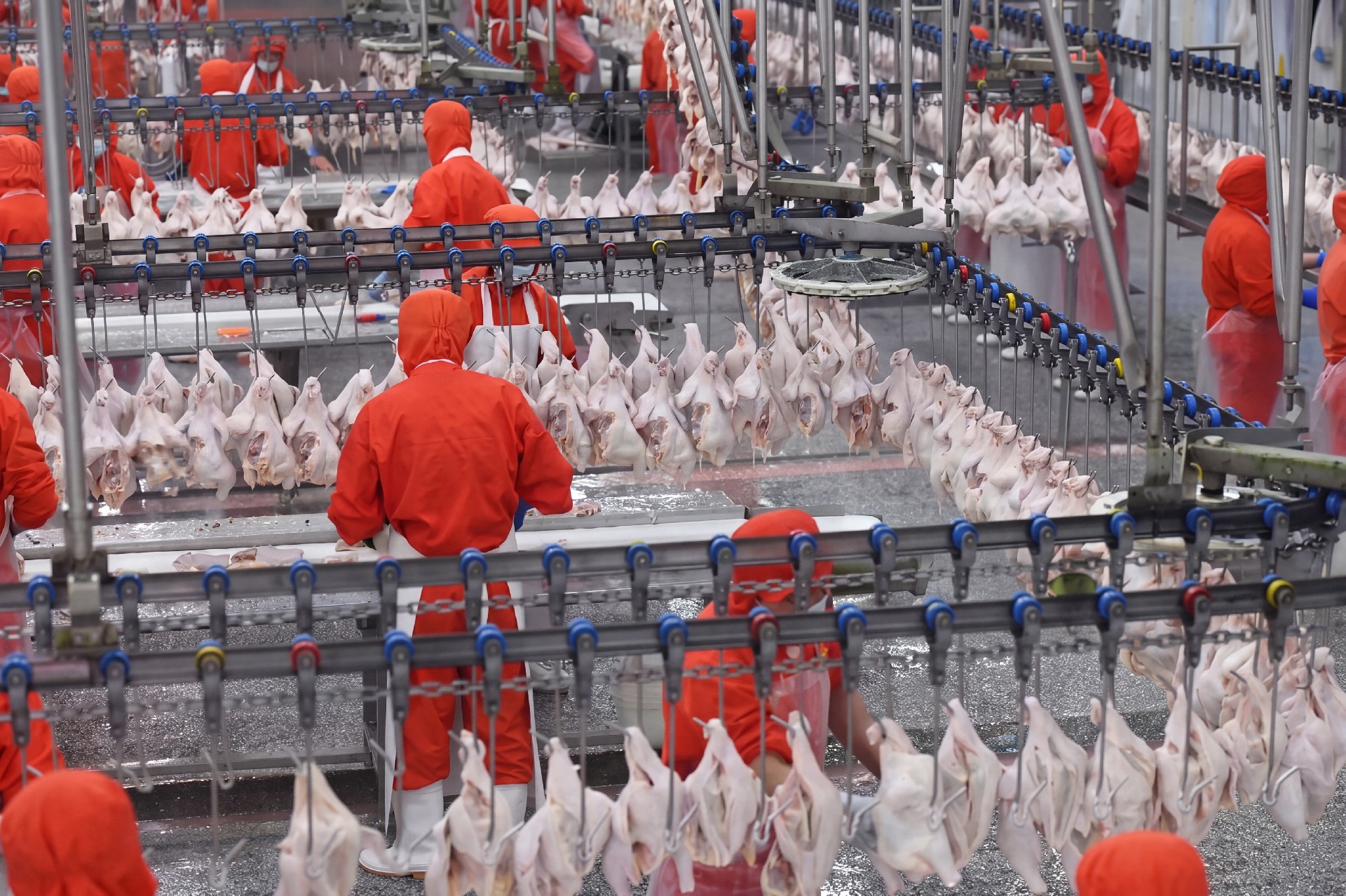
Overhead conveyors move poultry, carcasses, and meat carriers through slaughtering, cleaning, inspection, cutting, chilling, and packaging. The system must combine positioning, load support, corrosion control, and cleanability.
Typical Applications
Poultry slaughter lines
Pig processing plants
Meat cutting facilities
Hanging conveyor systems
Automated processing workshops
Match the Conveyor to the Process
Poultry Shackle Lines
Poultry lines use spaced shackles connected to trolleys or conveyor chain. The chain controls movement while shackles maintain orientation. Pitch error around a long circuit can misalign carriers with transfer or processing stations.
Selection must consider pitch, speed, bends, elevation, washdown, start-stop frequency, and repeated loading of pins, bushes, welds, and attachments.
Pig and Carcass Rail Systems
Trolley wheels and rail commonly carry vertical carcass load, while chain or pushing dogs provide horizontal traction. Calculate chain tension from rolling resistance, inclines, acceleration, curves, take-up force, and jamming—not by treating the chain as a lifting sling.
The hook, trolley axle, wheel, rail joint, support, attachment, chain, sprocket, and brake form one load path. The lowest-rated component governs.
Cutting and Packaging Zones
Components above exposed product require corrosion control and protection against dripping. Select material for water, chlorides, fats, disinfectants, temperature, and cleaning frequency. Stainless steel chain must be supplied without a coating and still requires wear evaluation.
Calculate Throughput and Chain Pull
Line Capacity
For one carrier at each pitch:
Theoretical carriers per hour = 3600 × v ÷ p
v is speed in m/s and p is pitch in metres. As a calculation example, not a project case, a 0.10 m/s line with 0.20 m spacing provides 1,800 carrier positions per hour. Actual output is lower after empty positions, inspection gaps, stops, and rejected product are included.
Process time is t = L ÷ v. Raising speed reduces time in each process zone, so speed cannot be selected from output alone.
Drive Pull
Include loaded and empty trolleys, rail condition, gradients, curves, return chain, acceleration, take-up tension, and starting. Check transient load during braking, transfer, or blockage. Motor, gearbox, torque limiter, chain, attachments, sprockets, shafts, rail, and supports must be rated together.
Select the Correct Chain
Conveyor Chain Is Not Lifting Chain
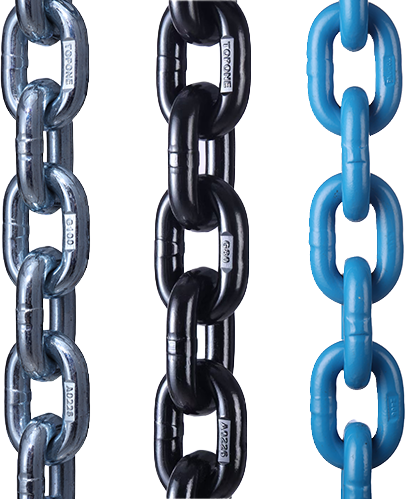
These lines use purpose-designed trolley, forged, rivetless, pin-and-bush, or welded attachment chain. Grade 80 lifting chain does not automatically qualify for continuous conveying.
TOPONE requires a chain drawing or unworn sample. Verify pitch, pin diameter, bearing surface, widths, attachments, trolley spacing, sprockets, and design pull. Minimum breaking force is a test value, not permissible operating pull.
Specify material, manufacturing process, heat treatment, calibration, surface condition, and testing together. Inspect dimensions, articulation, pin or weld integrity, attachment alignment, tensile properties, and traceability.
Hygienic Design
ISO 14159:2002 provides hygienic-design requirements. Components contacting food, or able to drip onto it, should have smooth, cleanable, corrosion-resistant surfaces without inaccessible crevices. Separate dirty and clean zones, control lubricant migration, provide drainage, and prevent residue collecting inside tracks or attachments.
Where incidental lubricant contact is possible, follow ISO 21469:2006. Hygienic lubricant does not replace drip trays, controlled application, or removal of excess oil.
Safety and Inspection
Guard sprockets, take-up units, transfers, and nip points. Provide emergency stopping and isolation according to risk assessment. Secure stored tension and suspended product before maintenance.
Inspect pitch growth, pins, bushes, welds, attachments, hooks, trolleys, wheels, rails, supports, sprockets, take-up travel, corrosion, and lubricant discharge. Reinspect after jams, derailment, overload, emergency stop, or abnormal noise. Apply conveyor-specific discard limits, not a lifting-chain wear percentage.
Information Required by TOPONE
Chain drawing and conveyor arrangement
Product mass and trolley spacing
Speed, output, gradients, curves, and process lengths
Continuous, starting, braking, and jam chain pull
Cleaning chemicals, washdown, and corrosion exposure
Material, lubrication, testing, and traceability requirements