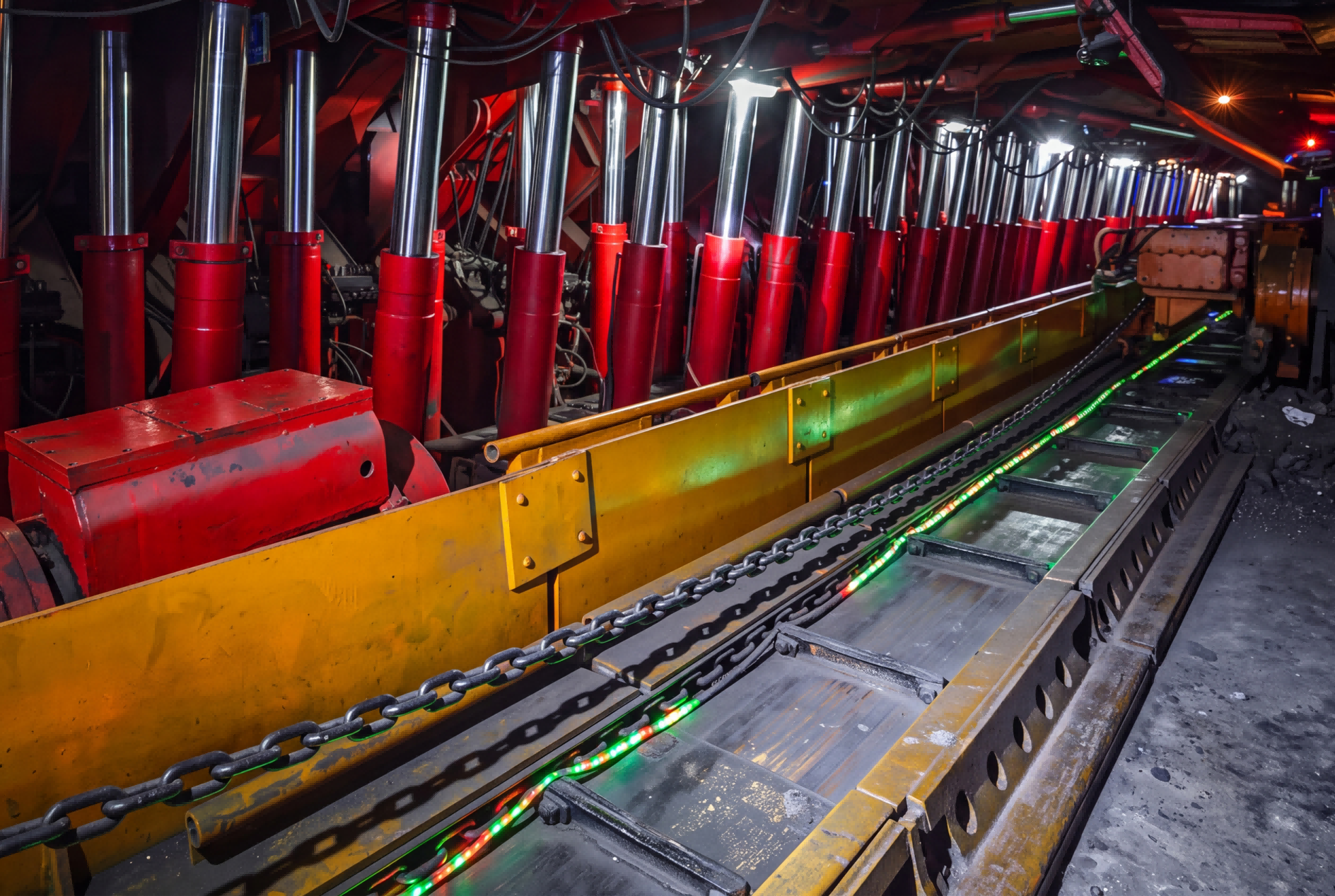
Underground roadways carry cables, ventilation fans, slurry pipes, and instruments above vehicles and personnel. Supports must resist mass, vibration, start-up torque, pipe contents, corrosion, impact, and roof movement. “High-strength chain” alone is not a specification.
Typical Applications
Underground cable suspension
Ventilation system support
Tunnel pipeline installation
Secondary safety protection
Equipment securing
Separate Three Duties
Permanent Suspension
Permanent hangers carry service load continuously. Use tested suspension chain—not conveyor or untested commercial chain. The load path includes the anchor, bracket, chain, connector, equipment lug, and strata. Its lowest-rated element governs.
Restraint and Secondary Protection
A restraint limits movement during vibration or start-up. A secondary chain catches equipment after primary-support failure; it needs an independent approved attachment and minimal slack. It is not personal fall-arrest equipment and cannot be sized from static weight alone.
Select the Correct Chain
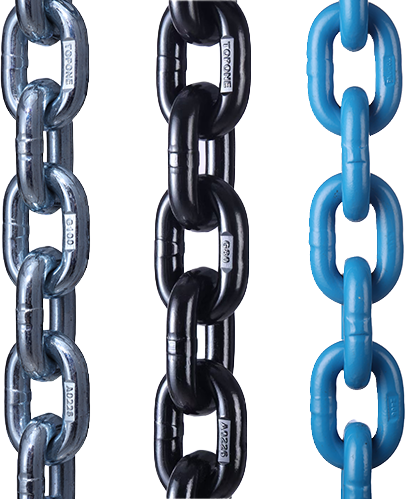
TOPONE DIN 20637 Long-Link Chain
DIN 20637:1997-10 covers tested, long-link round steel chains for mining monorail suspensions. TOPONE’s 16 × 80 mm chain has nominal diameter 16 mm, pitch 80 mm, inside width 22.4 +3/−0 mm, test force 60 kN, breaking force 180 kN, maximum elongation 1.6% at test force, minimum elongation 2.0% at breaking force, minimum deflection 21 mm, and mass 4.7 kg/m.
The 60 kN and 180 kN figures are verification values, not a working load limit. Permissible load must be calculated for the complete assembly using the mine plan, local rules, anchor data, connection geometry, design factors, and inspections.
Do Not Interchange Products
Conveyor chain works with flights and sprockets under abrasive conveying loads; it is not automatically a suspension chain. A marked Grade 80 sling is for temporary lifting as a rated assembly; its sling WLL does not approve permanent suspension.
For wet or chemical exposure, specify a factory-controlled finish compatible with chain material and heat treatment. Do not galvanize, weld, heat, or repair heat-treated chain on site without manufacturer approval and requalification. Bolts through links, side-loaded shackles, twisted links, and field-welded attachments create stresses absent from axial test data.
Design the Complete Support
Static Suspension
Include equipment, pipe contents, cables or trays, brackets, insulation, deposits, and maintenance load:
Design action = load factor × gravity × total supported mass
Do not divide this equally among hangers unless the structure distributes it. Check anchors, chain, connectors, attachment bearing, clearance, vibration, and thermal movement. Support spacing comes from equipment, pipe, cable, roof-control, and project design—not chain diameter alone.
Secondary Retention
After primary failure, a mass m falling through height h creates potential energy mgh. With little stopping travel, peak force can greatly exceed static weight. Keep slack short and use a verified dynamic design; breaking force divided by an assumed safety factor is not an arrest rating.
Documented Mine Lesson
A 1999 MSHA investigation recorded a slurry pipe with 10.75 in outside diameter, 0.511 in wall thickness, and mass 11.25 lb/ft, suspended by welded 5/16 in chains from roof brackets. Roof and rib deterioration allowed debris to accumulate, transferring canopy load to the pipe suspension before a collapse killed two workers. This was not identified as a simple chain-strength failure; ground, anchors, brackets, services, and changing loads must be inspected as one system.
Installation and Inspection
Verify identification, dimensions, certificate, anchor approval, connector fit, and drawing revision. Install without twist, knotting, sharp-edge contact, or side loading. Protect cable insulation and tunnel clearance.
Set intervals by mine risk assessment and reinspect after blasting, impact, flooding, roof movement, overload, or abnormal vibration. Check anchors, brackets, fasteners, connectors, link wear, elongation, twist, gouges, pitting, coating loss, and lugs. Apply manufacturer or project discard criteria; there is no universal wear percentage. Replace suspect parts—do not heat-straighten or field-weld them.
Information Required by TOPONE
Supported item and operating mass
Suspension, restraint, or secondary-protection duty
Support quantity, spacing, anchor, and bracket details
Vibration, impact, temperature, water, and chemical exposure
Required standard, finish, marking, and certificates