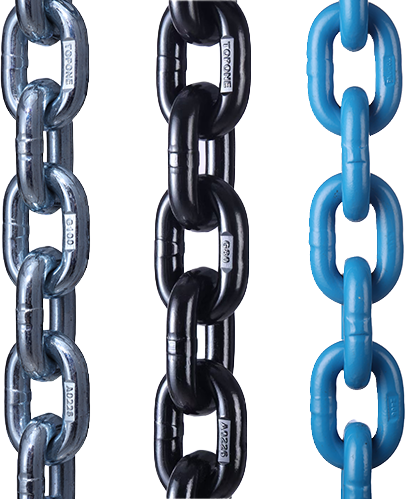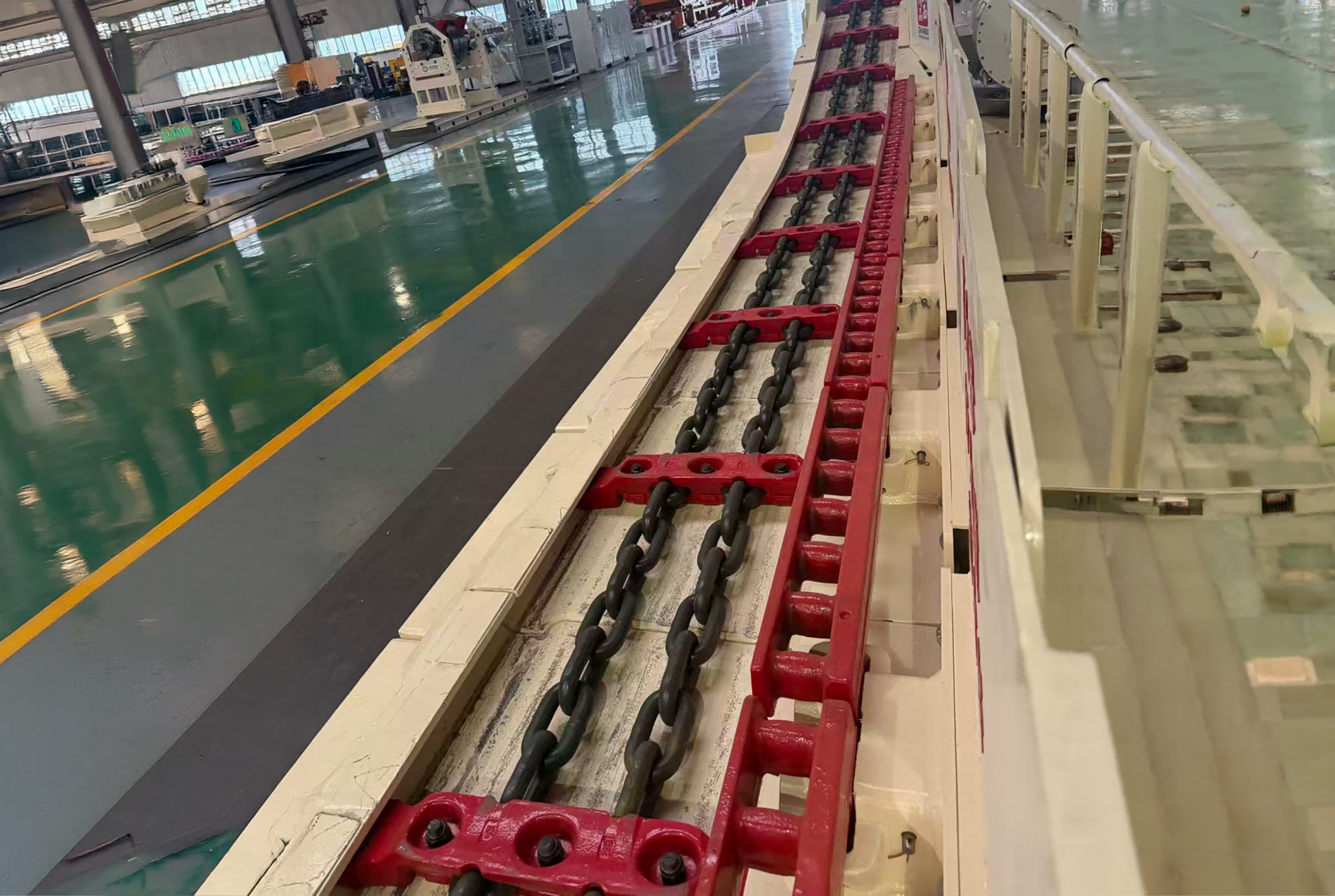
An AFC carries coal and rock along a longwall face while its chain repeatedly bends through drive and return sprockets. Tension, impact, interlink wear, water and abrasive fines act together. The chain is part of the AFC drive system, not a general lifting chain.
Typical Applications
Coal mining face transport
Underground mineral conveying
Longwall mining systems
Continuous mining operations
Heavy material transfer
Use a Mining Conveyor Chain System
Chain Type and Standards
DIN 22252:2012 covers round steel link chains used as traction elements in continuous mining conveyors and winning equipment. It expressly excludes use as lifting accessories, slings or hoist load chain. DIN EN 12321 addresses AFC safety. Equipment designs may also specify DIN 22256 sprockets, DIN 22258 connectors and DIN 22259 scraper bars.
Round-link chain articulates through the sprocket and connector. DIN 22255 flat-link chain reduces the vertical-link profile where more clearance or less pan contact is required. The two types are not interchangeable unless pitch, widths, sprocket pockets, connector and flight geometry all match the AFC design.
Calculate System Pull before Selecting Chain
Required Inputs
Chain force is not the hourly throughput in tonnes. Calculation must include chain and scraper mass, material load per metre, conveyor length, inclination, pan resistance, pretension, acceleration, drive distribution and breakaway or jam load. Two-strand load sharing requires matched chains, aligned sprockets and OEM confirmation.
Test force and minimum breaking force are qualification values, not allowable continuous pull. Do not apply a chain-sling design factor to create an AFC working load. Operating tension and overload settings must come from the conveyor calculation and mine rules.
TOPONE 30 x 108 Example
TOPONE's DIN 22252 table specifies 30 ±0.9 mm diameter, 108 ±1.1 mm pitch, 34 mm minimum inside width, 97 mm maximum outside width and 18.0 kg/m mass. Grade C data give 850 kN test force, 1,130 kN minimum breaking force and 70,000 minimum fatigue cycles.
The corresponding 30 x 108 DIN 22258-1 connector is listed at 848 kN test force, 1,000 kN breaking force and 80,000 fatigue cycles. Its 1,000 kN breaking value is below the chain's 1,130 kN, showing that the weakest compatible component governs. Fatigue cycles verify a laboratory test regime; they do not equal underground service hours.
Match Treatment to the Wear Mechanism
Hardness and Toughness
Rock contamination increases interlink and sprocket-pocket wear, while jams require core toughness. The highest hardness is not automatically the best choice. TOPONE lists LTT G90 at 40-42 HRC with 14% elongation; QO G60 at 45-47 HRC with 10% elongation; and C-N G40 with a surface layer up to 64 HRC or 800 HV, depth up to 15% of chain diameter and 1-3.5% elongation.
These are different wear-toughness balances. Select treatment from abrasiveness, corrosion, impact frequency, sprocket condition and OEM approval. Do not add a coating automatically: TOPONE notes that anti-corrosion coatings reduce chain mechanical properties.
Control Installation and Wear
Matched Installation
Use calibrated chain with the specified sprocket pockets, scraper spacing and approved connectors. For twin-chain systems, record matched strand lengths and pretension. Replacing one strand, mixing grades or using an unverified connector can create unequal loading. Never field-weld, heat or reshape a load-carrying link or connector.
Inspection during Production
Before commissioning, record chain length over a fixed number of pitches, diameter at interlink contact, connector condition and sprocket profile. In service, inspect pitch extension, diameter loss, flats, twist, pitting, weld-zone cracks, loose flight bars, connector locking and unequal tension. Inspect again after a jam or overload. Apply OEM and governing-standard discard limits; one wear percentage cannot cover every chain grade and AFC.
Information Required by TOPONE
Provide chain arrangement, conveyor length and inclination, drive power and number of drives, sprocket drawing and tooth count, speed, existing chain size and grade, scraper pitch, target capacity, material density and maximum lump size, start frequency, pretension method, water chemistry, corrosion history and required standard. TOPONE can match chain, connectors and interfaces for AFC manufacturer and mine-engineer approval.