Ports and offshore projects lift blocks, modules, engines and pipes through one load path: hook, master link, sling legs, connectors, lifting points and structure. The lowest-rated component limits the system, so rigging must match the load case, not cargo weight alone.
Lift Engineering
Load and Centre of Gravity
Verified weight includes temporary steelwork and below-the-hook rigging. The lift plan defines the centre-of-gravity envelope, lift-point capacities, crane radius, clearances, wind area and landing condition. Offshore load can also include vessel and crane dynamics, unequal leg loading, centre-of-gravity uncertainty and snag risk. No universal dynamic factor applies; use the approved procedure and standard, such as DNV-ST-N001 or ISO 19901-6.
Sling Angle
For an ideal symmetrical n-leg system, leg tension is T = W/(n × cos β), with β from vertical. A 100 t load on two legs gives 50 t per leg at 0° but 100 t per leg at 60°, before project factors. Real multi-point lifts seldom share load equally, so the worst leg governs. An engineered spreader keeps legs nearer vertical and reduces horizontal padeye force, but needs separate certification.
Sling Selection
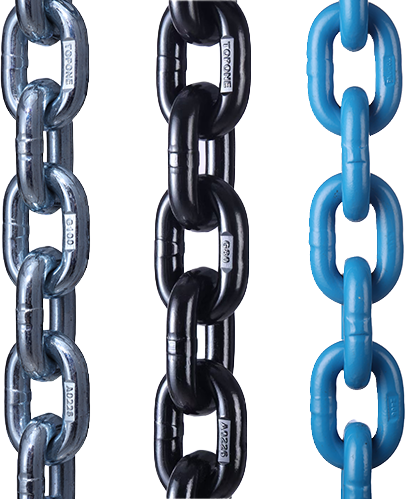
Grade 8 Chain
Short-link Grade 8 alloy chain suits compact rigging, abrasive steelwork and adjustable maintenance lifts. TOPONE configurations include single-, two-, three- and four-leg, adjustable, choker and endless slings. Chain, master link, connectors, shortening devices, hooks and shackles must be compatible and rated. Hooks carry in the bowl; tip, side or back loading is prohibited unless specifically designed.
For EN 818-2 and EN 818-4 assemblies, Grade 8 chain is electrically welded, heat-treated, calibrated and tested. WLL uses a minimum 4:1 design factor; this does not cover offshore dynamics, shock or misuse. Long-reach, high-capacity lifts may favour wire rope because chain weight rises with size.
Wire Rope and Synthetic Slings
Wire rope suits long-reach, high-capacity lifting, subject to termination design, D/d ratio and rejection criteria for broken wires, kinks, crushing and corrosion. Synthetic slings protect finished surfaces and reduce weight, but sharp steel requires edge protection; cuts, heat, chemicals or ultraviolet damage can make them unserviceable.
Application Arrangements
Blocks and Modules
Ship blocks and modules commonly use a calculated multi-leg bridle, lifting beam or spreader frame. Padeyes, trunnions, welds and local structure must be checked for the governing load direction, with specified NDT complete. Shackle fit, sling contact, hook clearance and lift-point alignment also require verification. A trial lift confirms balance but does not replace calculation.
Engines, Pipes and Maintenance
Marine engines must use manufacturer-approved lifting points; a spreader may prevent lug side loading. Pipes need balanced basket slings, engineered clamps or designated points with anti-roll control. An unsecured bundle is not one rigid load. Adjustable chain legs may level an offset maintenance load only when the shortening device is rated within the assembly.
Quality and Inspection
Traceable Manufacture
Specify WLL, grade, chain diameter, leg count, reach, design angle, hitch, fittings, temperature, protection, standard and class scope. The QA package should provide assembly identification, material traceability, dimensional inspection and proof-test certification, plus breaking, fatigue and NDT records where required. A 20,000-cycle fatigue qualification may apply under the chain standard; it is not predicted service life.
Marine Controls
Before lifting, verify tag, WLL, grade, reach, certificate and configuration. Inspect chain for wear, elongation, gouges, deformation, cracks, heat damage and corrosion; check master links, hooks, latches and shackles. Quarantine rigging after overload, shock or snagging. Never field-weld, heat, bend, grind or improvise repairs on heat-treated components.
Since 1 January 2026, SOLAS II-1/3-13 has required documentation, testing, examination, inspection and maintenance for onboard lifting appliances and loose gear; confirm flag-state, class and exemptions. Offshore containers require the complete container and lifting set—not an ordinary sling alone—to meet the selected scheme, such as DNV-ST-E271.
Data Required by TOPONE
Provide gross weight, centre of gravity and uncertainty, lift-point drawing and capacity, crane and hook data, reach, angles, lift path, environment, edge hazards, frequency, standard and certification scope. TOPONE can then configure components for that load case.