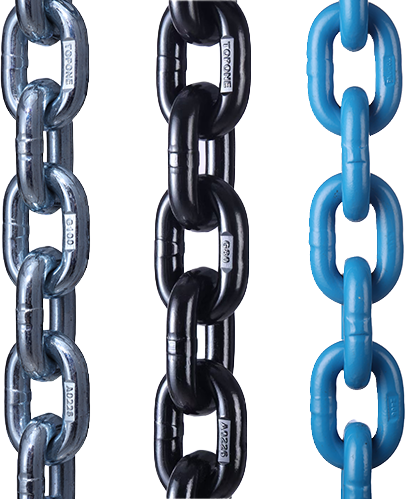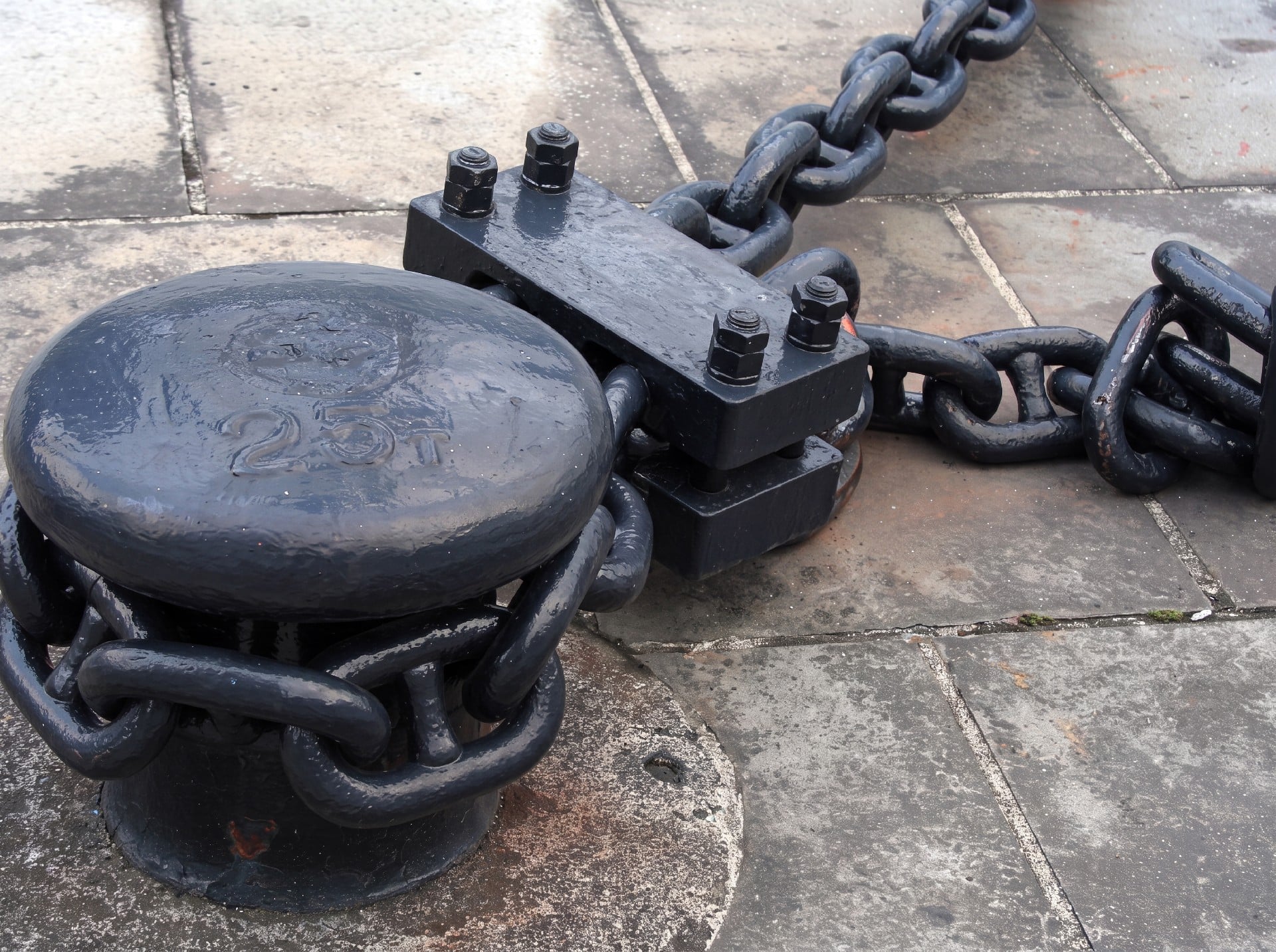
Anchoring and mooring systems hold vessels, floating docks, offshore units and buoys against wind, waves, current and changing water levels. The load path includes the anchor or foundation, chain, connections, fairlead and structure. Capacity is controlled by the lowest-rated component.
Ship Anchoring and Permanent Mooring
Ship Anchoring Systems
Ship anchoring is selected from the vessel’s equipment number, anchor mass, chain grade, diameter and length under class rules. TOPONE’s catalogue includes AC-14, Spek, JIS stockless, Danforth, Admiralty and Hall anchors with stud-link chain and connections. Anchor mass alone does not establish holding capacity; seabed, penetration, scope and load direction also matter.
Long-Term Mooring Systems
Floating docks, platforms and buoys remain connected for longer periods. Design inputs include water depth, tide range, wind, waves, current, line layout, fatigue, corrosion allowance and inspection access. Grade 1, 2 or 3 ship anchor chain must not replace project-specified offshore mooring chain solely because its diameter is equal.
TOPONE Chain and Connection Range
Published Product Range
The TOPONE catalogue states 6-107 mm for Grade 1, 2 and 3 stud-link and studless anchor chain and 8-53 mm for buoy chain. It also lists 6-107 mm swivels, 13-65 mm joining and end shackles and 13-70 mm non-standard components.
Connection options include enlarged and end links, Kenter and D-type joining shackles, end shackles, anchor swivel shackles and buoy shackles. Components must match the chain grade, test loads and dimensions.
Verified 34 mm Chain Data
For 34 mm stud-link chain, TOPONE gives Grade 1 proof and breaking loads of 328 kN and 468 kN. Grade 2 values are 468 kN and 655 kN; Grade 3 values are 655 kN and 937 kN. Approximate mass is 727 kg per 27.5 m. Proof and breaking loads are test values, not allowable mooring tensions.
Buoy Mooring Assembly Example
The TOPONE HF2.4-D1 arrangement uses a 34 mm main link, 36 mm enlarged link, 40 mm end link, 46 mm strengthening link, 41 mm swivel, 48 mm end shackle and 44 mm joining shackle. The different sizes show why a buoy mooring line must be ordered as a compatible assembly rather than as chain alone.
Material and Manufacturing Control
Chain Grade and Geometry
IACS anchoring requirements classify Grade 1 chain material at 300-490 N/mm² ultimate tensile strength, Grade 2 at 490-690 N/mm² and Grade 3 above 690 N/mm². Vessel and class rules determine the required grade.
ISO 1704:2022 defines stud-link geometry. A common link has nominal outside length 6d, pitch 4d and width 3.6d. Enlarged and end links use different proportions to fit connections and windlass pockets.
Testing and Traceability
The order must define steel grade, manufacturing route, heat treatment, dimensions, proof and break testing, non-destructive examination, marking, traceability and class witnessing where required. Diameter alone is insufficient for acceptance.
Offshore and Deep-Water Mooring
Mooring-Line Selection
Permanent offshore lines may combine chain, steel wire rope and synthetic fibre rope. Selection depends on stiffness, submerged weight, depth, seabed contact, fairlead geometry, fatigue and installation. Line tension and anchor load must come from intact and damaged-condition analysis, not catalogue breaking load alone.
Seabed Foundation Selection
Drag anchors, suction anchors, piles and gravity foundations resist different load directions. Geotechnical data and installation verification are required. A catalogue anchor must only be used where its holding performance and approval match the project.
Inspection and Service Control
Inspect diameter loss, link deformation, loose or missing studs, weld areas, corrosion, contact-zone wear, seized swivels, shackle pins and locking devices. Compare measurements with project, class or manufacturer discard criteria. Long-term systems also require fatigue records and risk-based inspection intervals.
Standards and TOPONE Solution
ISO 1704:2022 covers stud-link dimensions. IACS UR A1 defines ship anchoring equipment and Grade 1-3 test loads. Offshore projects may apply DNV-OS-E301, ABS position-mooring requirements or API Spec 2F.
TOPONE can configure anchors, stud or studless chain, buoy chain, enlarged and end links, joining shackles, swivels and end connections from verified project data.