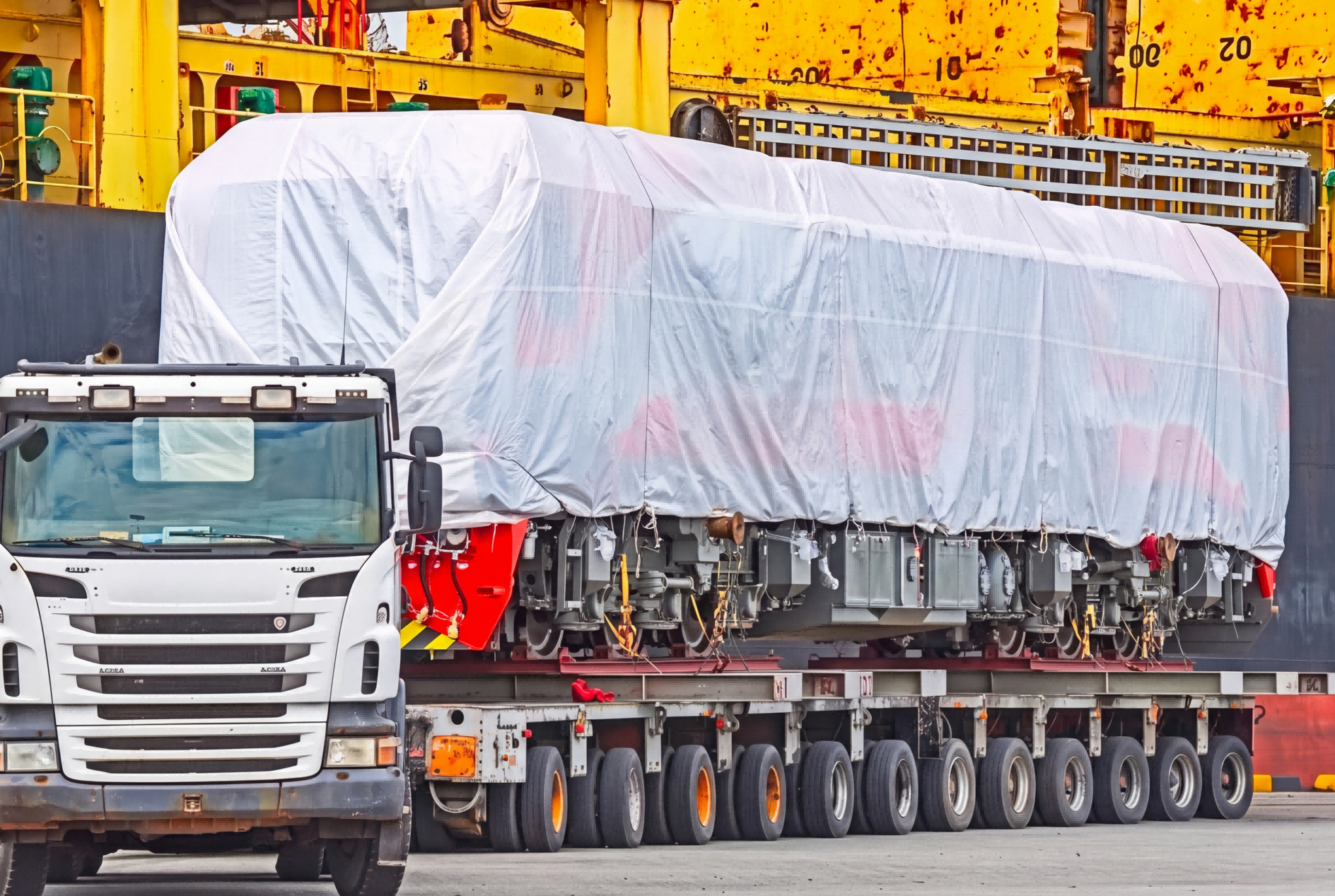
Crawler cranes, excavators, drilling rigs and mining machines combine high mass, moving upper structures, hydraulic attachments and concentrated track loads. The restraint system must control the transport configuration during braking, cornering, vibration and rough-road travel.
Typical Applications
Mining equipment transport
Crawler crane securing
Excavator shipment
Heavy machinery logistics
Construction equipment relocation
Transport Engineering
Mass, Centre of Gravity and Support
Use the verified transport mass, including counterweights, attachments, tools, fuel and all items remaining onboard. Confirm the centre of gravity for that configuration: removing a boom or relocating counterweights changes axle loads and stability. Check deck and axle capacity, clearance, ramp angle, route limits and all anchor ratings.
Tracks impose concentrated deck loads. Timber or engineered steel supports can distribute pressure, while attached stops resist sliding. Verify their bearing, shear and attachment capacities. Mud, oil and water reduce friction; undocumented friction must not replace direct restraint.
Design Forces
EU Directive 2014/47/EU and U.S. FMCSA criteria use 0.8 times cargo weight forward and 0.5 times cargo weight laterally and rearward. For example, a 50 t excavator represents 392 kN forward and 245 kN sideways or rearward before permitted friction credit.
Only the chain-force component opposing movement provides restraint. A chain installed 60° away from the required direction contributes 50% of its straight-line capacity in that direction. Final calculations must follow the jurisdiction, manufacturer and route permit.
Machine Preparation
Lock Every Moving Part
Follow the manufacturer’s transport drawing. Lower and support buckets, booms and hydraulic attachments in the approved position. Mechanically lock the upper structure, swing system, drill mast and articulated joints; hydraulic pressure is not a positive lock.
Counterweights, removable tracks, boom sections, mats and tools carried separately need independent support and restraint. Attach chains only to designated tiedown points or verified structural locations, never to handrails, steps, cylinders, hoses, cable trays or covers.
Direct Chain Restraint
Four-point Arrangement
Under 49 CFR 393.130, tracked or wheeled equipment weighing at least 4,536 kg requires at least four tiedowns near the front and rear or at manufacturer-designed points. They must prevent forward, rearward, lateral and vertical movement. Four is only a minimum count; capacity, geometry and the weakest component still govern.
Opposed front and rear chains normally provide longitudinal and transverse restraint. Verified track stops or chocks can supplement them.
TOPONE Chain and Binder Selection
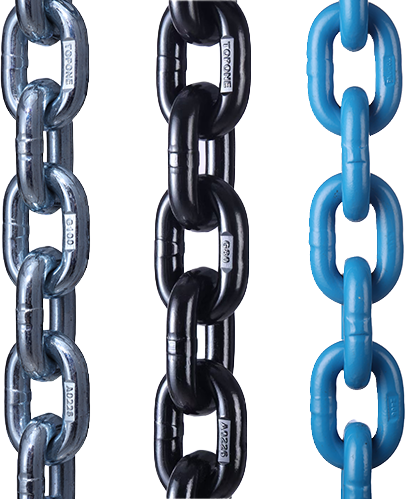
TOPONE supplies G70 binder chain, G80 binder or tow chain, and lever- and ratchet-type load binders. Its catalogue rates the 3/8 in × 16 ft G70 binder chain at 6,600 lb WLL and 26,400 lb minimum breaking strength. These are component ratings, not allowable machine mass.
Chain, hooks, binder and trailer anchor must use one compatible LC or WLL method; the lowest rating governs. TOPONE’s binder catalogue states a test load of twice rated load and a 3.5:1 safety factor. Size, range, fittings, markings and proof documents must match the governing standard. Do not treat lifting-sling WLL as European lashing capacity without documented equivalence.
Seat grab hooks fully in compatible links and secure binder handles. Do not use extension pipes unless designed for the binder. Prevent knots, twists, side-loaded hooks and damaging edge contact.
Inspection and Journey Control
Removal and Recheck Criteria
Inspect anchors, markings, links, hooks, binders, blocking and deck condition before departure. EN 12195-3-based guidance treats cracks, deformation, chain elongation above 3%, or wear above 10% of nominal diameter as removal criteria. Do not repair chain with bolts, field welds or improvised links.
Recheck after initial movement, severe braking, rough-road impact or settlement. Where 49 CFR 392.9 applies, inspect within the first 50 miles and again after a duty-status change, three hours or 150 miles, whichever occurs first.
Information Required by TOPONE
Provide machine mass, transport drawing, centre of gravity, attachment arrangement, anchor ratings, design acceleration, chain angles, friction basis, route conditions and governing standard. TOPONE can then configure compatible chains, hooks and binders for the calculated demand.