Bridge girders, steel segments, trusses and modular frames may have large exposed areas but limited lateral stiffness before permanent connections are completed. Temporary wind lashing must be designed for each erection stage, not selected from component weight alone.
Typical Applications
Long-span bridge construction
Temporary structural stabilization
Steel segment positioning
High-altitude assembly projects
Mega-structure installation
Wind-load Basis
Calculate Each Stage
AASHTO’s Guide Specifications for Wind Loads on Bridges During Construction covers girders, bracing and substructures before deck placement. EN 1991-1-4 covers wind actions on civil engineering works under construction. Calculations must include wind speed, terrain, elevation, gust, direction, shape, shielding, exposure period and dynamic response.
For preliminary screening, basic velocity pressure is q = 0.613V² N/m² with V in m/s. At 40 m/s, q is about 0.981 kPa. Across 150 m² of projected area, this equals 147 kN before code factors. Acting 12 m above the restraint level, it produces about 1.77 MN·m of moment. This is an explanatory calculation, not a final design.
Projected area, centre of pressure and stiffness change as girders, truss panels or deck units are added. Verify every stage, including overnight and storm conditions.
Restraint-system Design
Verify the Load Path
The load path passes through the structural connection, shackle, chain or wire rope, tensioner and anchor into the supporting structure. The lowest design resistance governs. Padeyes, welds, bolts, shackle-pin bearing, anchor pull-out and support stability require verification.
Opposed legs normally restrain wind from both directions. For tension T at angle θ above horizontal, horizontal resistance is T cosθ and vertical force is T sinθ. Unequal angles, lengths or stiffnesses prevent equal load sharing; total capacity cannot be obtained by simply multiplying one leg rating.
Chain, Wire Rope or Webbing
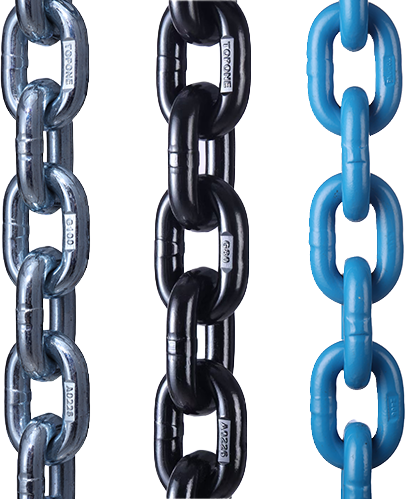
TOPONE Grade 80 chain assemblies suit short restraint legs requiring compact adjustment, low elongation and resistance to rough steel contact. The catalogue specifies quenched-and-tempered alloy-steel components and a 4:1 lifting design factor. Lifting WLL is not automatically allowable wind-guy tension. The engineer must specify compatible design ratings for every component and anchor.
Steel wire rope is practical for long guy lines and high connection points because it provides longer reach at lower mass. ISO 2408 covers bright, zinc-coated and Zn-Al-coated round-strand ropes. Construction, minimum breaking force, termination efficiency, bend radius, corrosion allowance and tensioning method must match the design. Use engineered sockets or swaged eyes with thimbles; field terminations require approval.
Polyester webbing protects finished surfaces during light positioning, but edges, welding spatter, heat and outdoor exposure can damage it. It is not a primary high-load wind restraint unless the rated assembly and protection are approved.
Installation and Control
Pretension, Monitoring and Release
Apply the specified pretension. Excess can distort a segment or overload anchors; insufficient tension permits impact loading. When required, verify force using calibrated load cells or instrumented tensioners. Load shackles on their intended axis, keep chain untwisted and lock tensioners against release.
The method statement must define the operating wind limit, stop-work trigger, storm condition and anemometer position. Inspect before each shift and after a strong gust, stage change, impact, adjustment or movement. Check anchors and welds for cracking or displacement, chains for deformation, and wire ropes for broken wires, corrosion, kinks, crushing or damaged terminations.
OSHA 29 CFR 1926.754 requires stability throughout steel erection. Plumbing-up equipment is installed when required by a competent person and removed only with that person’s approval. Retain wind lashings until permanent bolts, welds, diaphragms and bracing reach the specified capacity.
Information Required by TOPONE
Provide the erection-stage model, standard, wind data, projected areas, centre-of-pressure heights, anchor ratings, angles, design tension, pretension, exposure period and corrosion environment. TOPONE can then select compatible chain or wire-rope assemblies for the approved plan.