Mining sites, cement plants and heavy engineering facilities maintain crushers, conveyors, motors and process equipment in dusty, wet or restricted areas. Chain hoists provide vertical lifting at fixed points when the load, suspension and operating environment are verified.
Maintenance Applications
Crusher and Conveyor Repair
Typical lifts include crusher parts, conveyor pulleys, gearboxes, motors and structural sections. Suspend the hoist from an engineered beam, trolley, gantry or approved lifting point. Conveyor frames, handrails and pipework are not suspension points unless their load capacity has been verified.
Motor Replacement and Shutdown Servicing
Lift motors and mechanical assemblies from designated lifting lugs or an engineered lifting frame. Total suspended mass includes the equipment, lifting beam, slings, shackles and all other attachments. A chain hoist can position the component, but an engineered mechanical support is required before personnel work beneath it.
Selecting the Chain Hoist
Manual Chain Block Data
A manual chain block is suitable for fixed maintenance points, intermittent lifting and locations without a stable electrical supply.
TOPONE catalogue data list the HSZ-C2 at 2 t rated capacity, 3 m standard lift and 3 t test load. It has a 380 mm minimum distance between hooks, two falls of 8 mm load chain and a net weight of 14 kg.
The HSZ-C5 is rated at 5 t with 3 m standard lift and 7.5 t test load. It uses two falls of 10 mm load chain, has a 600 mm minimum distance between hooks and weighs 36 kg.
The HSZ-C10 is rated at 10 t with 3.5 m standard lift and 15 t test load. It uses four falls of 10 mm load chain, has a 700 mm minimum distance between hooks and weighs 68 kg.
These values apply only to the stated models. Hoist selection must be based on total suspended mass, available headroom, suspension capacity and operating frequency.
Electric Hoist Data and Limitations
The TOPONE HHBB-2.0B electric chain hoist is catalogued at 2.0 t rated capacity with 3 m standard lift, a 1.5 kW motor and a lifting speed of 3.4 m/min. It uses two falls of 7.1 mm load chain and weighs 69 kg.
These catalogue figures do not establish the hoist’s duty class, ingress protection or explosion protection. Power supply, starts per hour, temperature, dust, moisture and hazardous-area requirements must therefore be confirmed before selection.
Load Control and Suspension
Vertical Lifting and Multiple Hoists
Keep the hoist directly above the load. Use a compatible trolley when horizontal movement is required and never side-pull the load chain.
Where two hoists lift one crusher, conveyor or structural component, equal load sharing must not be assumed. Center-of-gravity position, hook spacing, suspension deflection and movement can transfer load between the two units. The lifting plan must calculate the load applied to each hoist separately.
Hazardous Energy Isolation
Electrical, hydraulic, pneumatic, mechanical and gravity energy must be isolated before crusher, conveyor or motor maintenance begins. For United States general-industry facilities, OSHA 29 CFR 1910.147 requires authorized employees to perform lockout or tagout during servicing. A chain hoist does not replace energy isolation, blocking or mechanical support.
Hoist Chain Material and Manufacturing
Fine-Tolerance Grade T Chain
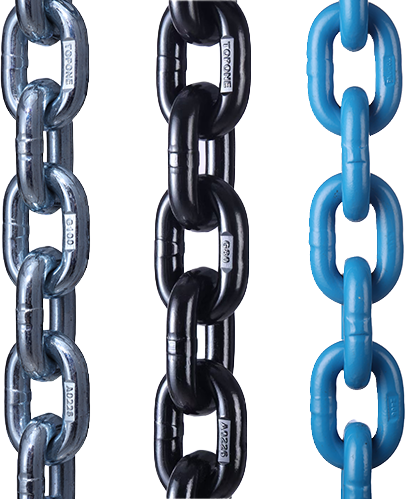
TOPONE identifies the HSZ-C load chain as high-grade alloy steel and its hooks as forged and heat-treated.
ISO 3077 covers electrically welded, heat-treated and tested Grade T fine-tolerance hoist chain in nominal sizes from 3 mm to 22 mm. Replacement chain must match the load wheel and chain guide in diameter, pitch, inside width and material condition. Chain-sling chain with a similar diameter is not an approved replacement for calibrated hoist load chain.
Inspection in Dusty and Outdoor Conditions
Inspection Points
Inspect the suspension, trolley, identification, hooks, latches, brake, controls, limit devices, chain container and reeving before lifting.
Check the load chain for wear, elongation, twist, gouges, corrosion and stiff links according to the manufacturer’s limits. Remove abnormal equipment from service. Cleaning and lubrication must follow the hoist manufacturer’s instructions.
Operating Limits
Never exceed rated capacity, shock-load, side-pull, lift people or allow personnel beneath a suspended load. Stop operation if the brake slips, the chain jumps or twists, the suspension moves or abnormal sound occurs.
A standard electric chain hoist must not be described as suitable for an explosive underground mine unless the required explosion protection and mining approval are supported by documentation.
Applicable Standards and TOPONE Solution
EN 13157 applies to hand-powered chain blocks. EN 14492-2 applies to powered hoists, while ASME B30.16 covers hand-chain-operated, electric-powered and air-powered hoists.
EN 14492-2 does not specify the additional requirements for explosive atmospheres in underground mines. TOPONE equipment selection therefore begins with verified load, headroom, suspension, operating frequency and environmental data rather than rated capacity alone.